

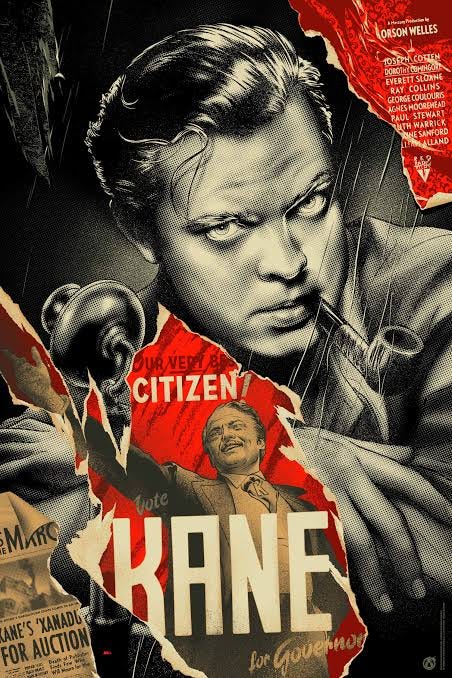
FADE IN:
NARRATOR - Kane’s empire, in its glory, held dominion over thirty-seven newspapers, thirteen magazines, a radio network. An empire upon an empire. The first of grocery stores, paper mills, apartment buildings, factories, forests, ocean-liners - an empire through which for fifty years flowed, in an unending stream, the wealth of The earth’s third richest gold mine... Famed in American legend is the origin of the Kane fortune... How, to boarding housekeeper Mary Kane, by a defaulting boarder, in 1868 was left the supposedly worthless deed to an abandoned mine shaft: the Colorado Lode.
THE MAGNIFICENT ENQUIRER BUILDING OF TODAY.
MAP of the USA, covering the entire screen, which in animated diagram shows the Kane publications spreading from city to city. Starting from New York, miniature newsboys speed madly to Chicago, Detroit, St. Louis, Los Angeles, San Francisco, Washington, Atlanta, El Paso, etc., Screaming “wuxtry, Kane papers, wuxtry.”
_____
(1870)
SHOT OF EARLY TINTYPE STILLS OF THOMAS FOSTER KANE AND HIS WIFE, MARY, on their wedding day. A SIMILAR PICTURE of Mary Kane some four or five years later with her little boy, Charles Foster Kane.
NARRATOR - Fifty-seven years later, before a congressional investigation, Walter P. Thatcher, grand old man of wall street, for years chief target of Kane papers’ attack on “trusts,” recalls a journey he made as a youth...
SHOT OF CAPITOL, IN WASHINGTON D.C.
SHOT of CONGRESSIONAL INVESTIGATING COMMITTEE (reproduction of existing J.P. Morgan newsreel). This runs silent under narration. WALTER P. THATCHER is on the stand. He is flanked by his son, WALTER P. THATCHER JR., And other partners. He is being questioned by some merry Andrew congressmen. At this moment, a baby alligator has just been placed in his lap, causing considerable confusion and embarrassment.
NEWSREEL CLOSE-UP of Thatcher, the soundtrack of which now fades in.
THATCHER - ...Because of that trivial incident...
INVESTIGATOR - It is a fact, however, is it not, that in 1870, you did go to Colorado?
THATCHER - I did.
INVESTIGATOR - In connection with the Kane affairs?
THATCHER - Yes. My firm had been appointed trustees by Mrs. Kane for the fortune, which she had recently acquired. It was her wish that I should take charge of this boy, Charles Foster Kane.
NARRATOR - That same month in union square -
INVESTIGATOR - Is it not a fact that on that occasion, the boy personally attacked you after striking you in the stomach with a sled?
(loud laughter and confusion.)
THATCHER - Mr. Chairman, I will read to this committee a prepared statement I have brought with me – and I will then refuse to answer any further questions. Mr. Johnson, please!
A YOUNG ASSISTANT hands him a sheet of paper from a briefcase.
THATCHER - (reading it) “with full awareness of the meaning of my words and the responsibility of what I am about to say, it is my considered belief that Mr. Charles Foster Kane, in every essence of his social beliefs and by the dangerous manner in which he has persistently attacked the american traditions of private property, initiative and opportunity for advancement, is – in fact - nothing more or less than a communist.”
NEWSREEL OF UNION SQUARE MEETING, section of crowd carrying banners urging the boycott of Kane papers. A SPEAKER is on the platform above the crowd.
SPEAKER - (fading in on soundtrack - till) The words Charles Foster Kane” are a menace to every working man in this land. He is today what he has always been and always will be - a fascist!
NARRATOR - And yet another opinion - Kane’s own.
SILENT NEWSREEL on a windy platform, flag-draped, in front of the magnificent Enquirer building. On platform, in full ceremonial dress, is Charles Foster Kane. He orates silently.
TITLE:
“I am, have been, and will be only one thing - an American.”
Charles Foster Kane.
SAME LOCALE, Kane shaking hands out of frame.
ANOTHER NEWSREEL SHOT, much later, very brief, showing Kane, older and much fatter, very tired-looking, seated with his second wife in a nightclub. He looks lonely and unhappy in the midst of the gaiety.
From the screenplay of CITIZEN KANE, c. 1941, by Herman Mankiewicz & Orson Welles.
The last release of a new print of CITIZEN KANE (1941) re-opened the debate as to whose genius was responsible for the film’s enormous critical success. Many, many Best Films of All Time lists have it in the top ten, and several even list it as the greatest film ever made. When one mixes into this the still-extant hegemony of the French NOUVELLE VAGUE (New Wave) and its auteur theory, we are primed for screenwriters to take a new wave of hits.
The Irish Independent.IE has recently weighed in with an article by Paul Whitington:
“In the early 1970s the New Yorker magazine’s legendary, fearsome film critic Pauline Kael set the cat among the pigeons when she claimed that Herman Mankiewicz, and not Orson Welles, deserved most of the credit for CITIZEN KANE.
“Kael’s attack on (the) masterpiece sparked a furious debate that has never quite been resolved. The release of a new print of the 1941 film... gives us a good excuse to re-examine it.
“The new Kane print will be shown this month at the IFI, Temple Bar, as part of a Welles season, and is as breathtaking an achievement today as it was when first released. The question is: does Welles deserve the lion’s share of the credit for it or not?
“In an interview just prior to the film’s release, Welles had remarked, almost in passing, ‘so I wrote CITIZEN KANE’. But in a darkened study in Hollywood sat a quietly fuming screenwriter who saw things differently.
“Herman J Mankiewicz was a sophisticated East Coast former newspaper columnist and wit who arrived in Hollywood in the late 1920s and subsequently put his literary stamp on films as diverse as THE FRONT PAGE, DINNER AT EIGHT
and THE WIZARD OF OZ. His brilliance as a screenwriter was well known to Welles, who went to pay the writer court in 1939.
“Orson had been toying for a while with the idea of a film about a public figure who would somehow encapsulate the American experience.
“Mankiewicz had also been planning a screenplay about a celebrity of sorts that would be told by those who knew him ... It was Herman Mankiewicz who came up with the idea of William Randolph Hearst as a model...
“Pauline Kael would later claim that Mankiewicz had been planning to write a film about Hearst as early as 1925—I have a copy of his earlier 268 page script, titled, AMERICAN—but it was his collaboration with Welles that provided the spark. Once they’d hit on the plan, Welles was happy to let the screenwriter do his magic, and Kael would later dig up a former secretary of Mankiewicz’s who claimed that Welles had not written a single word.
“He may have made the odd change, but it seems certain that the lion’s share of the writing was done by Mankiewicz, who was not best pleased when it emerged that RKO was not planning to give him a writing credit. On the finished film they got a co-credit, but many would later forget Mankiewicz’s contribution.
“Pauline Kael wanted Herman Mankiewicz to be given due credit as one of the great creative forces of the 1930s and 1940s, and used the Holy Grail of CITIZEN KANE to make her case. Among those principally outraged by her actions were director and film buff Peter Bogdanovitch, who became a fierce advocate on Welles’s behalf.”
_____
Lest there be reader confusion, let me state that I take the position that commercially-presented films are inevitably and always, collaborations, comprising the contributions of any number of artists, technicians, production, releasing, distribution, publicizing, and exhibiting personnel. This can range as far afield as to include the projectionist of the re-release of the digitally re-mastered director’s cut re-dux, i.e., anyone involved in putting the film before an audience. And this said, I believe that this does not diminish any contributing artist’s genius. Film authorship is not a zero-sum game.
Author and screenwriting “guru,” Robert McKee described CITIZEN KANE as:
“...a bloated exercise in razzle-dazzle spectacle, populated by stereotypical characters, twisted with manipulative storytelling, stuffed full of self-contradictory Freudian and Pirandellian clichés, made by a heavy-handed showoff out to impress the world...”
---STORY, by Robert McKee, HarperCollins, 1997.
He may have been playing devil’s advocate. But I strongly doubt it, because he just takes his shot and never sets the record straight afterward.
Nonetheless, he cannot deny the radically different approach Herman Mankiewicz and Orson Welles took with their film back in 1941. It’s well-known who Kane’s principle characters represent (William Randolph Hearst and his mistress, Marion Davies; Welles’s contribution to Mankiewicz’s narrative approach), so such criticism as stereotyping is dubious. Most of the supporting characters played small enough roles that the criticism is nearly irrelevant, anyway. And those that weren’t, the newspaper people, could no more be called stereotypes than could their colleagues in HIS GIRL FRIDAY,
or THE HARDER THEY FALL, films which escape McKee’s ire.
Welles’s systematic use of faster film stock, deep focus, and low-angle shots that included ceilings were in sharp contrast to the films of the time. Hollywood’s films in the 1930s and 1940s were not only shot mostly on sound stages, but they were shot as though on a stage, with three walls and nary a ceiling, as though under a theater’s proscenium arch. They exuded artifice. The non-theatrical and more realistic techniques used in CITIZEN KANE worked in concert toward a unified artistic and humanistic end: a life examined; its worth; its truth; its contradictions. In effect, it was the first “Cubist” film, as it showed “more than [merely] the three dimensions” of Charles Foster Kane. And at the end, with the meaning of Rosebud revealed, we learn Kane’s deepest truth, what mattered to him after all was said and done:
(SPOILERS)
Not a sled, but a childhood and a life that was not determined by conquests, possessions, material gain, money, power. This was a universal question asked and answered, something only the great films do. And done in ground-breaking, artistically-rigorous style.
KANE’s non-traditional narrative construction and cinematic techniques were consistent with the subject matter and certainly ground-breaking by their formal usage. And that narrative approach, it is well-established (see Marc Norman’s history of screenwriting, WHAT HAPPENS NEXT, for example), was contributed by Herman Mankiewicz.
The film, at one minute less than two hours (a not unheard-of feature-film running time, even in 1941), is called by McKee a “bloated exercise.” But, perhaps, to be fair, he means “bloated” because of what he sees as trivial subject-matter: merely the worth of a man’s entire life.
These techniques went on to be used in many films McKee lauds in his book and seminars, yet their first substantial use in a major Hollywood film is considered by him to be “razzle-dazzle”.
McKee holds far greater respect for another film from that period in Hollywood’s history, CASABLANCA.
This film, in which the shooting was begun with only half a completed script, was written by, depending on which memoir or interview you read:
Howard Koch, a self-admitted, fairly wet-behind-the-ears (at that time) screenwriter who never ever approached its level again in a long Hollywood career (see his book, CASABLANCA, Script and Legend, Overlook Press, 1973).
Brothers, Julius and Phillip Epstein (Julius Epstein claimed they wrote all but Casey Robinson’s “terrible” line, “A franc for your thoughts,” including saying what L.A. intersection (!) they were at when, in their car, they thought of the long-sought-after ending; Epstein claimed that Koch’s pages were never used; and said about the script that “There wasn’t one moment of reality in CASABLANCA,” and it was “slick shit,” in Patrick McGilligan’s book, Backstory 1, University of California Press, 1986, p. 171 and p. 185).
Casey Robinson, who, also in McGilligan’s book, Backstory 1, p. 306-8, claimed, 1.) to have originally found the source play, EVERYBODY COMES TO RICK’S, 2.) was responsible for re-setting it against World War II, and, 3.) made Laszlo and Ilsa refugees. Then he claimed he came in after the Epsteins and Koch, and wrote the romance scenes and the ending (and can also say where he was when he wrote it!), though he magnanimously allows that Hal Wallis came up with the line “Louis, I think this is the beginning of a beautiful friendship” that ended the film.
CASABLANCA is a film that escapes McKee’s charge against CITIZEN KANE of manipulation, despite putting dueling national anthems before its wartime audience, among other jingo-isms. CASABLANCA is said by Alan Fisk, whose mother lived in the city of CASABLANCA at the same time as the film (see http://johnaugust.com/archives/2003/robert-mckee), to have caused laughter and ridicule on its debut due to its ludicrous depiction of the white city. Nonetheless, that 102 minute “exercise” receives a trim (or dare we say, “bloated”?) 360 minute shot-by-shot workout in McKee’s seminars.
That all said, understand that I take no position as to Mr. Epstein’s assessment of the film that won him and his brother the Best Screenplay Oscar. For my part, I like CASABLANCA, though it can’t hold a candle to CITIZEN KANE, the “Cult of Bogart” notwithstanding. And, no, I have not drunk the Welles Kool-Aid either.
Let’s consider a few of the primary innovations attributed to CITIZEN KANE:
Deep Focus - This cinematic stylistic approach puts its subject into his/its environment. It does this by using lots of light, a small aperture, and, often, a wide-angle lens so that the story subject is simultaneously in focus along with the depth of the physical world he/she/it is within. This, rather than being the only detail in focus with everything else softer or out-of-focus, thereby isolating the subject in the shot, and separating it from its environment. Its use in CITIZEN KANE was consistent with the story as told by individuals and episodes from the subject’s life and environment. It was a “deep-focus” narrative. Contributors – Cinematographer, Gregg Toland; Director, Orson Welles.
Narrative Style - Charles Foster Kane is unknowable (as, in truth, is anyone). He is seen through his behavior as interpreted by “us,” and through the people that knew him, multiple viewpoints only, therefore. As we’ve said, this is a narrative version of deep focus, as it is a life in situ, or in its milieu. Contributor – Screenwriter, Herman Mankiewicz as established in drafts by Mankiewicz that pre-dated Welles’s arrival on the project.
Expressionistic Lighting and Camera - This cinematic stylistic exaggerates the visual impact of the imagery. It intensifies the deep focus effect by using camera angles that accentuate and/or subordinate the film’s visual subject for dramatic impact. It intensifies the dramatic effect by using lighting and shadow to lend mystery and surprise, as well as visual depth to the otherwise flat deep focus field. Contributors - Cinematographer, Gregg Toland; Director, Orson Welles.
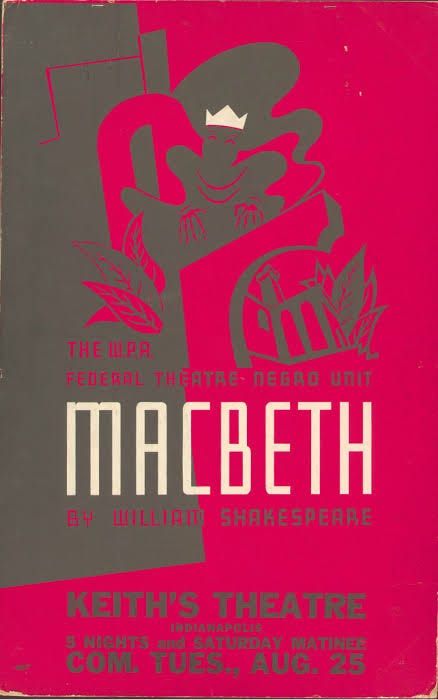
Welles came to Hollywood at underdog-studio RKO’s bidding after setting the New York drama scene afire with his all-black-cast production of MACBETH,
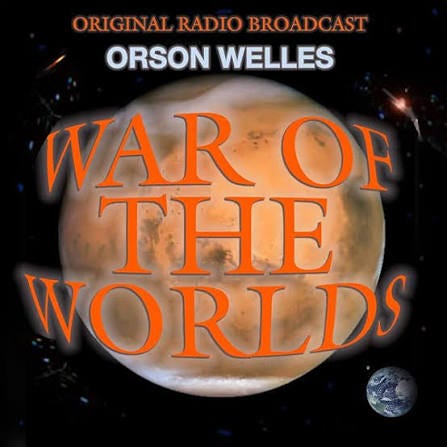
and his infamous radio production of THE WAR OF THE WORLDS.
His genius was legendary. RKO wanted it for its cachet. So Mankiewicz was used and discarded. But, lest we let our sympathies control us, his wasn’t the genius responsible for this great film.
After auteur critic and New Wave director, Claude Chabrol, had been directing awhile, he found himself asked, once more, about the movement of which he had been a part. His answer?
“There are no waves, there is only the ocean.”
Having been immersed in the collaboration, he knew something about who did what.
Many of the more “intellectual” critics spend their time worrying about the who and never considering for very long, the what. Films are what audiences come to see, not evidence of some artist’s worth at the expense of others. Critics need personality to dominate because beyond the “text” (the film itself), they need to have a subject that’s inherently greater than its source and so, transcending the material, they can relate it for us, the “great unwashed,” to its world. After all, the film has already covered the film’s subject better than they ever could. One could see it as symbiotic, but between the critic and the audience, only one party really ever benefits, and that’s the one who is doing the observing (sometimes, the lying). So, “symbiotic”? Or perhaps... because of its “shelf life” and therefore superficial worth… some popular film criticism might be better seen as parasitic prior to its ultimate fate as “fish wrap” on the way to the landfill. To be fair, though, popular criticism has worth as a warning system for good and bad films. I mostly quibble with the writers who go beyond their own “thumbs”.
So, who is responsible?
As always in the movies, it is the collaboration. With CITIZEN KANE there was a fortuitous convergence of talent that super-charged a group of individually-luminous artists. Each, himself, could be seen by his prior work to have aspects of genius about him. Together, in KANE, they became what can only be seen as a “super-genius”.
It comes down to this: What is the truth of someone? Is it what that someone says about him or herself? Is it what someone else who knows them says about them? Is it what many someones or everyone says about them? Is it the commonalities from among them all? Or the commonalities plus the contradictions? When we look into a room and we see a teacup, the rest of the cup’s surroundings are in view but out of focus and only in our peripheral vision. Do we see the “truth” of the cup? What if, on the other side of the cup there is an inscription that says “Coffee-Only”? Does this mean it is not a teacup, or that it is a teacup that is, instead, meant for “Coffee-only”? Has tea ever been in the cup? If we could see the entire surroundings of the cup in equal focus, but there is no mirror showing the inscription on the opposite side, do we know the truth of the teacup? What is its truth? So, what, then, is the truth of Charles Foster Kane? What can be the truth of anyone? And so, what is the truth of CITIZEN KANE? All we have is the certainty that a group of people came together once and a superbly effective film resulted that had several remarkable, ground-breaking features. Gregg Toland operated the camera, picked the lenses, chose the faster film stock, and where to put and not put the lights. Or did Orson Welles direct him on some of the details? Or every detail? Which? Or did it come out of discussion? For us, then, as those “parasites” feed and formulate their truths, it can only be the collaboration.
If collaboration-as-genius disheartens some who prefer the comfort of seeing Welles or Mankiewicz as the film’s sole genius, try looking at it this way: Welles was a genius; so was Mankiewicz, so were lighting-cameraman Gregg Toland, and also composer, Bernard Herrmann. There is no “zero-sum” about it as some critics would have us believe. It was as though the JUSTICE LEAGUE itself made a film: superheroes all. If genius collaborates… genius can result, even super-genius. #
FADE OUT
Quote of the Post:
So, who is responsible?
As always in the movies, it is the collaboration.
---The Last Reveal
Pieces of this article are taken from my earlier article on CASABLANCA.
If you found this article of interest, please restack.