


I once had a professor who started the class with a grammatically correct sentence that used seven strung-together “that”s (followed, later, by four more!!!).
To say [that] it was remarkable (at least, to me), is an understatement. In the decades since that… class, I’ve tried to remember and reconstruct… that… sentence. (But, now, with the use of the Web, I found it, and it’s footnoted (1) at the end with full explanation.)
The reason it has hung with me all these years since, is, because, in that… single sentence, there was… a there… there, a “there” that existed outside of the grammar, outside of the specific meaning of the sentence.
I write… for that… “there”.
Perhaps, the best way to illustrate this is not with words, but rather by forcing the reader to “grok” (2) it, through sound… music… music with “there”.
(Note – There are LOTS of examples linked ahead. I suggest you read past and come back to them, rather than get side-tracked. They are, in effect, a blues and rock n’ roll Primer.)
Someone once asked me: “Why can’t the current generation of rock guitarists play the guitar properly? Hardly anyone these days can pull off a decent extended guitar solo of the type which was commonplace in ‘60s, ‘70s, and [even some] ‘80s rock.”
I heard someone say that… it’s because the “sensibilities” were lacking. I agree, but it’s deeper than that: with no “there,” the later guitarists could only “one-up,” their predecessors. “One-up” through a kind of frenetic distraction, an assault of speed and energy. And, too, the term, “sensibility,” is too simple, too vague. It hardly articulates it. As I wrote, it comes down to the “there”. And as I will illustrate, with many of the later guitarists, there is no “there” there, no “there” there, at all. Or, if there is, it’s an internal, ego-sourced “there,” A cry to “Look at me!” rather than an artist’s outward expression of emotion. Or… maybe, you just had to… be “there”.
Honestly, though, I don’t think so. The “blues” (Delta and Chicago styles, primarily) is a distinct black American (Robert Johnson, Son House, Muddy Waters, Howlin’ Wolf, B.B. King, et al) music. And, yet, it “spoke to,” and was picked up by, a few white guys in Great Britain (Eric Clapton, Peter Green, Jeff Beck, Jimmy Page, Mick Taylor, Rory Gallagher, et al), and then a few more in the southern U.S. Still later, a veritable horde, an army of white guys (and women), across the world jumped aboard. And, so it went. Those white guys, at first glance, had no lives equivalent to those originators’“there,” but, nonetheless, they somehow felt it, they felt the “that”. Why? Because it was human, it was real. They took that that, and they electrified it. And, with their guitars, amplifying their black progenitors’ lead, they sent it out into the world.
So what was it? What was “that thing [they had]”?
Many (later 1980s and beyond) bands didn’t seem to get the emotion. They could play, sometimes with spectacular virtuosity (or at least finger speed), but there was no soul. As I’ve said, no “there” there. It was “all flash and no cash,” “all yak and no shack.”
It reminds me of the idiots who, looking at photos of Nazi concentration camp survivors, stand firm that it never happened, or, worse, blame the evidence in those pictures on Photoshop, or A.I. And, when it comes to the “there” in the Blues, you can deny slavery ever happened, you can say “Jim Crow” didn’t run for another century afterward, but you can’t “un-happen” the truth.
So… the “there” in music: It’s the difference between talk and poetry… chaotic babel, and a coherent, unified melody that has an internal consistency, one that builds to a peak, and then concludes, one that pays off. In effect, the entire solo needs to be “of the piece.” Instead we get “shredding,” which is impressive... in yelling contests. They don’t get that the space between notes can be as important, or even more-so, than the notes, themselves. Aristotle and his Greeks would have gotten it. James Joyce? Not so much. (He would have LOVED that sentence, though!)
This approach to musical riffs and solos was, perhaps, first signaled by horn player, Louis Armstrong, in his recording, ‘Cornet Chop Suey,’ in 1926. He may have gotten it from another horn player (who never recorded) when Armstrong was about 12, but Louis Armstrong made it his own. Lyrics without lyrics. You could fill them in yourself. And just as with Aristotle’s Poetics, they have a beginning, a middle, and (like the best rap), “mos def,” an end. They have a story, a THERE. Of course, this is true of all great music. But, equally, it’s not to be ignored just because it’s in rock ‘n roll or popular music.
You listen to the famous solos and riffs Eric Clapton improvised on “Crossroads,” and the epic solo on “Spoonful,” in the Winterland show in 1968 (Cream’s Wheels Of Fire album) and, just as in the best classical and jazz music, the solos and extended sections become songs within the songs. You can put whole unified stories to the notes. On Crossroads, it’s like a woman berating her man for everything he’s done to her in their life together. It becomes a raging litany of his wrongs, in no way connected to the lyrics of “Crossroads,” but nonetheless, a screaming cascade of emotion. Whether that solo was all one piece, or up to four separate pieces (as some have claimed), it holds together, it’s “of the piece”. It has, as Bruce Lee once said in a different context, “emotional content.” Then you compare that to much of the guitar work of the later 1980s and beyond, and too much of it is just yada yada yada, no statement, build, culmination, coda, in short, as Bob Seger sang, “It ain’t got the same soul”! In fact, there’s no soul to it.
And this isn’t just true of Eric Clapton. “There” was everywhere at one time. You hear notes become words, a song within the song, in bands both famous and forgotten, all through from the mid-1960s to the early 1980s. The following are just some of the best examples, with their YouTube links:
· Big Brother and the Holding Company’s raucous solo by Sam Andrews in their Winterland show in ‘68 on “Combination of the Two,” or his opening to “Ball and Chain” (the Cheap Thrills album);
· Jorma Kaukonen’s primeval beast of a guitar on many Jefferson Airplane songs;
· The collapse of hope played by Michael Monarch on Steppenwolf’s “The Pusher“;
· Paul Kosoff on “All Right Now” from Free;
· Rolling Stone, Keith Richard’s riffs and solo straight outa Hell in “Sympathy For The Devil”;
· Alvin Lee’s (Ten Years After) incredible out of control solo at Woodstock in “I’m Goin’ Home” (there are mostly truncated versions of this on YouTube);
· Leslie West’s amazing and criminally forgotten (by radio, anyway) work with Mountain;
· Neil Young’s brooding lament to madness on “Down By The River”;
· Carlos Santana covering Peter Green’s “Black Magic Woman”;
· Allen Collins’ solo and Gary Rossington’s riffs on Lynyrd Skynyrd’s “Free Bird”;
· Duane Allman’s unforgettable deep south electrification of “Statesboro Blues” among his, and bandmate, Dickey Betts’s (and the Allman Brothers’) many other songs;
· Steve Hunter’s opening on the live version of Lou Reed’s “Sweet Jane”;
· Peter Frampton’s talking guitar on “Do You Feel Like We Do” from Frampton Comes Alive;
· Joe Walsh’s “Funk #49” and “Life’s Been Good”;
· Angus Young’s (AC/DC) noodling preamble to “Thunderstruck”;
· David Gilmour’s various and large body of work (Pink Floyd) on a host of albums;
· Billy Gibbon’s (ZZ Top) stuff;
· Lots of solos and riffs by Led Zeppelin’s Jimmy Page;
· And, of course, Jimi Hendrix; especially his “Voodoo Child, Slight Return”
Perhaps this last was the peak of all of them (at least until Stevie Ray Vaughn amplified and extended it even further, giving it still more “there”). But even all of that‘s just the iceberg tip. Compared to these, much of the later guitar work--not all (RIP SRV)--is just a speed bump next to the Rockies.
Most movies have some level of “there” in them. I prefer the ones that have a quality of ambiguity that have (or allow for) revelation, questioning, mysteries, future truths through repeat viewings and re-interpretation. In short, I prefer films with a lot of “there”. Here are a few:
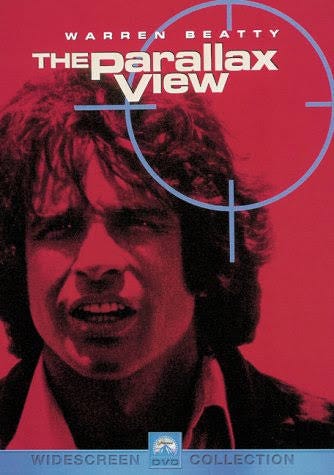
THE PARALLAX VIEW
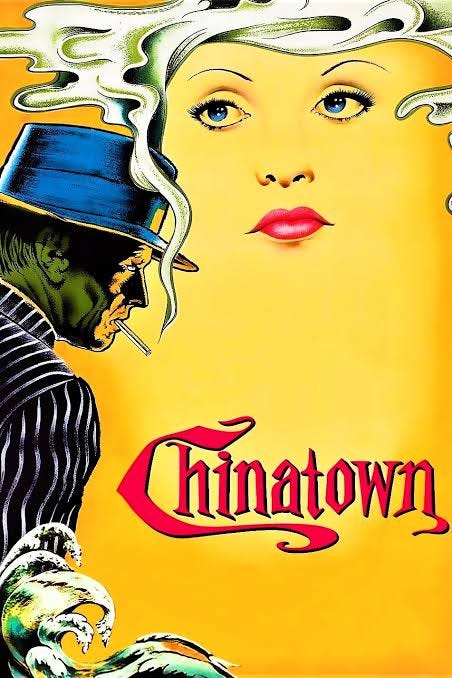
CHINATOWN
TAXI DRIVER
THE WICKER MAN (1st ver.)
THE SHINING
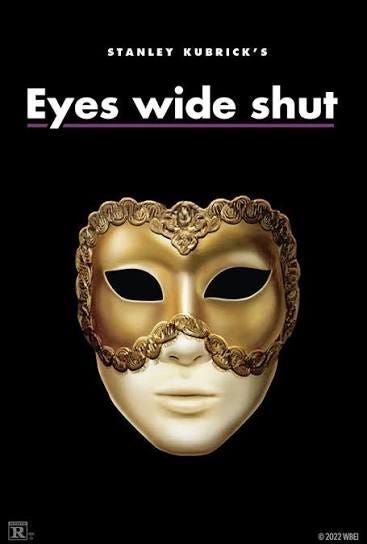
EYES WIDE SHUT
THE SEVEN SAMURAI
THE SEARCHERS
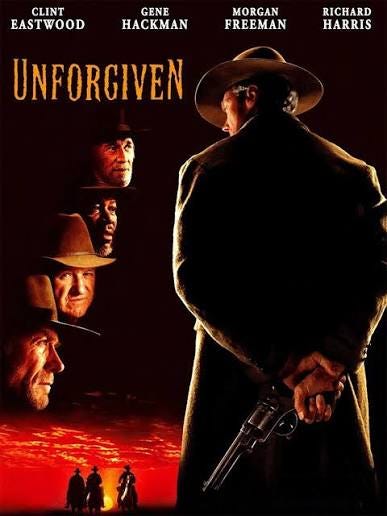
UNFORGIVEN (Eastwood’s)
THE WILD BUNCH
BUTCH CASSIDY AND THE SUNDANCE KID
ANNIE HALL
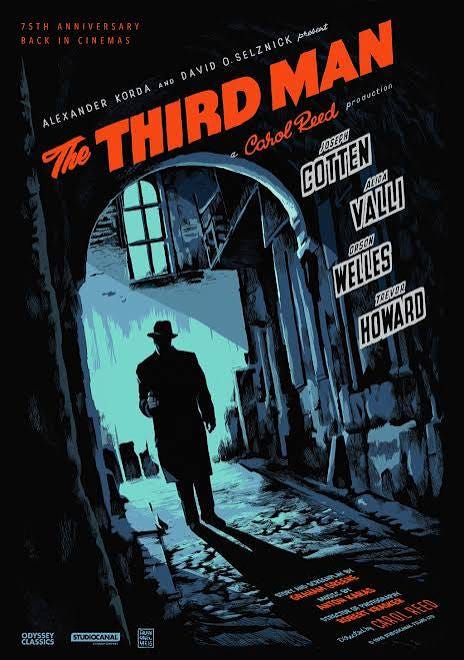
THE THIRD MAN
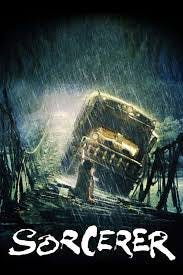
SORCERER
FORBIDDEN PLANET
THE HAUNTING
KISS KISS BANG BANG
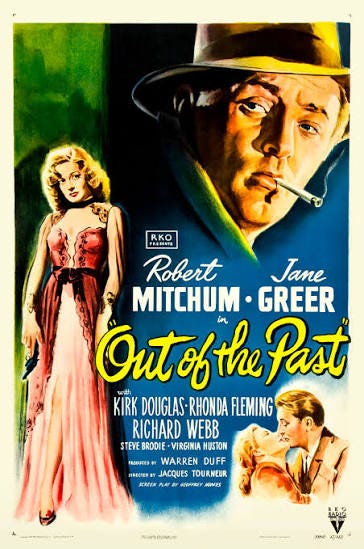
OUT OF THE PAST
2001: A SPACE ODYSSEY
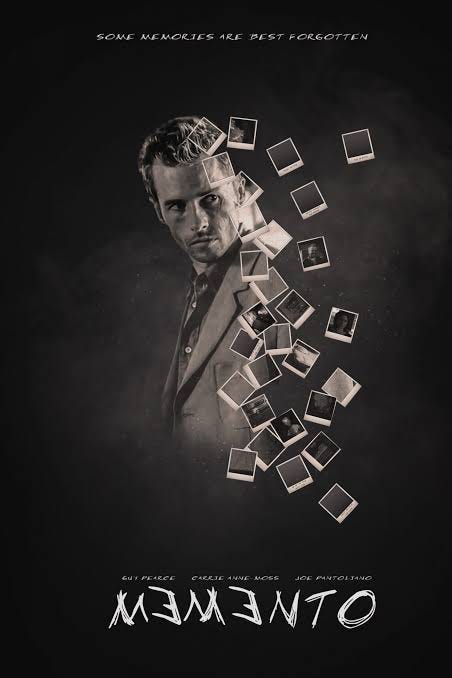
MEMENTO
THE SIXTH SENSE
THE BIG LEBOWSKI
BLOOD SIMPLE
MILLER’S CROSSING
NETWORK
THE DEVILS
These, and many others, bring me back, again and again, offering new and different, even contrary things in repeat viewings. These are films that can enrich us, make us think, and which advance the art-form. #
Please Re-stack if you found this article of interest.
Footnotes:
1 - “It is true for all that, that that that, that that that refers to, is not the same that, that that that refers to.”
A sentence with a similar pattern, which may help to unravel the above, is:
It is true, despite everything you say, that this word which this word refers to, is not the same word which this word refers to.
Or, if you insist on being really correct:
It is true, despite everything you say, that this word to which this word refers, is not the same word to which this word refers.
The grammatical usage:
The first 7 “thats”:.
That 1 – pronoun; that 2 – conjunction; that 3 – adjective determiner; that 4 – noun; that 5 – relative pronoun for “which”; that 6 – adjective determiner; that 7 – noun as “that”
And the next 4 “thats”:
That 8 – noun as “that”; that 9 – relative pronoun for “which”; that 10 – adjective determiner; that 11 – noun as “that”
2 – “Grok” as used in Robert Heinlein’s STRANGER IN A STRANGE LAND:
· Literal Translation: “To drink” water, sustaining physical life.
· Deep Comprehension: To understand something so completely and thoroughly that the knower and the known become a single entity.
· Universal Concept: It encompasses ideas like loving, fearing, or sharing existence with a subject because you cannot truly know or hate it without completely merging with it first.