

There’s an apocryphal story about a professor teaching a class…
“A ‘double positive’ isn't a standard grammatical term like a double negative (which creates a positive meaning, e.g., ‘not bad’). But there’s no such thing in grammar of a ‘double positive’ doing the reverse of the same thing.”
“Yeah, right!” says a student.
Never say never.
Many writing instructors, and especially many writers claim creativity can’t be taught. Are they right? Or is it just wishful thinking motivated by turf protection?
In 1968, George Land conducted a research study to test the creativity of 1,600 children ranging in ages from three-to-five years old who were enrolled in a Head Start program. This was the same creativity test he devised for NASA to help select innovative engineers and scientists. The assessment worked so well he decided to try it on children. He re-tested the same children at 10 years of age, and again at 15 years of age. The results were astounding.
Test results amongst 5 year olds: 98%
Test results amongst 10 year olds: 30%
Test results amongst 15 year olds: 12%
Same test given to 280,000 adults: 2%
“What we have concluded,” wrote Land, “is that non-creative behavior is learned.”
George Land, Ph.D. (1932 – 2016) was an author, a general systems scientist and Fellow of the World Business Academy.
From CreativityAtWork.com, by Linda Naiman
And…
Consider this on the subject of creativity from that great interview by Dan Schneider of screenwriter Lem Dobbs (THE LIMEY, KAFKA, LEE):
Dan Schneider - But, to be a good writer, I think you must learn all the rules until you’ve inculcated. Once that’s done, you have to seriously unlearn them to be truly creative. Creativity is one of those things that you either have or do not have. There’s no teaching it. Thoughts?
Lem Dobbs - Well, I have tried teaching it and in exactly those terms. Somerset Maugham said if you can write a play, it’s as easy as falling off a log, and if you can’t, no one can teach you. I tell students right away that Picasso didn’t just reinvent the human form right off the bat. First he learned to draw better than anyone else alive. Buñuel could be surreal because he could also be real. Sometimes both in the same movie. My father was among the last generation who went to art school when going to art school meant learning how to draw. From life. Day in, day out, sitting looking at a model. Then the Sixties came along and Do Your Own Thing became the norm. Let the students express themselves, that’s what being “creative” is. If they want to hang a toilet seat around their neck and chant while splashing paint on a wall, let them. Who’s to say what Art is? And that was the beginning of the end. That’s how we came to this pass -- one man’s heaven, another’s personal hell -- where “quirky” now equals quality and we have SYNECDOCHE, NEW YORK and LITTLE MISS SUNSHINE and JUNO instead of STAGECOACH and OUT OF THE PAST and SERPICO. There was always an insufferable subgenre of the kooky -- movies purporting to show that “nonconformists” lead more authentic lives -- A THOUSAND CLOWNS and A FINE MADNESS and anything with Liza Minnelli -- but it wasn’t the defining barometer of critical taste.
It’s why every jackass in the world now writes screenplays -- that and the money they started hearing about. Everyone thinks movies are accessible to them, you see, everyone has spent their life going to movies, watching movies on television, renting movies … They didn’t grow up performing appendectomies. No one seems to realize that the people at the very top, the ones everyone else would like to be -- Spielberg, Scorsese, Tarantino -- they know more about movies than you do, they’ve seen more. Thousands more. Movies are in their blood. It’s incredible when you read the bad screenplays of amateurs and aspirants, not only do they not resemble real life or human behavior, they don’t resemble movies. “Creativity” is promoted now like it’s a civil right. But to mention the sordid subject of talent is unseemly and elitist and muddies the playing field. After all, America’s got talent.
The fools who write those unreadable HOW TO WRITE A SCREENPLAY books don’t seem to have any knowledge of movies beyond a superficial understanding of the same handful of classics or modern hits that everyone knows. Some director recently announced his attachment to some project and said, “I seem to be attracted to reluctant hero stories.” Does he really not realize those are the only stories Hollywood has ever made? You have to inculcate movies, not “screenwriting.” There are shapes and patterns and a certain commercial contract made with the audience at the dawn of time. Then if you want to break that contract and go off and make Cassavetes or Antonioni films, fine -- or fine. Cassavetes, at any rate, had to do one to subsidize the other.
--- Lem Dobbs, Interviewed by Dan Schneider
(Writers! Run, don’t walk, to that (nearly book-length) interview!!!)
At the risk of joining the ranks of the fools, I have a book that focuses on helping writers to increase their “creativity.” And this “jackass” also writes screenplays. But while I won’t challenge Tarantino on his knowledge of Asian action movies, I feel I could “give a run” to both Spielberg and Scorsese on domestic films, and hold my own on much of international cinema. But knowing the length and breadth of world cinema won’t get wannabe screenwriters a meeting with that MBA studio exec who knows movies all the way back to “the early 2000s, plus Star Wars, of course. But if you want to talk about Keynesian approaches to economics...” I have, more than once, in conversations, referenced famous classic films to blank stares from industry professionals. When they compare your idea to a recent re-make, rather than the original, you know you’re in trouble.
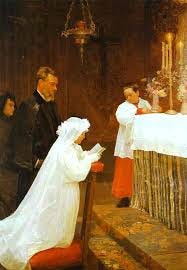
Dobbs, however, makes a host of valid points here. Picasso’s paintings, FIRST COMMUNION (1896):
and SCIENCE AND CHARITY (1896):

both demonstrate that he mastered classical approaches to painting before he created his own unique styles of expression.
But I believe that creativity is less mystical than many see it. Creativity, I feel, is mostly just finding a good road, less traveled. Where, normally, one idea leads fairly obviously to a (“a” not “the”) next idea, and “Joe Average” takes that easy path, the creative person chooses other paths to that next idea. Why? Perhaps it’s a need to get to a new and different answer. Perhaps their own experience of the world points them. Perhaps they just want to stand out. But given a hundred random individuals, it’s a sure bet that a few will find wholly different answers compared to the majority. And that’s not magic. There is no creative gene, no STAR WARS Universe’s “midi-chlorians” giving some people a creative “force”.
If you want proof, ask yourself whether you feel you are one of the highly creative folks in this world. I’ll venture you’ll say you’re not. Then list some of your own really good ideas over the course of your life. I don’t mean earth-shaking ideas, just good ones, things you felt blessed to have come up with for big reasons or small. Can’t think of any? Never had a single idea worth anything? I don’t believe you. Think harder. Think wider. Think farther back. “Oh, there was that one time...” Right. That was a good idea, wasn’t it? So, now, if you’re not creative, where’d you get them? I’ll tell you: you got them from the odd moment in which you thought further, longer, different- ly, or maybe “sideways,” rather than thinking straight-forwardly and as little as possible, the way you usually do. Think about those ideas. Examine the process you went through. Where did they come from? Might you have had some creative inspiration of your own? And might you have said one or another came “right out of left field”? That’s lateral thinking, folks.
Once, long ago, I lost a shed in my yard to fallen tree branches. It happened in stages over a couple years. First minor damage. Then worse damage. Then the roof collapsed. So, one late spring weekend, I decided to get a new shed. I went to a home center and picked one out. It came in a box and was delivered by truck. I slid the huge carton into my garage for the day, planning to assemble it the next weekend. But the day came and went. And… so did summer. By early winter, I realized I needed my garage back, so I had better get going on it. And then I thought, “Wait a second, that slab where the old shed was is ‘Ground ZERO! There’re LOTS more branches hanging over it.” So, I decided to return the shed. But the home center doesn’t pick up. It only delivers. And the carton of the new shed was wayyyy too big for my car. So, what to do? I had no friends with available trucks. I was stumped.
I thought about the problem, thought about it in the context of my “wider” world. What solutions might be hiding, perhaps to the left or to the right, in my world? I thought about my “truck-less” friends. And then I realized one “friend” owned no trucks, but… he sold them. I called him. I asked to “test-drive” a truck. He lost a sale, but kept a friend. I’ve bought five cars from him over the years, and sent three others to do the same. And I got my garage back.
A writer client I represented long ago (as an agent) had been pitching ideas to the producers of Star Trek - Deep Space Nine. He had done several meetings with them to no success. Each time he pitched one of his stories, they responded enthusiastically, but passed, sometimes saying it was very similar to something they already were developing. I told him he was thinking in their universe, and he was right on target. So much so, in fact, that he was coming up with ideas that were the same as theirs. He was thinking… vertically. Nothing wrong with that, but so were they. So…
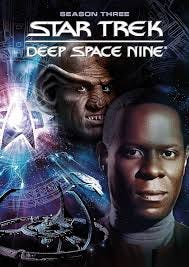
I was a writer, too, back then. So, I thought about his problem, about the wider “world” of Star Trek - Deep Space Nine. I looked to the right, looked to the left, in the corners, behind doors. What was also in that world? And then I found a story. In that story universe, Deep Space Nine had a casino, and it was run by a little alien guy, a “Ferengi” named Quark:

His planet was ultra-capitalist, and its culture was based on profit-taking. It was also mysogynistic to the max. The women had to stay at home, naked. They were, in effect, the “have-nots” of the Ferengi. I thought about the “have-nots” of America, the disenfranchised, who were never given their chance at the American Dream. Back in the 19th and into the 20th Century, these were the immigrants, the Irish, the Italians, the European Jews. What did they do when no one would hire them? Some formed gangs and resorted to crime. So… what if? What if some of the Ferengi females became the mafia of planet Ferenginar? What if three “in-your-face” Ferengi “made women” showed up on Deep Space Nine, dressed to the max, and tried to “muscle” Quark’s casino? I wrote it into an hour-length episode, an unconventional-for-Trek comedy I called “MUSCLE,” and sent it in. Within six weeks, Deep Space Nine announced it was in its final season, so they sent the script back with regrets.
That’s the writing life. But that process of conception? Gold, Jerry… GOLD!
So, I see creativity as a conscious method employing lateral thinking to find alternatives to the obvious, the stereotypical, the vertical. And given this, it is only a small effort to develop strategies toward using such thinking consistently. Edward De Bono, in fact, did this for the business world to great success. And it’s been done for screenwriters, as well.
People, however, and artists foremost among them, prefer to believe that their creativity is a kind of “super-power” that they and only a small group of similarly-blessed “heroes” have. They don’t like to think too hard about how they get their inspiration, because, to put it frankly, they are threatened. Maybe it has the effect of knocking them down a notch or two in their own and other people’s estimation. Everyone is equal, but, as Orwell said, they prefer to be “more equal.” They don’t like the thought of someone using a “method” to create the same thing as what they achieved “magically” through their “God-given” talent. And to extend it further, I’ll venture that talent is just creativity applied along with focus and practice, to a particular expression or art. It’s why someone gets better at something, they apply focus and practice to the thing for which they first showed an affinity. It’s work... by creative people, people like... all of us. Including you.
So, like lateral thinking proponent, Edward de Bono, I believe creativity can be taught. And that’s not to say that it can be guaranteed. The great artist is probably far more practiced at employing such strategies, far more able to take the approaches that much farther along. But you have it already, and you can get better at using it. Do so and, viola! You’re talented too! #
Please Re-stack if you found this article of interest.
Thank you so much for sharing this with me and for your generous comment on my article. I really enjoyed your perspective, especially the idea that creativity is less a mysterious gift and more a way of thinking that can be practiced and strengthened. Your examples of lateral thinking brought that idea to life beautifully. I also appreciated your reminder that creativity often begins when we resist the obvious path and allow ourselves to think sideways. This was such an engaging and thought-provoking companion to Unlocking Creativity. I’m very glad your comment led me here.
I had a friend hear my novel premise and started telling me about his.
He then said I want you to write it.
I said absolutely not.
No, no, no, I'll give you the ideas and you write them, you take the credit.
It's not really your story then if I write it. You do it.
I can't write like you.
Yes you can, you just didn't try.
A week or two later he started writing it.
Whether he finishes it or not is up for debate, but he's locked a spine and seasons.
I've gotten the same thing about my artwork.
I wish I could draw
You can.
No, that's a gift that you were given
No, I worked my ass off to draw like this. I spent hours fighting lines that wouldn't surrender. It was not a gift, it was practice.
Can you draw me a picture? I want, whatever it is.
Are you going to pay me?
For a drawing? No.
Then no.
Why? it's just a drawing.
No, it's time, effort and focus. You want me to spend hours, drawing a thing I might not even like, for free? Absolutely not.