

(For reference see Parts 1 - 8)
Let’s look at a few films with unique features and structures not on Alex Epstein’s list:
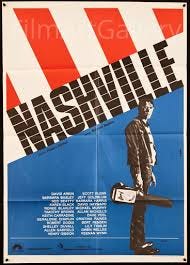
Robert Altman’s and Joan Tewksbury’s NASHVILLE, with its ensemble cast and numerous and conflicting character goals throughout, has been held up as a structure-less film. But, Field, himself, (and screenwriter, Joan Tewksbury (IX-1) believes, the city is the protagonist. His analysis of the “acts,” however, results in an unconvincing delineation of weakly linked events, doing more to show the limitations of his model than it does its potential. What’s lacking is any unifying link between the events of the film and the attributed central character, the city itself. The events merely happen to the various characters and the city contains them, providing, as he says, “context.” For Field, that view suffices, supporting the argument that he fails to understand his own character-as-dependent-upon-plot-point-I insight (which, in turn, implies our own structure-as-dependent-upon-character inference)—for, where is the “character” he implies, of which the structure is a function? And what is its function about? (All is not lost, however, as we shall see in a few moments.)
To be fair, with the exceptions, perhaps, of GRAND HOTEL and THE BIG CHILL, NASHVILLE is one of the few films of its kind (a collective protagonist) to appear in popular Hollywood cinema. Field’s insight that the protagonist is not limited to a single individual, indeed, even a person, amplifies his earlier contribution of the structural need for a protagonist in the first place, and remains a quantum leap forward in our understanding of story structure. Despite this, virtually every one of his readers (including, as we saw here, Field, himself) ignored these crucial insights. Instead, they maintained their understanding of structure as one exclusively on the surface level, the part-linking physical plane, with required moments on key page numbers, with or without a hero.
Interestingly, when forced to serve as a model of story structure—something it has never tried to be—the Campbell-Vogler model suffers NASHVILLE even more so. Without a hero present as an actual flesh-and-blood character, as a model of story structure, Campbell-Vogler breaks down. The city may be seen to be on a journey, but the required motifs are missing. And unless one switches from cities and metaphoric journeys to characters directly interacting with the city-unit itself, there is no ability to include archetypes in any Campbell-Vogler analysis of the film.
But, then, NASHVILLE just serves to point up the general failure of nearly all of these theoretical models as successful structural paradigms encompassing the length and breadth of stories. Even had a character been found to become the hero, the Campbell-Vogler model doesn’t proportion its assignation of importance any greater to any of the key motifs: “The call to adventure,” “Seizing the sword,” or “The return with the elixer,” for example, and so it fails to allow these stages of protagonist growth to stand out in relief against other, lesser elements. So, even though it is a powerful model to construct the physical level of stories, it fails to support such construction with the necessary unity and transformation. It needs logical level support. It needs our notion of the deep structure.
NASHVILLE, ultimately, does not work if viewed as a series of events which happen to an ensemble of people in a causally-linked order. Not much of anything significant happens to any one person (except the person who gets shot, of course). In such a view the film looks more like a documentary of the making of an unconsciously trendy, very bad soap opera.
Paul Schrader, who, on another film, worked with NASHVILLE screenwriter Joan Tewksbury, has called the film, “...the largest wading pool constructed by mankind. I mean, just because you cover twenty-five characters superficially doesn’t mean that it’s a greater accomplishment than covering one character superficially. It’s like multiplying by zero.”---The Craft of the Screenwriter, p. 287.
Schrader’s assessment, notwithstanding, in order to demonstrate the broad ability of our own structural view to encompass disparate filmic approaches, and risking a charge of over-thinking it, I’ll take Syd Field’s weak NASHVILLE analysis one step further. NASHVILLE’s “hero,” its protagonist, is neither a person nor even the city, itself, except by association. It is an abstraction, an idea. The city of Nashville within the film is, in fact, a metaphor. Taking our model to its most outré, one could say that the “city-hero” is actually a metaphor for America as it grew from the 1950s through the 1960s, and into the 1970s. Part 1 demonstrates innocence, as America was, in the 1950s, suddenly facing its own darker side (McCarthyism, militarism, racism, etc.). This is seen in the transition from the airport scenes to the freeway traffic jam. Part 2 represents a coming of age, as the country experienced in the 1960s, trying to free itself from its own self-repression. This is the country’s progression through various obstacles and toward a kind of freedom for people to freely interact with one another. And Part 3, with the assassination attempt, represents a kind of bittersweet illumination, as, in the aftermaths of the Kennedy and King assassinations, the country realized it had to endure, to live with itself, warts and all, forever struggling with its limitations. Seen this way, and only this way, NASHVILLE becomes a unified, if much too 1970s-hip, whole. Seen any other, surface-level way, it seems a fragmented and self-indulgent mess. And perhaps that’s all it ever was. But if a unity is there, it is in the meaning of the collective whole, the city-as-America metaphor, itself. And so, the lesson is clear: find the protagonist, and the structure emerges from the shadows.
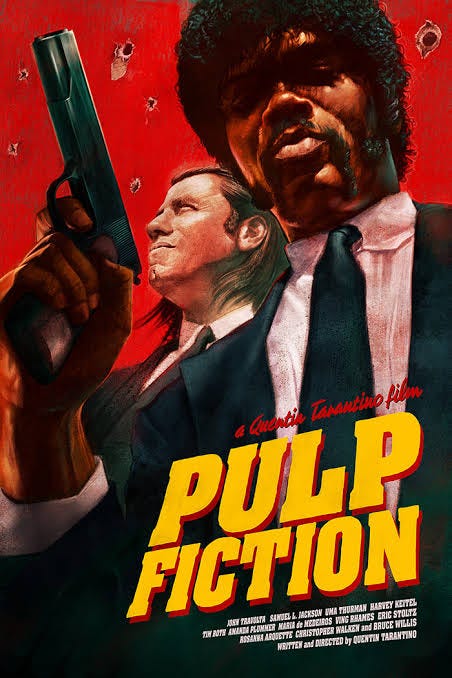
PULP FICTION is a film held up by many as, effectively destroying structure because of its re-ordering and scrambling of the traditional three acts. From an examination of the linear progression of the scenes through time, it seems to have the beginning partly at the beginning, and partly at the end, the end mostly in the middle, and the middle mostly near the real-time beginning. The film seems to succeed despite this scrambling on sheer chutzpah and Quentin Tarantino’s and Roger Avary’s amazingly baroque dialogue riffs (IX-2). The structure may have taken its cue from director Jean-Luc Godard, who, when asked if films need to have beginnings, middles, and ends, famously replied, “Yes, but not necessarily in that order.” While this seems overly coy, in the case of PULP FICTION, it applies.
I submit that the film does, indeed, succeed due to its classic Aristotelian and Fieldian 3-part structure. If one examines the deeper, logical-level of the film, the true structure, as always, emerges. The protagonist is effectively the criminal gang headed by Marsellus (sic) Wallace. Its cohesion (and, therefore its existence) is threatened by a series of events: Vincent’s near losing of Marsellus’s wife, Mia, to a heroin overdose; Butch’s betrayal of Marsellus; and Jules and Vincent’s accidental killing of one of Marsellus’s hench-men. As each of these obstacles is overcome, the group grows in illumination: Vincent, as it pertains to his calling to the gang and his precarious relationship to his employer; Butch, in his rescue of Marsellus despite his earlier betrayal; and Jules as his estimation of his own odds of survival has determined they’ve bottomed out. Marsellus, himself, grows in releasing Butch in thanks for his rescue, after having planned to kill him upon discovering the betrayal.
For each of these examples of growth to work in concert, the film requires assembly as it, in fact, was assembled. The true structure emerges from this assembly, and only this assembly. Linda Seger and Carolyn Miller, in an essay on unconventional narrative forms for Creative Screenwriting magazine (March/April, 2001), identified a variety of new structural forms appearing in films today. Concerning PULP FICTION, they said:
“PULP FICTION...employs a curved structure, a Loop, since it starts with the beginning, but the ending loops back and is played in the middle of the story. The structure helped solve the essential challenge of the piece: how does one create a form to unite several disparate parts? If the film had not used this looping structure, characters would have dropped out of the story part way through--either because of death, escape, or simply by choosing to get out of the killing business. This would have given the story a lack of cohesiveness (italics, mine), and robbed it of a transformational arc that started in the second scene of the film and ended in the last scene of the film.”
And later, they say:
“For the Loop, writers Tarantino and Avary had to continually weave connecting threads between the multiple, seemingly disconnected story-lines, as well as the various scenes that take place out of chronological order... they created an overall umbrella to the story through all the characters’ fear of the villain, the evil and powerful Marsellus (sic).”
Apply the Aristotle-Field paradigm to PULP FICTION and it breaks down unless the protagonist is seen as the criminal gang as a whole, joined by, among other things, that “umbrella” of fear identified by Seger and Miller. The time juxtaposition, with Vincent Vega dying in the middle, but being present when Jules decides to quit the gang at the end, among other juxtapositions, effectively destroys a time-only causality requirement implied by a superficial reading of Aristotle and Field.
This is even clearer with the Campbell-Vogler model. Who is the journeying hero? Vincent? Jules? Butch? None of the others has enough screen time. But none of the first three fills the bill sufficiently, either. Which archetypes are present? Is there a mentor? (Mr. Wolf, perhaps?) Some have said that the protagonist is, indeed, Jules, as he exhibits the true transformational epiphany at the end, and his gradually deeper understanding of the Ezekiel verses which he recites during the film seems to articulate an arc of transformation. But Jules is wholly missing from Butch’s story and much of Vincent’s story, so the reasoning, once again, breaks down.
If structure is mere connection of parts, then PULP FICTION is, while a structured assembly, to understate it greatly, a unique example. If structure is connection and support of parts, then, an only-the-gang-as-protagonist view achieves it. Tarantino, himself, signals this when he states at the outset, PULP FICTION is “Three stories about one story.” (italics, mine) There’s only a single candidate for the “one story” in the film, and it’s the gang’s story.
Variants
To re-examine, then, the current views (Campbell-Vogler; a superficial reading of Aristotle-Field) argue that three or more causally linked parts are a structure, so, why must structure incorporate, indeed require unity? Well a building is made of parts which may well fit together, but if the whole is not unified by the structural support extending to all those parts, the building falls down. So, too, do stories. If not, any group of characters occupied at any causal action, i.e., random chunks of everyday life, would qualify as stories. Mere parts do not a story structure make. A unifying, transformative element is required. In screenplays, that is the protagonist. Since movies are dynamic, i.e., they’re meaningfully different at the end than they were at the beginning, the unifying element must alter over story time. And, usually, he must grow.
As I mentioned earlier, the only exception to this is if the protagonist fails to grow in the face of the need for it. In that case, the growth is still present, but it is solely in the understanding of the audience at the expense of the protagonist. FORREST GUMP is an example of a protagonist’s failure-to-grow. The audience, by the end, learns to accept an unchanging, though enduring, Forrest, with the world changing around him. In either example: growth, or non-growth in spite of a need for it, a transforming illumination is achieved within the audience, and the story’s structure emerges. The key to great story structure, then, is not merely what happens to the protagonist. Rather, it is that something transformational, from darkness to illumination, happens within the audience. This is true whether or not the protagonist transforms. For, as we have shown and must stress, story meaning lies within the audience.
Other examples of the unchanging hero range from pure action films like the James Bond movies to more serious works like DEATH OF A SALESMAN. In such a view, the Bond-ian hero stays intact, gets the girl, and defeats the evil-doers. The change occurs, as I have stated, in the audience, and in the case of this kind of action picture, the change is almost all on the plot level: the audience learns how Bond defeats the baddies. Instead of a transformation of meaning within the hero and/or the audience, it may only be a catharsis, a culmination of the emotion and tension built over the course of the story. On the other hand, it may be a transformation within the audience of new insight into the protagonist and his indomitable ability to endure. It has a power, when handled well, which can rival and even, at times, exceed the impact of a serviceable meaning transformation in a typical story providing our transformational arc of character. In the case of the catharsis, it is not often deep, but it is a fun ride when done well. But some “unchanging” protagonists actually do change in the better examples of the action film. The transformation is only hinted at, but it is, nonetheless, solidly present, appearing in otherwise little moments within the story wherein the character opens up and exposes his vulnerability (IX-3). With DEATH OF A SALESMAN, on the other hand, the point of the story is, among other things, Willy’s inability to change. Our recognition of it is the transformation in action. So, profound truths are just as available to the writer, when working with the unchanging hero, as are pure escapist “entertainments” (in the Graham Greene sense).
In character-dominant (as opposed to action-dominant or a balance of both) stories, the structural changes can actually occur off-screen. A comparison of an earlier draft of M. Night Shyamalan’s screenplay for his film, THE SIXTH SENSE, with the finished film, demonstrates just how elegantly this can work. The changes within the hero from the start to the inciting incident, and then to the part 1/part 2 transition all happen inside the hero’s head. In the script, the part 1/part 2 transition happens in a scene cut from the film. But the transformation is articulated, by the words and behavior of the protagonist anyway. The movie’s story is Malcolm’s (Bruce Willis). It’s about his need for redemption after failing a patient. The transitions are: Malcolm is shot by a former patient, Vincent, whom he realizes, afterward, he failed to help (and for whose suicide he blames himself). Malcolm sets out to right that wrong, finds a boy in similar need, Cole, and begins to investigate his case. The transition to the second act comes when Malcolm realizes Cole is, indeed, like his former patient, Vincent. Cole tells Malcolm he can’t be helped by him. Then, Malcolm meets his wife at a restaurant and explains his need to help Cole because “they’re so much alike” (Cole and Vincent). In this way, Malcolm confirms his transformation from looking for redemption, to finding the path toward getting it. Then, having committed to Cole, he embarks on the main action of the story, gaining his redemption by helping Cole where he had not helped Vincent.
Later, when he realizes he isn’t helping Cole (in fact, Cole has begun to help him—so, now, who is the doctor?), we find ourselves at the mid-point of the script and movie. Unlike the first transition, the transition to part 3 is actually in the movie. It’s at the point when Malcolm tells Cole to listen to the dead people he sees, that he may be able to help them. Cole takes the advice, and exorcises his demons as a result. Cole, in turn, helps Malcolm by telling him how the dead talk to the living—while they sleep. When Malcolm goes home, his wife is asleep. After he discovers that he, in fact, is, himself, dead, he talks to his sleeping wife, and says goodbye. His redemption is complete, and he is at peace. Unlike an action film, all of the transitions are exclusively within Malcolm rather than also in the plot. They are internal ones, in his mind, and the 1st part/2nd part transition even happens off-screen! Nonetheless, he (and the audience) grows as a result of the experience of the story. #
(Stay tuned for Part 10)
——-
IX-1 – Screenplay, 3rd Ed., p. 123.
IX-2 – The script was based on a “show” script by Avary called, PANDEMONIUM REIGNED. But Avary sold it to Tarantino for $25,000 (because Avary needed the money to get married) and Tarantino did his own revision. Avary, who went on his own to make KILLING ZOE, claims PULP FICTION is half his work, and a description of the original script’s plot suggests there may be something to this. But Tarantino claims only the middle section (act 2, typically half the film) of the original was Avary’s. And the dialogue sounds like Tarantino’s—though the two had worked together long enough that that may be arguable, too. Ultimately Tarantino bought sole screenplay credit from Avary in exchange for lots of money and an original “story by” credit. The effect of this was to split the friendship, a lesson to all collaborators.
IX-3 – Transformation within both the protagonist and the audience as it appears in the action genre (the Bond films, the DIE HARD films, the Indiana Jones films, etc.) is interesting in that, mostly it appears not to be present. But, in the best of these (including those listed above), it’s there. At times the poorer cases in a series, for example, transformation of both protagonist and audience is not present. But, when present, it has the effect of elevating the particular film, often single-handedly making it a classic. This is seen in RAIDERS OF THE LOST ARK, when Indy lets down his wall and shows his vulnerability and need for love in the scene with Marian where he itemizes all the places he hurts. It’s seen in ON HER MAJESTY’S SECRET SERVICE (orig. version) where Bond loses the love of his life. These scenes, in effect signal the hero’s transformation: he’s been (or is being) changed by the experience. These moments give the films heart, solidifying the bond the heroes make with the audience, and they, by themselves, raise them to the next level. #
(Stay tuned for Part 10)
Please Re-stack if you found this article of interest.