

(For reference, see earlier Parts, 1 - 6)
In this part of the series we will identify the structures of several more of Alex Epstein’s cited list of “structure-less” films.
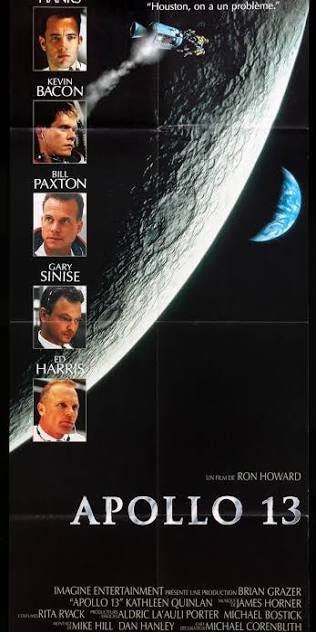
APOLLO 13
Q – Whose (and what) story is it?
A – The Apollo 13 mission’s (the mission’s response to the threat of destruction).
The Physical and Logical Structures are each in 3 identical and corresponding parts:
Act 1/Part 1 – (1” – 35”) – The events introducing the crew and the NASA scene, leading up to the launch; the preparation for the launch establishing the training and the way trouble might arise during a mission; the relationships of the families of the astronauts; the launch and first “leg” of the journey up to the point at which the explosion occurs and threatens the mission.
Act 2/Part 2 – (35” – 103”) – The assessment of the damage, and the impact of the explosion on the crew as well as NASA and the families; efforts on Earth to figure out what to do to save the crew; the arrival of Mattingly the astronaut who missed the mission, and his efforts to figure out how to save the astronauts; the arrival on the dark side of the moon is the Mid-Point of the story as well as the mid-point of the mission; the crew continues to try to cope with the inability to get home, including saving the battery power by shutting down all non-essential systems; on Earth the NASA engineers look for a way to repair the air cleaning equipment so the carbon dioxide can be removed from the air aboard the ship; NASA finally solves the air-cleaning problem, and moves on to how to get them home fast enough to avoid suffocation when the air runs out; a very risky engine burn succeeds, gaining them the necessary speed, so they are assured of getting back in time, though their safe re-entry is still in doubt.
Act 3/Part 3 – (103” – 133”) – The crew hangs on as the engineers on Earth work to make sure the ship enters the atmosphere at the exact right angle to achieve re-entry without burning up or bouncing off the atmosphere and back into space unable to return; the families and NASA cope with the uncertainty; successful re-entry and splash-down.
Conclusion – The film is almost “Fieldian” in its three-part breakdown: Part 1 runs 35 minutes, Part 2 runs 68 minutes, and Part 3 runs 30 minutes of actual story time (almost precisely in the Field paradigm, with a breakdown of 26% - 51% - 23%). The reason Epstein sees no acts in this film is that he doesn’t view the mission as the protagonist, nor the story as structuring about it. If he had, the structure would have stood out like the Las Vegas Strip on payday.
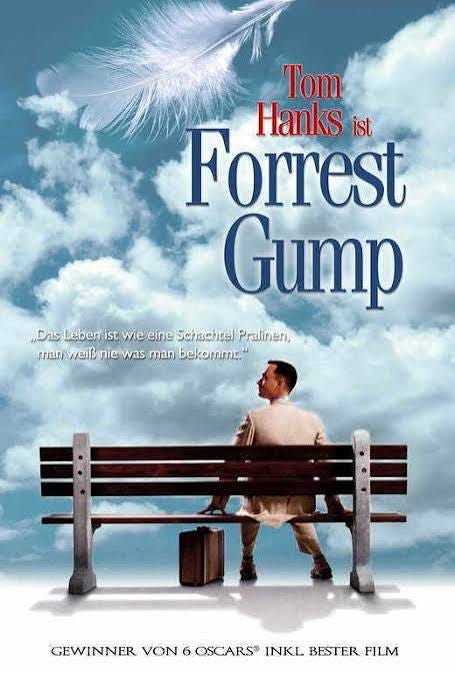
FORREST GUMP
Q - Whose (and what) story is it?
A – Forrest’s. However, he doesn’t materially seem to change through the story. This is one of those cases where the audience changes in its understanding because of Forrest’s indomitable spirit in the face of the turmoil around him. A way to articulate this is to see Forrest as a metaphor for the country, a kind of embodiment of the American spirit. Like it, Forrest endures through war and social change. But the essential and salient points are still there to signal the changes (bolded and italicized).
The film’s length is 141” and it structures in an unorthodox manner: Part 1 covers 56” of screen time; Part 2 covers 63” of screen time and Part 3 covers only 22” of screen time. This works for this movie because the short Part 3 signals that the rest—the task America faces (as seen through Forrest)—is still ahead, there’s a long way to go, both for Forrest (a single father at this point), and for America (imperfect and struggling), but everything either one needs to get through, each already has.
The Physical and Logical Structures each are in 3 identical and corresponding parts:
Act 1/Part 1 – (1”- 56”) – This portion comprises Forrest’s youth through his arrival in Vietnam. Forrest’s remarkable good fortune, beginning with being able to “throw off his shackles” and run faster than his pursuers, an ability that, despite his problems, gets him into college and beyond, signals that Forrest serves as a metaphor. When he loses Bubba in Vietnam, he gains a purpose: to carry on Bubba’s ambition to own and operate a shrimping boat. Bubba’s death is the event that thrusts Forrest into Act2/Part 2 and his adulthood.
Act 2/Part 2 – (56” - 119”) – This portion comprises Forrest’s entry to and progress in adulthood. Forrest’s success with international ping pong and how endorsements enable him to start the shrimping business with Lt. Dan, put him into position for the trials he must face. These include his overcoming and/or contention with such challenges and obstacles as Lt. Dan’s depression, Forrest’s mother’s death, and Jenny’s continuing struggles with life. Thanks to the sheer luck and inexperience of being out during a hurricane that spares them but destroys all the other shrimp boats docked back in port, Forrest and Lt. Dan corner the shrimp market. Forrest as a metaphor is reinforced when he decides to run across America for several years, crossing and re-crossing the continent, “from sea to shining sea.” The act culminates with Jenny’s re-appearance in Forrest’s life and her acceptance of his love, followed by her abruptly leaving him, once again. Thanks to the rise of technology and Lt. Dan’s foresight, and thanks to Lt. Dan’s investing, Forrest and he get in on the ground floor of the computer industry. When Jenny finally writes Forrest and asks him to visit, Forrest races to see her and finds out he’s a father, the event that sends Forrest into the final portion of the story.
Act 3/Part 3 – (119” – 141”) – This portion, then, follows Forrest as he adjusts to learning he’s a father. Following this news, Jenny lets him know she has an illness, and asks him to marry her. They marry with Lt. Dan in attendance. Forrest assumes fatherhood and tends to Jenny as she declines in health. When she is gone, Forrest takes over as sole parent, and faces his and his son’s future with a kind of serenity, somehow in tune with the changes he’s seen in his extraordinary life.
Conclusion – FORREST GUMP is a story of America, enduring through trial, embodied in one young man who moves blithely through it, yet unaware of it in any context. And true to Forrest’s lack of awareness, the film audience in America mostly never saw itself in him. The structural breakdown is 39% - 45% - 15%. The story’s transformation seems almost external to him, internal to us: He goes from innocence to a kind of victim of political and social forces greater than himself; emerges from that only to grapple with personal change, success, and their costs; finally to accept the responsibility of caring for someone other than himself, and, as always, facing an uncertain future. Only through our own hindsight are we able to appreciate the impact of the forces acting upon and around him. And only in that way are we able to recognize the profound qualities this country itself embodies, as evidenced by the character of Forrest Gump.
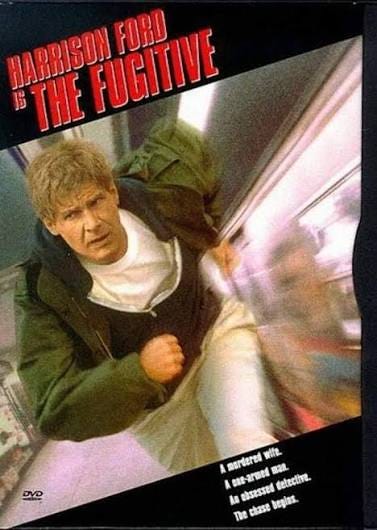
THE FUGITIVE
Q – Whose (and what) story is it?
A – Dr. Richard Kimble’s (his search for his wife’s killer)
The Physical and Logical Structures are each in 3 identical and corresponding parts:
Act 1/Part 1 – (1” – 24”) – The film begins during a long credit sequence that extends all the way to the 15 minute point. During this, we see intercut sequences of Dr. Richard Kimble’s wife’s murder; back-story of a reception and Kimble’s interrogation by the police; Kimble in surgery after being pulled away from the reception; The Inciting Incident in Kimble’s story is his conviction as his wife’s murderer at the 10 minute point in the story; then, during transference to prison to await execution, aboard his prison bus, another prisoner fakes a seizure and stabs a guard who tries to assist him; a melee ensues, the prisoner gets a gun, another guard opens up with a shotgun, and the bus driver is hit, causing the bus to crash and land on railroad tracks; as the remaining prisoners, Kimble and one other, try to collect themselves, a train is heard to be approaching; Kimble tries to help the wounded guard as the others jump from the bus to avoid the train; just as the train hits the bus, Kimble gets clear; He starts to run from the scene; Gerard and his team arrive at the scene within an hour, and at the 24” mark, Gerard declares Kimble a fugitive.
Act 2/Part 2 – (24” – 90”) – The hunt is on; Kimble runs and Gerard sets up the manhunt; Kimble begins the process of solving his own predicament by attending to his own wound at a clinic, then he begins to change his appearance by shaving off his beard; Gerard gets a lead and starts to close in on Kimble; Kimble steals an ambulance, but the hunters are on to him, pursuing him by car and helicopter; Kimble abandons the ambulance in a tunnel within a dam complex, finding his way into the service tunnels within the dam; Gerard chases on foot, catching up to him at the tunnel’s end overlooking the drop to the spillway, hundreds of feet below; Kimble jumps. Gerard sets about finding either Kimble alive or his body in the spillway; Kimble gets away, and finds his way to a hospital where he is able to begin the process of finding the one-armed man whom he fought, the killer of his wife; meanwhile Gerard hunts the other fugitive and finds him in a house, where he has to kill him; Kimble begins to research prosthetic arms like the one he saw in his fight with his wife’s killer; Kimble makes his way back to Chicago and contacts his colleague, Dr. Chuck Nichols for money; Gerard continues to pick up leads and begins to study Kimble, noticing that he isn’t just running, but is hunting something, too; searching in his hospital database, at the mid-point, 67” into the story, Kimble manages to narrow his search down to five suspects with the type/brand of prosthesis of the killer; Kimble saves a kid whom the hospital has incorrectly diagnosed, along the way; Gerard learns of this, and begins to realize Kimble is innocent; Kimble tries to find the killer through his list of leads, and learns that one is a prisoner in the jail, so he goes there and tries to get a conference with him; Gerard has tracked the same lead and intends to find this inmate, too, so they are both in the jail at the same time; Kimble realizes the guy isn’t his man, so starts to leave when he is spotted by Gerard; the chase is on, as Kimble manages to disappear into a downtown St. Patrick’s Day parade; Kimble continues his search, breaking into a suspect’s apartment, and realizes he has identified the killer, a man named Sykes; he calls Gerard and tells him that “I just found a big piece” of the mystery about why his wife was murdered, and he realizes it has to do with him and a colleague at the hospital, Dr. Lentz—this is the Act 2/Part 2 to Act 3/Part 3 transition point, 90” into the story.
Act 3/Part 3 – (90” – 124”) – Kimble begins to close in on Sykes; Gerard does, too, discovering that Sykes has a connection to Kimble and the hospital; the team stakes out the Sykes house, waiting for him to return home; Kimble contacts Dr. Nichols again and tells him he’s found his wife’s killer and that it had to do with Dr. Lentz, their colleague at the hospital; Kimble contacts one of his other colleagues at the hospital, a woman in the tissue lab, and having procured several samples of liver tissue that he had submitted to a drug company for testing of a new drug, his colleague declares that the samples were switched and all from the same liver, thus calling into question the drug’s efficacy; they also determine that Lentz, who had died suspiciously in a car accident, could not have switched half of the samples because he was already dead, so suspicion is now falling on Dr. Nichols, himself; meanwhile, Sykes, aware he is being hunted by Kimble, begins to hunt Kimble; they come together aboard an “El” train, and Sykes mistakenly kills a Chicago cop during the fight; Kimble subdues Sykes in the fight and handcuffs him there before making his getaway; Kimble goes to a conference at which Nichols will be announcing his testing of the drug, confronts him, accuses him, and a running battle and chase ensues; meanwhile Gerard, who has been close on Kimble’s heels but having to clean up all of his collateral damage, gets to the hotel conference and hunts Kimble; Ultimately, Kimble kills Nichols as Nichols is about to shoot Gerard, uniting Kimble and Gerard as allies rather than enemies, and ending the struggle; the film story ends at the 124” point.
Conclusion – The film is, as a Fieldian model, not far from being “mathematical” in its three part breakdown, with the first part at 24,” the second part at 90,” and the ending at 124” (a breakdown of 20% - 53% - 27%). Once it is determined that the story is Kimble’s hunt for the truth of his wife’s killer, the act transitions become clear: when he becomes a fugitive as he begins his own hunt (1), when he identifies the true killer (2), and when he resolves the entire mystery (3). Again, Epstein fails to see the transitions because he fails to identify whose (and what) story it is; this despite the title and the obviousness of the story’s through-line.
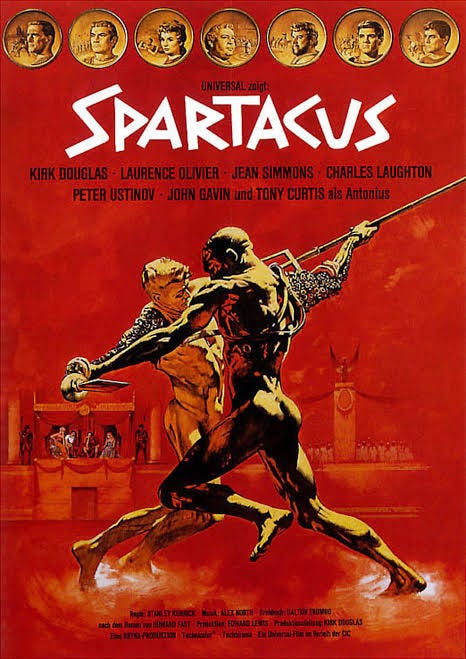
SPARTACUS
Q – Whose (and what) story is it?
A – It’s the Rebellion’s (its rise and fall)
The Physical and Logical Structures are each in 3 identical and corresponding parts:
Act 1/Part 1 – (1” – 45”) – The beginnings of the slave rebellion up to the decision to revolt at the gladiator school, 45” in story time, or exactly 25% into the story.
Act 2/Part 2 – (45” – 147”) – The rebellion begins and gains strength as Rome first dismisses it and finally decides to crush it with all its strength; the rebels are defeated 147” in, comprising 56% of the story.
Act 3/Part 3 – (147” – 182”) – The rebellion is crushed, but not its spirit; the rebels prefer to die over giving up Spartacus; Crassus takes Spartacus’ wife and child, but fails to defeat his spirit; Gracchus frees Spartacus’s wife and allows her to escape before committing suicide; Spartacus is crucified, but sees his son and wife before he, too dies. The story ends at 182,” giving the third part 19% of the story, again, not far off of the Field paradigm.
Conclusion – SPARTACUS is structured in the movie standard of 3 acts (a breakdown of 25% - 56% - 19%). This is clear once the protagonist is seen as the rebellion, and the transformation arcs on its origin, confrontation with Rome, and its ultimate defeat by her. #
In the next articles in our series, we will identify the structures of other films from Alex Epstein’s list of “structure-less” films.
Stay tuned for Part 8.
Please Re-stack if you found this article of interest.