

(This is Part 3 of a series of articles, continuing from Part 1, and Part 2)
Improving Structure
Today, almost a half century since Syd Field first refined what the original sound film writers had done with Aristotle and his Poetics, the three acts have been broken up, thrown out, and even forgotten for other models entirely (III-1).
Concurrent with Field, George Lucas mentioned that his structural model for STAR WARS was rooted in Joseph Campbell’s insights into the structure of myth. Campbell, in his book, The Hero with a Thousand Faces, Princeton University Press, 1949,
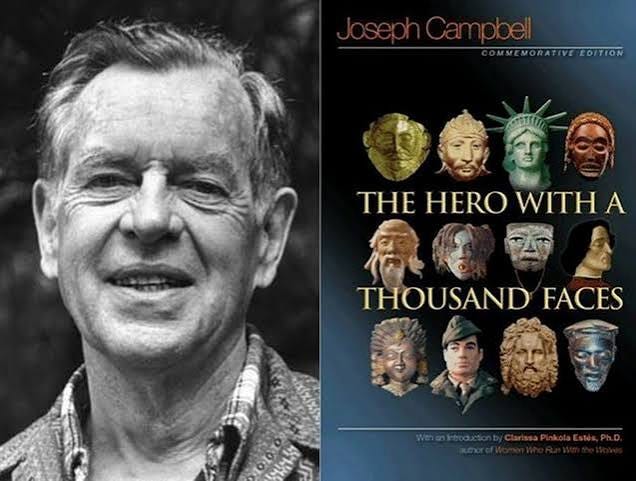
described a pattern he identified in virtually all mythic tales told world-wide since the dawn of storytelling. He described various “motifs” which he found to recur from culture to culture, such that they could be formalized and even identified in modern storytelling (III-2).
Following Lucas’s lead, this was adapted by Christopher Vogler (first in a paper, later in a book, The Writer’s Journey, Mythic Structure for Storytellers & Screenwriters, Michael Wiese Productions, 1992)
into a Field-like model, or paradigm, for screenwriting. A superb tool for the storyteller, this Campbell-Vogler model sees stories as heroic journeys, quests, involving 12 stages of the journey and 8 archetypal characters. Stages include, among others, “The call to adventure,” “Meeting the mentor,” and “The return with the elixer.” Archetypes include “The Hero,” “The Shapeshifter,” “The Threshold Guardian,” and “The Trickster,” among others. This is an elegant and extremely useful model for story-construction, just as it has been throughout history, from the earliest proto-Homo Sapiens gathered about the first fire, to George Lucas at his typewriter in the 1970s, and beyond.
But, do we really know much about Odysseus or Gilgamesh and what internal needs or convictions (beyond the obvious) made them go on their heroic journeys? Even though the character of the hero is central to the Campbell-Vogler model, because there is never a requirement to the contrary, the hero can effectively make the journey in a superficial manner, i.e., attaining the goal of the quest, but without really growing in understanding the full meaning of the result. Let’s be clear: despite the fact that elements within the screenwriting community have found a kind of equivalency by contrasting Vogler’s approach with Field’s, nowhere does Vogler claim his and Campbell’s ideas encompass all of story structure or supplant Field. Structurally-speaking, the Campbell-Vogler hero is effectively incidental, as its presence is not required to achieve a unified resonance of meaning within the audience. The model, in effect, does not recognize that potential in its stories. So, while it is a highly useful plot-construction tool, even superior (to Field’s), the stories it yields can lack the transformative and (as we’ve said) “resonant illumination” found in the best tales employing the transcendent hero (unrecognized by) the Field paradigm .
In later years, the Campbell-Vogler model had replaced Field in the vogue of the moment. Disney studios went so far, prior to Vogler’s publishing his book on the subject, as to make Vogler’s paper and later seminar required study and attendance for its development executive corps. Many saw this model for storytelling, as I just indicated, superior to Field’s, probably because the thorny issue of how to write the second act was elegantly sidestepped by the multi-section approach with archetypes advocated by Vogler. The “pie” being cut into a greater number of parts yielded smaller pieces, and writers who struggled to understand their stories had more sign-posts to work from. But, where Field talked about screenplay structure, Vogler talked about story conception and assembly, and, like Field, confined himself to the plot level. As I will show in the next section, if it is (erroneously) interpreted as a structural model, Campbell-Vogler fails to account for certain examples of contemporary narrative cinema.
Following Field and Vogler, from the late 1980s to the present, there came a series of screenwriting “teachers” (or “gurus”: including most prominently, Michael Hauge, John Truby, Robert McKee, David Siegel, Blake Snyder, and even Syd Field, himself) offering seminars, articles, and books. Each had their own variations on both the Aristotle-Field and Campbell-Vogler paradigms, and offered their own tips and insights into the craft. Collectively, however, they had the effect of improving those Aristotle-Field and Campbell-Vogler notions of structure to death. They all had useful things to contribute, but most suffered from a restrictive, biased, and implied my-view-above-all notion of structure.
They call to mind something the philosopher and psychologist, William James once said,
“A great many people think they are thinking when they are really rearranging their prejudices.”
Also, not a one of them is, or has become, a successful screenwriter. Collectively, they became, as we’ve said, known as screenwriting “gurus,” and their ardent followers functioned almost like a group of warring religions. Selling a script is difficult, and experts offering methodologies for success (or, to get into Heaven) are always very popular. Finally, Scott Myers, in his posts and in a Medium article on the Sonata Musical form for screenwriting (ahead) writes:
“All the variable screenplay structures, templates and paradigms, if you stray too far from three acts, I think you are moving away from something intrinsic to narrative itself.” (my italics and bolding)
Among the individuals who otherwise might be lumped into this group of gurus, are some (Linda Seger,
and Richard Walter,
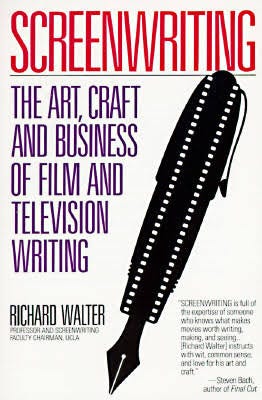
for example) who may not deserve such designation in any pejorative sense. Robert McKee (whose “guru” membership his supporters and detractors have fought over to a standstill), offers a well-known seminar that claims a vast pool of successful graduates and was even lampooned in Charlie Kaufman’s film, ADAPTATION. McKee’s book, Story,
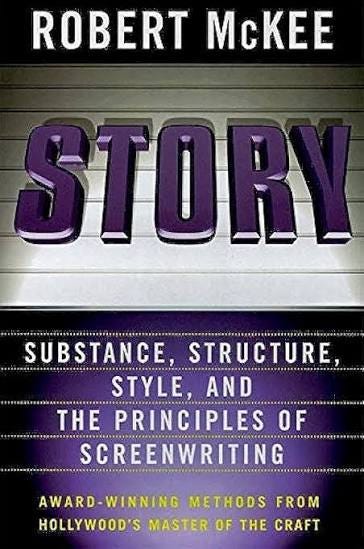
however, establishes his considerable (though not preeminent) knowledge, of the art of screenwriting. His credentials include some (not vast) experience as a screenwriter and director along with his extensive credentials as a teacher (III-3).
McKee defines structure as would a classicist (as might Aristotle, were he among the gurus, today) using a generalized, non-story-specific, universalist’s terminology:
“A selection of events from the characters’ life stories that is composed into a strategic sequence to arouse specific emotions and to express a specific view of life” – Story, Regan Books, 1998, p.33.
For him it is closer to an arrangement of the classic drama’s pre-defined parts (beats, acts, scenes, sequences, etc.) for story advancement, emotional change, and statement of point-of-view. While I don’t disagree, I find the aspect of structure that really matters missing from his definition: transformation (III-4). Transformation amounts to the element that structure serves, i.e., the protagonist in flux. An expression of a “specific point-of-view,” is insufficient to embody our concept of transformation as it progresses within a story in what we will risk (III-5) referring to, ahead, as the protagonist’s Arc of Transformation.
Architects don’t merely design rooms and floors and elevator shafts. They design buildings with lifetimes of transformative usage for which those components must serve. While McKee is obviously aware of the films his structural “events” are part of, he fails to make the connection:
His reference to “characters’ life stories (in the possessive case)” refers to our concept of “all the characters in a story’s universe,” (because he refers to “characters’, in the plural, i.e., all the characters, not singly: the protagonist; while the story, the “selection” is singular, i.e., one specific story), so, he’s referring to something greater than the protagonist, or what embodies and yields our concept of transformation as it applies to the meaning within the story.
He does reference a story’s “spine,” in places, and that (because, without the spine, there is no function), for me, is closer to what matters about structure than any arrangement of parts, emotional content and viewpoint (mere contributors to meaning), notwithstanding, because it implies an organic unity (the protagonist’s spine of transformation). Ultimately, for McKee, structure, it appears, is merely an explication of plot conditioned by a character’s emotion and view. It ignores their effect upon the protagonist and the audience. For myself and others (such as Dara Marks), structure is an explication of character in transformation, i.e., the element the plot, conditioned or not, is itself about, and its resultant effect on that character and its audience.
Screenwriting as Religion
Following the lead of the gurus, a new ad hoc group emerged on the scene populated by disaffected or unsuccessful screenwriters, frustrated story analysts, and writer wannabes. Mostly, they operate on the internet, appear at screenwriting conferences, judge screenwriting competitions, and/or consult to writers for heavy fees. As the difficulty in selling scripts left the possibility that certain secrets lay between writers and success, customary practices by the film industry became codified into sets of rules which some of these self-appointed screenwriting “authorities” maintained writers broke at their peril. These pseudo-experts, heavily invested, as they are, into the minutia of screenwriting practice have now become, as we’ve argued, a kind of screenwriting priesthood. These clerics accept no nonsense from writers who don’t use the precisely correct font (Courier 12 pt., NOT [until later] Courier New 12 pt., to name one anal-retentive bit of screenwriting fundamentalism), or fasten scripts with two (not three, despite the three holes) brads. They demand that screenwriters keep description, indeed page count (to the exclusion, at times, of dramatic clarity), to a minimum, and keep all references to or even implications of the presence of the camera and the editor out of their works. White space on the page (i.e., text-free) became a kind of “Holy Grail,” rationalized as taking the “pain” out of script-reading (apparently for overworked executives and the screenwriting priest corps).
No one seemed to notice that this dubious goal (literally toward nothing),
amounts to the triumph of a screenwriting version of the modern dumbing-down movement: take the substance out, and sell the sizzle rather than the steak. This, all in the service (read that, kissing-up) to heavy-lidded “creative” executives. This, to prevent stepping on the jobs of the other “authors” of the piece: actors, directors, editors, costume designers, development executives, partners, girlfriends, etc.), whose jobs would not exist, were it not for the presence, already, of the story to which they then graciously bestow their authorship. In “Eyes Wide Open - A Memoir of Stanley Kubrick,” screenwriter, Frederic Raphael recalls working with the director on his final film, EYES WIDE SHUT:
“Longing to deserve the accolade of auteurship, directors often seek to append their names to the writing credits. Their habit is to be empowered to embellish scripts which they were powerless to begin. The writer may be crucial to the conception of a movie; he is seldom integral to the business of shooting it. He has to take his chances to what powerful directors or demanding stars will do when he is out of the way. Studio contracts make sure that nothing can guarantee him against being dumped or rewritten, misconstrued or ignored. Directors are often unpunished serial killers from writers whom they have jettisoned or, so they judge, improved.”
These minutia-laden, cited “anti-pedantic,” and ritualistic rules amounted to excessively analytic practices supposedly rooted in tired industry executives with a need to get to bed on time, or story analysts with severe Napoleon Complexes, subordinating, as they do, the story at hand for the “story deal” ahead. And “the Hell with Content!” These experts apparently assumed that someone with one or two screenwriting seminars under his belt and an hour (if that) skimming through a script knows more about the writer’s story than that writer (who built it over 3 months to a decade or more), him or herself. The rules extended so far as to include a set of “anti-rules,” in which Fieldian structure and other models were to be shunned as overly simplistic, or “too regimented”—as though counting your brads was not! Jonathan Swift’s small-end egg-openers have nothing on these folks. Demystification, of course, always threatens a priesthood. But thanks to the hegemony of this self-appointed standards group, the rules, when broken, were easy to spot, unlike, perhaps, the causes of a failing story. They yielded the needed results: the flow of fees continued, jobs were not at risk, innovation and individuality were squashed, priesthood power was maintained.
Has anyone noticed how often the movies we hold up as leaders and innovators break these same rules? Has anyone noticed how few credits their innovating writers often have when said rules were broken? The priesthood’s party-line that rules may be broken only when the writer’s track record is firmly in place (i.e., when the priesthood’s own influence is firmly trumped anyway) has no basis in the marketplace. David Lynch’s first feature, ERASERHEAD, didn’t just break the rules, it was unaware of them. It would’ve been turned into the cinematic equivalent of processed, synthetic cheese had it conformed to them. Because of the flashbacks alone, Christopher McQuarrie’s script, THE USUAL SUSPECTS, couldn’t have been written had it been forced to follow the priesthood’s rules. Joel and Ethan Coen’s script, RAISING ARIZONA, would have been scorned merely on the basis of its excessive narration. And Quentin Tarantino’s third produced film script, PULP FICTION, thanks just to the length of its dialogue scenes, would have resulted in his being sent to a series of guru seminars for re-education (never mind its perceived structure, a subject I will discuss in some detail ahead). Ultimately, the Priesthood demonstrates the fallacy of its own dictums when it lauds screenwriters and filmmakers like David Lynch, Quentin Tarantino, Christopher McQuarrie, the Coens, and Charlie Kaufman, yet derides new screenwriters who practice similar techniques, all on the grounds they have no track record. What was Kaufman’s track record before BEING JOHN MALKOVICH? It was some work in television, and not of the incredibly ground-breaking kind, either.
On the question of structure, in fact, the most zealous among the priesthood reserves its most severe penalty: denial. For them, as some have stated on the web, Field’s 3-Act structure is literally a myth. When forced to acknowledge it exists, one individual in the priesthood points to his own patented list of successful films (some of which we’ll be examining) which are, according to him, “structure-less.”
For the gurus, the film industry could not exist without such rigid control of the rules of screenwriting, for every rule is accompanied by a rationalization designed to support it: speed, simplicity, visual-only writing, respect for the other artists, etc. But one only has to go back to scripts of sixty or more years ago to find common lengths in the 150-page range or greater, extensive setting description, camera direction, actor instructions above and within the dialogue, and directions for the editing process (III-6). I’m not arguing for a return to those far less readable and pedantic times. But such practices attest to the earliest intent of screenwriters to communicate a vision rather than just the dialogue and action. The fact that such practices have disappeared demonstrates the forced erosion of such an original vision, and, not coincidentally, it was, thanks to the French New Wave, concurrent with the ascendance of the director as auteur.
Still, up on the official level, in print and in consultation, each of the gurus, the so-called “experts,” had valuable insights into screenwriting. And they accomplished this, despite often disagreeing violently with one another in competition for their flock’s money and loyalty. As may be all too familiar to some people of faith, there were advocates of the two-act, the four-act, the five-act, the seven-act, and the nine- act structures. There were advocates of musical approaches (III-7). Even no-act structure was advocated. Perhaps the most useful approach for writers, and one I would certainly endorse as a practical method of dealing with the surface-level structure of the long-story form in screenplays is an approach used since the early days of narrative film, called by some, (and elucidated in) “The Sequence Approach.” (III-8) As a method of taming the enormity of the long-story form, this approach has no peer, for it manages to break the story down into manageable units that each have their own unique goals and characteristics. I urge the reader to explore it. #
(Stay tuned for Part 4)
_____
III-1 – In Screenwriters’ Masterclass, p. 238, writer-director Alexander Payne comments, “When I give screenwriting seminars or classes and they ask me, ‘What advice do you have for young screenwriters?,’ I say, ‘Don’t read any screenwriting books.’ I actually think the whole three-act structure is so deeply ingrained in us from living in this culture and watching movies that in order to come up with new movies (which is what I want to see), you really have to fight what you have innately learned. When you’re writing, you will find yourself being drawn naturally by gravity into doing something which corresponds to all of these things that you have seen. You have to fight that instinct in order to come up with a new movie.” Payne can “fight” the logic, or recognize that our notion of multi-level structure frees him to (as scores of other filmmakers have practiced already) craft his story using his surface or plot structure of choice, rather than merely Field’s 3 acts.
III-2 – “A 2006 study by Jonathan Gottschall, an English professor at Washington & Jefferson College, found relevant depictions of romantic love in folktales scattered across space and time. The idea of romantic love has not been traditionally considered to be a cultural universal because of the many societies in which marriage is mainly an economic or utilitarian consideration. But Gottschall’s study suggests that rather than being a construct of certain societies, romantic love must have roots in our common ancestry. In other words, romance—not just sex—has a biological basis in the brain.
“You do find these commonalities,” Gottschall says. He is one of several scholars, known informally as literary Darwinists, who assert that story themes do not simply spring from each specific culture. Instead the literary Darwinists propose that stories from around the world have universal themes reflecting our common underlying biology.
“Another of Gottschall’s studies published [more recently] reveals a persistent mind-set regarding gender roles. His team did a content analysis of 90 folktale collections, each consisting of 50 to 100 stories, from societies running the gamut from industrial nations to hunter-gatherer tribes. They found overwhelmingly similar gender depictions emphasizing strong male protagonists and female beauty. To counterbalance the possibility that male storytellers were biasing gender idealizations, the team also sampled cultures that were more egalitarian and less patriarchal.
“‘We couldn’t even find one culture that had more emphasis on male beauty,’ Gottschall notes, explaining that the study sample had three times as many male as compared with female main characters and six times as many references to female beauty as to male beauty. That difference in gender stereotypes, he suggests, may reflect the classic Darwinian emphasis on reproductive health in women, signified by youth and beauty, and on the desirable male ability to provide for a family, signaled by physical power and success.” ---Scientific American magazine, September, 2008, The Secrets of Storytelling: Why We Love a Good Yarn, by Jeremy Hsu.
III-3 – In David S. Cohen’s book, Screen Play, p. 123, screenwriter, Leslie Dixon (OUTRAGEOUS FORTUNE, MRS. DOUBTFIRE, PAY IT FORWARD) comments, “Somebody gave me a copy of Robert McKee’s Story. I said, ‘This is like trying to understand a human being by looking at DNA.’ Maybe we could put the McKee book on the shelf, and right next to it could be the Leslie Dixon book, which would be a flyer saying, ‘Do they want to turn the page?’” That’s nice for established folks and insiders, but for new screenwriters with little experience, such advice is little more than glib sloganizing: useful (as are our quotes), but how does that help someone take the story in their head all the way to the theater screen? “The devil is,” indeed, “in the details.” Like a lot of writers, Ms. Dixon does not want to look too hard under the rock of her talent, presumably out of fear of what she (or they) expect to find. “Oh ye of little faith,” talent, de-mystified, is no less potent, no less yours.
III-4 – Ring Lardner, Jr., in his interview with Pat McGilligan and Barry Strugatz in Backstory 3, pp. 223-4, describing the differences between the source book and the movie of M*A*S*H: “I took some of the main incidents, invented a couple more, and organized them into a continuity that I thought would work, even though it violated the cardinal rule that a story involves a change of character in one or more of the principals (italics, and bolding, mine). In my adaptation, the main characters were all the same all the way through, and the illusion of a story had to be sustained by the action and the comedy.”
So, Lardner is unaware of, or ignores the reality that, just as “correlation is not causality,” unchanging characters do not result in unchanging meaning within the audience, i.e.,
Transformation is still present: it’s in the audience’s understanding.
Lardner’s comment, by a writer from Hollywood’s golden age, before today’s “rules” were conceived and imposed, is interesting. His reference to “one or more of the principals” (rather than the protagonist) implies that, as he is of a generation of writers who wrote from instinct and inspiration, rather than any training they received in film school (or guru seminars), his understanding of story is similarly instinctive. Today’s screenwriting establishment tends to think of all of its rules as formalized and in place from “time immemorial,” i.e., known, understood, and practiced by its masters from that golden age. In truth, our understanding of how stories work is still, and always… emerging.
And, as we’ve pointed out, the thing even he doesn’t recognize is that the “change” he claims doesn’t happen, actually does. It occurs in the audience’s mind based on the experience undergone by the protagonist: the entire group of M.A.S.H characters, and it is a realization through the group’s experience of the absurdity of war—later crystallized in the tv series and embodied by Jamie Farr’s character of Klinger. The characters in the film don’t change by design. It is required. Their un-changing stoicism gets them through it.
III-5 – Many writers (such as William Froug) eschew terminology such as “arc” and “paradigm” as needlessly theoretical, overtly intellectual, and steeped in a kind of academic ideology (which, as a “working man,” he shuns), instead of the realities and practicalities of all storytelling. While it is a valid viewpoint (and keeps him out of that ivory tower), such terminology helps us to understand things operating under the surface of stories just as those more “practical” approaches understand things on the surface.
III-6 - Now all of this would be fine, ascribable to the evolutionary process of any art-form, and unworthy of notice, but for the effect it has on the emerging writer community and its freedom to experiment and innovate within the medium. When a script is passed over because it has three brads or, heaven-forbid, screw posts binding it; when a work is tossed aside because it runs 131 pages or uses leatherette rather than card stock for its covers, something is truly wrong with the process. Jack Kerouac submitted his break-through novel, On the Road, on a single roll of brown butcher paper. How many “Kerouacs” among the new and emerging screenwriters will the industry miss in the coming years as it progresses to ever more white space and shorter and shorter page counts?
And, while all of that has been developing for the past several decades, the same gatekeepers are now asking writers to produce “pitch decks,” i.e., slick software and A.I.-generated sales documents, with LOTS of pictures of A-list actors, and market study data backing up the script’s potential for success. Apparently, just as they hate to read, they now hate to do their own previous work of selling scripts to their bosses!
III-7 - SONATA MUSICAL STRUCTURE
Some describe the films of Stanley Kubrick as employing the Sonata musical form as a model for their construction. Kubrick, himself, has said:
“A film is -- or should be -- more like music than like fiction. It should be a progression of moods and feelings. The theme, what’s behind the emotion, the meaning, all that comes later. After you’ve walked out of the theatre, maybe the next day or a week later, maybe without ever actually realizing it, you somehow get what the filmmaker has been trying to tell you.” (Source)
In his book, “Eyes Wide Open - A Memoir of Stanley Kubrick,” screenwriter of Kubrick’s EYES WIDE SHUT, Frederic Raphael recounts a conversation he had with the director during the writing of the script (with my clarifications in brackets):
“Kubrick: …you like things to have a shape [a structure], don’t you?
“Raphael: I believe I said so. Yes, I do. It shows you’re not… bluffing [that you appear to offer them a “steak,” but actually give them only the “sizzle”: a film that goes nowhere, that leads to no conclusion of meaning].
“Kubrick: Does it?
“Raphael: I think so. So does Aristotle. You don’t [a declaration, not a question].”
Kubrick advocates for films to eschew his “shape” (our “structure”), and instead, be made of “moods,” “feelings,” leading, if ever, to a conclusion long after. This implies that he sees “shape” as, perhaps, artificial, a construct that is ultimately, unnatural. He fails to recognize or acknowledge that imposing moods, manipulating feelings, while, in some cases being less obvious, is no less unnatural. He seems to approach films as hyper-ambiguous works in which audiences can just as easily miss his anti-“shape” “effects” as appreciate them, and arrive at any “shaped” conclusion(s) only if they do. But, we digress…
A sonata is an extended composition, differing from vocal composition in that it`s usually for piano or another solo instrument. It comes in (for the umpteenth time, what else?) three parts or movements: The Allegro, Adagio, and Rondo. They differ in tempo, tone and melody but are usually held together by the same motif (similar to a visual motif in film: the X`s in Ben Hecht`s SCARFACE, the flawed eyes in Robert Towne’s CHINATOWN, etc...)
Allegro is usually fast, bright, cheery, up in tone and melody. Adagio is slower, more leisurely. The last part, rondo, restates the other themes along with its own new theme (an echo of the main motif) at least three times, sometimes more. Handled properly, it all builds to a complete climax, and it is sometimes even followed by a coda, a formal tying-up.
The simplest way I`ve heard the sonata form described is first the allegro makes a statement of exposition, the adagio develops it more deeply, the rondo recapitulates it, and finally the coda closes it.
An example from modern American music is by Wynton Marsalis on his Blue Interlude, particularly the title track. I believe this was originally written to be accompanied by a dance troupe. A second example is the Jubilee Suite.
Thanks to Scott Myers, John August, and Roger Kamien for their elucidations on this form.
______________
CLASSIC SONATA-ALLEGRO FORM in Screenplay Structure
Sonata-Allegro form mirrors 3-act structure as follows. There are many exceptions, but this is the general classical form (a la Mozart):
Adagio (Exposition/Act I):
Themes/characters introduced; stable harmonies/events.
Allegro (Development/Act II):
Themes comingled, reinvented, and restated through a variety of techniques; harmonies unstable with a tendency toward modulation; ends with a promise to the listener/viewer for a...
Rondo (Recapitulation/Act III):
A return ‘home’ to stability and a satisfying conclusion.
Coda (Epilogue; optional):
A new, yet related, theme/idea tagged on the end.
III-8 – Most prominently laid out and discussed in Paul Joseph Gulino’s excellent book, Screenwriting: The Sequence Approach.
But it comes out in other places, too. Screenwriter and director, Alexander Payne, interviewed in SPLICEDwire on April 16, 1999, http://splicedwire.com/features/payne.html, commented: “There’s a strong tendency right now toward formula. Like this is how a screenplay is written: By page 30 this has to happen, your Act Two goes to page 90...That’s just horse sh--. I think a badly crafted, great idea for a new film with a ton of spelling mistakes is just 100 times better than a well-crafted stale script.
“For example, Scorsese talks not about three acts in a script, but rather five sequences. Or you watch Fellini films -- you watch NIGHTS OF CABIRIA or LA DOLCE VITA or 8 1/2 -- and you get a sense not of a three act structure, but of episodes with (one) character going through all these episodes. Then you get to the end of the film and there’s a sudden realization or a moment that pulls a loose string suddenly taut through the whole movie you’ve been watching up until that point.
“(We need) different mental models of what a film can be, and if you pay too much attention to these books, by (Syd Field) and Robert McKee and I don’t know who else, they’re only presenting one cultural paradigm, and that’s really, really dangerous to the act of creation and to our cinema, which needs new ideas and new blood now more than ever. Hollywood films have become a cesspool of formula and it’s up to us to try to change it.
“(Suddenly laughs out loud.) I feel like a preacher!” (No, Mr. Payne, you are one.)
Lest we also are lumped into Payne’s “one cultural paradigm” crowd, perhaps we should re-state that we, here, see these “paradigms” (what happens in a story) all operating at the surface level. Therefore, we support all, rather than one, of the many successful narrative paradigms. Story meaning (what one thinks about what happens), on the other hand, operates primarily at deeper levels. So story plots, therefore, can be communicated through any such paradigms. We, then, advocate many approaches to narrative on that plot level, as determined by the story, the teller, and its success with its audience.
(Stay tuned for Part 4)
Please Re-stack if you found this article of interest.