

(For reference, see Parts 1 - 9)
We continue examining unique, potentially structure-less films with one that challenges all traditional variations on how stories are structured and so, told:
MEMENTO
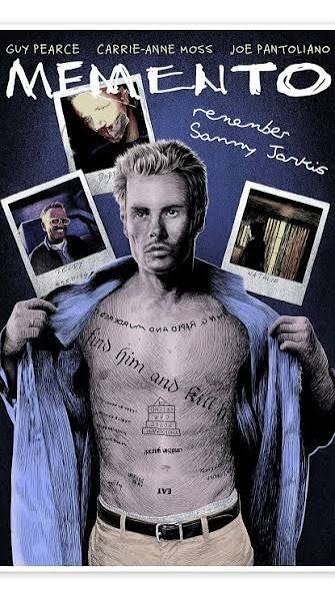
Christopher Nolan’s remarkable film, MEMENTO, is perhaps the ideal example of how structure is a function of character. Why? If story structure is linked parts in causal progression, MEMENTO is backwards. But, if story structure is three proportioned parts linked by causal meaning to a growing hero/viewer, then MEMENTO is the example that “proves the rule.”
This is because the conventional plot-based view of structure fails to account for MEMENTO. As I said, it’s backwards. And a plot that is structured backwards is not merely a film backwardly structured. One can’t just pick up the film, turn it around, and plop it down, back-to-front and front-to-back. This is because a story is a construct one enters with little or no understanding, gaining it as one goes along. If it were akin to a building one entered from the rear rather than from the front, one would enter the rooms from the wrong way, not knowing where for certain one was, seeing people in relationships and activities one might not understand. Meaning would, if ever, be achieved at a greater cost in time, and then, probably only a part of what is required. Then there’s the issue of time. It, too, would have to run backwards. In MEMENTO, except at the outset, it doesn’t. But a growth in illumination occurs as the film progresses. It’s just that while the growth is about the protagonist, it isn’t only within the protagonist. Additionally it is in the mind of the audience.
The film tells the story of Leonard Shelby, a former insurance investigator whom we are told was injured when an intruder broke into his home and murdered his wife. Shelby suffered a brain injury, specifically to his hippocampus, and this has resulted in Shelby’s inability to make new memories. Known as Korsokoff’s Syndrome, the condition leaves him with no short-term memory retention beyond the first few minutes. As a result, Leonard has been plunged into a world in which he is constantly at sea, unable to know for certain where he is, or what he is doing. His last memories, in fact, are of the events of his injury, and the rape and murder of his wife. Because of his plight and his final memories, he is determined to have vengeance, both for his wife, and the bleak and empty life with which he is left. He has single-mindedly set about that process, finding all sorts of ways to create alternative sources of memory. He uses a Polaroid camera to photograph key details leading him on his path. He writes notes to himself, incessantly. And, most bizarrely, he has had established facts tattooed on his body so that he can’t lose them.
Writer/director Nolan then sets out to tell Leonard’s story in such a way as to put the audience into Leonard’s own predicament. He re-orders his script and film so that the major sequences each run forward in time, but are assembled in chronologically-reversed order. The film opens with the final moments of the final scene—Leonard’s killing of Teddy (this part even plays onscreen backwards, signaling what lies ahead). Each reverse-ordered sequence begins with the very moment at which the next reverse-ordered sequence ends. This effectively keeps the audience from total confusion. And yet it also keeps the viewer off-center, uncertain what could be coming next, despite the fact that they are the very moments which got them there. It’s like a cinematic version of the game show, “Jeopardy,” where one hears the answer, and then must divine the question that yielded it.
Amazingly enough, on a meaning level, the story assembles itself correctly in its audience members’ heads, even as it goes along, yet unfinished. Nolan gives the audience needed mental breaks between each reverse-ordered sequence. He does this with recurring black-and-white scenes, shot mostly in Leonard’s motel bedroom as he talks to someone—eventually we learn the caller is a cop, the character of Teddy, in fact—on the phone. In this manner, Nolan gets out important back-story, even as the audience, reeling, rights itself and readies for the next reverse-ordered sequence in this bizarre narrative barrage.
If one applies the Fieldian and our own notion of structure to MEMENTO, reverse-ordered and all, the structure that emerges is nonetheless front-ordered, and a function of the hero, Leonard Shelby. This is because, when all is said and done, structure is not in the film so much as it is in the mind of the audience, assembling, as the mind does, disparate facts, and attempting to make sense of them, no matter what order it receives them (X-1).
The thing to remember, in this case, is, it may be a movie on the screen, but it’s a story in your head! To illustrate this, imagine looking at a movie unspooled across a long corridor floor. You can’t see the “story” even by looking at all of the shots of the film unrolled before you on that floor. There is no meaning, only individual photographs, one after another, rarely changing, one-to-another, that run at 24 per second. There is no sound, just light patterns that only convert to sound after passing in front of an “exciter lamp” on the sound head of a projector. So, there is no meaning until an audience processes the association of those elements in the context of their ordered projection. It only becomes a story when the mind relates the scene or idea presently before it to ideas or scenes from the past, or, anticipated scenes or ideas from the future. The awareness and understanding happens entirely in the mind. So, there is no meaningful story structure in any film. Story structure, in fact, is only a construct of the mind, the mind of the audience (X-2).
For the audience, the story structure of MEMENTO assembles as follows: Leonard executes Teddy in the abandoned building. We want to know why. As the first quarter of the film progresses, we learn Leonard’s amazing plight, how he deals with it through notes, photos, and tattoos. We learn that he can trust no one, not even his motel desk-clerk. Everyone takes advantage of Leonard’s disability. We learn that Leonard has managed to connect Teddy to the mysterious “John G.,” the person his notes tell him killed his wife.
So, how is the connection made? Precisely at the Fieldian 25% mark, just under half an hour into this nearly two hour movie, Leonard receives a copy of Teddy’s driver’s license, identifying him as John Gammell—“John G.”—complete with photo, from the bartender, Natalie. This is the part two/part three transition, and we assemble it in our mind that way because we know that we are seeing the story from end to beginning. We trust the story to tell us its secrets in its own manner, and accept the reverse-ordered dénouement because we can order it correctly in our heads even as we assemble it in the reverse, as it is given to us.
The film continues to unfold, and we re-gress (chronologically (in scene order) backward; meaningfully forward) from part three into part two, getting to better-know Natalie, the woman Leonard tries to help, but whom we discover is using him just like everybody else. We learn the details of the case which serves as a model for Leonard’s memory-loss problem, the Sammy Jankis sub-plot. And we encounter the man Leonard must confront for Natalie, possibly a dangerous drug dealer named, Dodd. Eventually, this is confirmed, and Leonard’s rough treatment of him is justified, as we watch Dodd try to kill Leonard on their initial meeting.
Regressing deeper into part two, after we watch him destroy the few possessions left to him of his wife’s, we watch Leonard cope with his condition by trying to fool himself into believing his wife is still alive. With the help of a prostitute, he creates a warm bed and the fleeting scent and presence of a just-departed woman to which he can awaken. Later, we watch as Natalie’s true colors emerge, and she is seen to be manipulating him for her own purposes.
We learn that Sammy Jankis’s wife, not believing that his condition was genuine, had gone to Leonard when he was the insurance investigator on Sammy’s case, and begged him to tell her what he really believed: was Sammy faking it, or is it a real condition? Leonard confides that he, in fact, doesn’t believe it. Sammy’s wife, a diabetic who receives daily injections of insulin from Sammy, then sets out to test her husband to expose his charade of memory loss. She has him repeatedly inject her every fifteen minutes, expecting that if he has lied, he will come clean, and if he has not, she will let him kill her because she can’t face life with him in such a state. Her test succeeds, Sammy isn’t lying, and she goes into an irreversible diabetic coma convinced that their life together is, indeed, over. This gives us a clear sense of the hopelessness of Leonard’s condition. It effectively exonerates Leonard from the evil act we’ve seen him commit. Or, so it seems.
Then, just past the 75% mark, ninety minutes into the film, from within part two, we reach the part one/part two transition. Teddy—here revealed as the cop Leonard talks to on the phone in the black and white scenes between time changes—gives Leonard the initial information on John G. This will send him on his quest toward eventually deciding Teddy, himself, is his wife’s killer. Acting on Teddy’s information, Leonard lures Natalie’s boyfriend, Jimmy Grantz, the drug dealer working with Dodd, to an abandoned building. Believing him to be John G., Leonard kills him, strips him, puts on Jimmy’s clothes, and takes his wallet and car keys. Then his memory fades. Running outside, Leonard encounters Teddy—a stranger, once again—and now, having forgotten what he’s just done, and believing he’s found someone who may be hurt, he asks for help.
Inside, Teddy identifies himself as a cop. Suspicious of Teddy, because of his memory problem, Leonard knocks him over the head, takes his keys and gun. Stunned, Teddy gives himself away by calling the so-far unidentified (to Teddy) Leonard, “Lenny.” So, Teddy’s forced to come clean to Leonard: he’s a cop who set Leonard up to kill Jimmy, a drug dealer working with Dodd. Jimmy was someone he wanted to rip off and then kill. Teddy tells Leonard that the Sammy story is a lie Leonard’s told himself and others to cover up the truth: that his wife survived the attack, was, herself, a diabetic, and that Leonard, suffering just like his “Sammy,” actually (and unwittingly) killed his wife with an insulin overdose. She had descended into depression and couldn’t face the memories of the attack and rape, nor the prospect of life with her “new” memory-less Leonard.
Teddy explains that he helped Leonard kill his man—“the REAL John G.”—a year ago, but that Leonard forgot, and continues to look for him incessantly. The guy he killed a year ago was only a rapist, not his wife’s killer. Leonard was. Leonard has a memory flashback of himself injecting his wife, and realizes Teddy is telling the truth. Finally, Teddy tells Leonard that his own real name is John Gammell—my mother calls me Teddy”—and that there are lots of John G.’s in the world “for us to find.”
Leonard can’t deal with this. He does the only thing he can: he throws Teddy’s car keys into the brush and runs. But as he flees, with Teddy behind him, scrambling about, trying to find his keys, Leonard realizes the way to free himself. It won’t give him his memory back, but it will free him from Teddy’s manipulations forever. Tearing up a note he’s just written to himself that he’s “done it,” he’s avenged the death of his wife, he writes a new one, deliberately identifying Teddy’s license plate as his wife’s killer’s. Teddy’s fate is sealed. And Leonard will finally get some measure of revenge, even if it can’t be against his wife’s killer.
So the arc of transformation hinges on Leonard’s quest to find the murderer of his wife. In MEMENTO-time, he links the photo of Teddy to the name John Edward Gammell, or his quarry, “John G.” Further on in MEMENTO-time (but earlier in real time), he learns from Teddy that the killer is a “John G.” But we are filtering all this through our increasing body of memories informed by our knowledge that Leonard kills Teddy. We are seeing Leonard being set up, time after time, and suspect “Teddy,” already a manipulator, to be a liar. So, we watch, gripped, waiting to learn the truth. And, when Teddy comes clean late in the film, and Leonard is told he killed his own wife, we are tempted to disbelieve. The conspiracy theorists among us probably still do.
But, if we do, if we disbelieve Teddy at this crucial point in the film, we have nothing left to us toward understanding MEMENTO’s story. It becomes a meaningless exercise in which Leonard merely goes through his motions, forever unaware. And since he is unaware, is he a murderer, or merely a force of unbridled nature, run amok? But Leonard doesn’t disbelieve. He realizes Teddy is telling the truth because of his flashback. And in that single realization, Leonard creates for us the needed final “act” crescendo: he sees a way to achieve some level of success, not revenge for his wife, but freedom from Teddy and his manipulations.
For Leonard, the film of MEMENTO, re-edited into chronological order (X-3), is a kind of third act in a larger story, the first two acts of which extend backward into the period before the start of the film. These, perhaps, consist of an act one, which includes the rape (actually Leonard’s sub-consciously self-protective fantasy to justify his searching-out a “rapist-killer”) and death of his wife, with Leonard’s actual killing of her concealed in his memory loss. And an act two, introducing Teddy helping Leonard find and kill the real John G., followed by Leonard being unable to remember it, and Teddy taking advantage of this to have Leonard do his own dirty work. All of this comes to Leonard (and us, if we’re processing it all) in a rush in the final minutes of the film.
As such, the information at the end of MEMENTO in which Leonard remembers his own killing of his wife, and his determination to end Teddy’s manipulations, is a third act crescendo both for our larger Leonard movie and for our own understanding of MEMENTO’s story as we assemble it in our heads. This, then, is how the film’s “act one” (edited to be at the end) is our story’s “act three.” And that, in turn, is how MEMENTO structures around its transforming hero.
In this way, the three parts about-a-transformation, have fallen into place, and the structure—a hero-in-transformation structure—emerges. The transformation only happens given all of the information we’ve gained over the entire film, information we’ve re-assembled into coherent meaning despite the assembly of the film. And this demonstrates that the actual meaning of the story isn’t in the physical film, it’s in the audience’s mind. Effectively, then, the only valid or useful structure MEMENTO has is Fieldian and Transformational. The Campbell-Vogler model, however, seen in reverse, is present. Interestingly, the archetypes all alter as the film progresses, but the patterns are present. Teddy is, in MEMENTO-time, initially the Mentor, later the Trickster. So, too, are the others. The elixer is the connective information of John G. eventually linking back to Teddy. A conventional, plot-based view of structure, also works. But, like Campbell-Vogler, it only works backwards.
The really delicious irony of MEMENTO is that we believe Teddy’s ultimate story at the film’s end because we see the flashback of Leonard and his wife with the insulin. It must be true because Leonard remembers it after Teddy reminds him. But Leonard also remembers the entire Sammy Jankis story in flashback earlier in the film. Both flashbacks were equally real, but at least one is false. Which one? It is left to us to decide, and, for my money, I’ll take the far more plausible latter one. Besides, only then does MEMENTO make sense structurally. #
Stay tuned for Part XI.
Please Re-stack if you found this article of interest.
——-
X-1 – This is how ANNIE HALL’s post-production assembly during editing (with time jumps, and causal time-ordering almost entirely ignored), nonetheless remains comprehensible.
There was a time, sometime before the 1960s, when film-goers used to go to “the movies” not always at an appointed time according to the showtime advertised, but, rather whenever they got there. And then, they would stay over to see the part they missed. This was common! And, yet, they had no trouble understanding the stories they saw. This is because their minds could re-structure the pieces into a coherent tale. That’s precisely what Christopher Nolan depended upon when conceiving of his film, MEMENTO. And that’s how the deeper, logical level, the meaning level, is, while placed there by the physical film through the plot, only really in the audience’s mind.
X-2 – In the case of PULP FICTION, both the past and the future aren’t even the real ones! Instead they are versions constructed by the mind in order to render meaning to the story’s non-causal events!
X-3 -- The Limited Edition DVD of MEMENTO has an “Easter Egg” on it with the entire film re-edited chronologically.
To open the hidden chronological-order Easter egg on the Memento Limited Edition DVD, you must navigate the special features menu and answer a series of questions or select specific hidden icons. [facebook.com/LastExitTo…, screenrant.com/hidden-d…]
Accessing the Easter Egg
Insert Disc 2: Place the second disc of the Limited Edition DVD into your player. [imdb.com/title/tt020914…, facebook.com/LastExitTo…]
Go to Special Features: Open the main menu and navigate to the special features or secrets section. [reddit.com/r/Christophe…, imdb.com/title/tt020914…]
Find the Hidden Icon: Look for a specific hidden icon, such as a clock or skull, or follow specific remote prompts. For detailed menu navigation steps, check out the guide on google.com/url?source=w…. [dvdtalk.com/features/na…, facebook.com/LastExitTo…]
Solve the Puzzle: Answer the required questions or input the correct sequence on the remote to unlock the linear cut. [imdb.com/title/tt020914…, screenrant.com/hidden-d…]
Note on Playback: Once unlocked, standard controls like fast-forward, rewind, and chapter skipping are disabled while watching the chronological version. [imdb.com/title/tt020914…, screenrant.com/hidden-d…]
(Stay tuned for Part 11)