

(For reference, see Parts 1 - 11)
We’ve seen how film stories can exhibit a wide variance in structures, at least on their surface. And we’ve seen how, when it comes to meaning, their deeper structure is always only in three parts. But the best films often have something more.
Additional Levels in the Multi-Level Model
“You can never solve a problem on the level on which it was created.”
---Albert Einstein
There is no denying the wide variance in structural assembly of story plots. And there is no denying the three-part arc of transformation of the protagonist. So this means they are both present and must be considered as present upon separate story levels. Once this is appreciated, it allows the entire spectrum of narrative story to fit a multi-level structural model. It also avoids making that structural model unwieldy. It is still controllable, still able to give up its insights into story development. So, let’s examine it up close:
This multi-level, multi-dimensional approach to structure allows for at least two, and sometimes many, levels from which structure springs. It assumes there is the dimensional level of time within which the other levels operate. First, as I’ve shown, there’s the surface level, where the plot is found, and then a deeper level, where what the plot means is found. I’ve referred to these as the Physical Level (exterior-or-surface-or-plot level) and the Logical Level (interior-or-meaning level). On occasion, though, there can be several additional, deeper levels below the Logical Level and subordinate to it, provided their content has an impact on the meaning-level. These deepest-level content planes are concerned with protagonist-transforming thematic, metaphoric, sub-textual, and intrinsically cinematic content.
I note that they must be more than being merely transitory or limited in their impact. They must have system-wide effect, as signified by their effect on the transformation of the protagonist (or the transformation of the audience’s understanding of the need for transformation even at the film-story’s un-changing protagonist’s expense). We can call the deepest levels as a group, the Sub-Logical-Levels, because, as they concern transformational content, they have meaning-attributes similar to those above on the primary meaning-level (the Logical Level), and operate still higher, on the Physical Level. Thus…
An aspect of these “Sub-Logical” levels that must be noted is that while they affect, enhance, and amplify the Logical Level’s raison d’etre, its meaning, of necessity, they operate on the Physical Level. And that’s their value. This is because they act as a kind of “unifying-glue,” connecting and (as said) amplifying the meaning through the events, action, and manner explication of the plot, thus unifying and intensifying the overall work. The result is that the work becomes maximally effective. For example…
Films where Sub-Logical Level, Metaphor (defined below) is employed include:
CITIZEN KANE - wherein the metaphor of Rosebud, emerging out of the plot, over-arches Kane’s entire character transformation;
CASABLANCA – wherein the song, As Time Goes By, as a thematic intensifier emerging out of the plot, serves to counterpoint Rick’s transformation;
CHINATOWN - wherein the thematic echo learned in CHINATOWN – “do as little as possible,” emergingout of the plot – over-arches Gittes’s transformation;
…and, proving that they don’t have to start with “C”…
FORREST GUMP - wherein the thematic identifier “Life is like a box of chocolates, you never know what you’re gonna get,” emerging out of the plot, over-arches the transformation of the audience’s understanding of Forrest’s indomitable spirit, enduring all that is thrown at him without changing one iota. So while Forrest never transforms, we, in our understanding, do.
BLOW-UP - wherein the use of photography as a signifier of truth, and thus, a metaphor for truth, itself, emerging out of the plot, can, nonetheless, conceal hidden “realities”;
RASHOMON – wherein the use of individual characters’ subjective “truths,” emerging out of the plot, are used in thematic concert to dispute an otherwise unassailable objective reality;
There are a host of additional, deeper, sub-logical levels of structure, though I believe that they must, of necessity, be subordinate to the Logical or Meaning Level and, yet, emerge or operate from the cinematics on the Physical or Plot level.
Why subordinate to the Logical Level?
They are subordinate because they must support the system-wide meaning established on the Logical Level, and not provide unrelated or momentary meaning that is not part of the overall, unified whole.
Probably the first of these Sub-Logical Levels would be the Thematic-Level, from which the over-arching theme (dilemma, plight, or problem) confronts the protagonist throughout and across the Physical or Plot Level. An example would be the problem (the system-spanning, over-arching theme) of loneliness confronting Travis Bickle in TAXI DRIVER. Another would be the inability to express love (as the system-wide, over-arching theme) in AMERICAN GIGOLO.
So, as we’ve illustrated through those earlier examples, the Sub-Logical level I call the Metaphoric-Level, is a kind of “focused-down” version of the Thematic Level, supporting (and/or affecting) it in specific instances. This level functions as subordinate to the Logical Level, but also, in that meaning sense, ABOVE the Logical Level in that it is able to directly “condition” (modify, illustrate, comment on) in a kind of discreet, quantized manner, on the Thematic Level meaning of the Logical Level, thus directly implying that the meaning applies to the larger universe of which the story is a part. In the case of TAXI DRIVER, with its Thematic Level of loneliness, the metaphor illustrating, or embodying this is the taxi cab. In AMERICAN GIGOLO, with its theme of an inability to express love, the metaphor embodying it is the ptotagonist’s profession of gigolo.
A particularly elevated and super-charged example of this is the silent film, THE BIG PARADE. Screenwriter and Substack writer, Cole Haddon, discusses this film’s unique “narrative mirroring” plot structure in this superb article. What is interesting, in this film’s case, is that while the metaphoric meaning is, as we’ve stated, happening on the plane of the Physical level by way of its dual use of the convoys, the “big parades,” first, taking the soldiers to the front, and then, later, bringing the survivors and the dead back. Throughout the film the plot structure is organized on either side of the mid-point narratively mirroring similar, yet different scenes from each half, thus expanding on the meaning of the Logical Level. It effectively comments on the theme within the story, and effectively, aided by the film’s title, applies it to the greater Universe, humanity, itself (!!!). THIS from a pre-sound era film! One cannot stress enough how narratively outré and sophisticated this is.
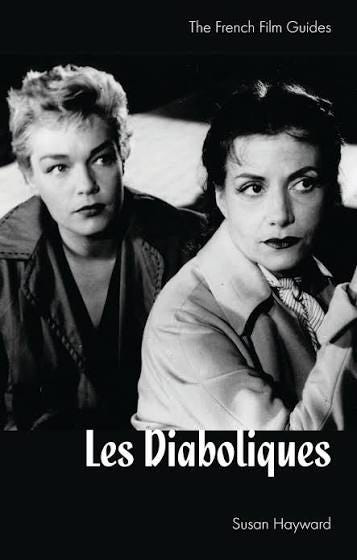
So, considering others, one Sub-Logical candidate that comes to mind is the Image-Level, in which the imagery and/or the image system used in the story and resulting film contribute to a transformational system-wide effect (water-as-evil, for example, in Clouzot’s LES DIABOLIQUES).
Another could be its sound counterpart, the Aural-Level. This might include sound effects (the M*A*S*H film’s use of Radar and the Commanding Officer’s simultaneous line-delivery, from within the action of the plot, as thematically ratifying the increasingly inescapable notion of the insanity of war; or the use of recorded sounds and their evolution from objective to subjective through the film in THE CONVERSATION), sound editing stylistics, and especially pertinent music (PSYCHO’s violin “screams” during the murder, for example, followed by the “breaths-taken” by the oboes, immediately afterward, and the “inquisitive” phrases during the house explorations), all arising out of the action of the plot.
Still another might be the Montage-Level, in which image assembly and editing rhythms, supporting and functioning through the plot, have a contributory effect to the transformation of the protagonist (e.g., any number of films that begin languidly and gradually pick up the editing pace as the tension level and the stakes rise toward the climax).
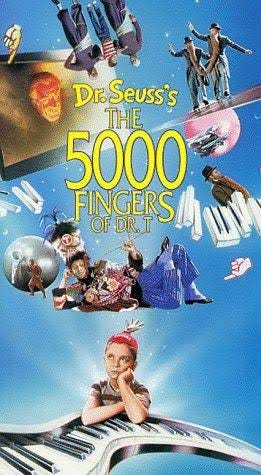
And, yet, another sub-logical level might be a level for Production Design (e.g. the dreamscape of THE 5,000 FINGERS OF DR. T), emerging out of the setting(s) and environment on the Physical or Plot Level.
Finally, one last level suggesting itself is a Symbolic-Level, with symbols present within the imagery, production design, costume-design, and settings emerging on and through the Physical-Level. One example that comes immediately to mind is 2001: A SPACE ODYSSEY, with its vulva-like doorways, its sperm-like, or penile-like spaceship, its vagina-like stargate passage, and its orbiting fetus, the “star-child,” at the end, all symbolizing the transformation of humanity: re-conception and re-birth.
The presence of these levels is evidence of, perhaps, the highest quality of screenwriting, the finest film stories, as the writer is using all (or most) of her/his available tools in a sufficiently elegant way to render the story’s meaning in the fullest, most rewarding, unified, and enlightening manner. So, to summarize our Multi-Level Model of Structure, with a progression of time as a context and continuum within which the following function, we can illustrate it as follows:
The Multi-Level Structural Model
Physical Level – The surface level on which the story’s plot functions; in any number of parts (acts), but generally, 3 to 7, in almost any proportion, but, if not 25/50/25%, then, often, closer to equal (such as 20/20/20/20/20% for a 5-part story).
Logical Level – A deeper level on which the story’s meaning functions, signified by the change (transformation) or non-change of the protagonist; always in three parts, running in the rough proportion of 25/50/25%.
_____
Sub-Logical Levels (functioning on the Physical Level, but affecting the Logical Level) include (but are not limited to):
Thematic Level - The Meaning-affecting, over-arching theme (dilemma, problem) confronting the protagonist, as illustrated by the plot of the story.
Metaphoric Level - Meaning-affecting, discreet thematic cases (over-arching the meaning) functioning as specific metaphor(s) on the Physical Level
Sub-textual Level – Meaning-affecting sub-textual function emerging out of the dialogue, character behavior, action, sequences, and scenes of the Physical Level.
Image Level – Meaning-affecting imagery functioning out of the action of the plot.
Aural Level – Meaning-affecting sound functioning out of the audio of the plot.
Montage Level – Meaning-affecting film editing functioning out of the relationships of the individual cinematics seen thoughout.
Design Level – Meaning-affecting production design functioning out of the environment within which the action of the plot operates.
Symbolic Level – Meaning-affecting symbolic functioning out of individual details seen thoughout.
_____
And now for something further afield. Long ago (1961) two French filmmakers brought out a film that, at the time, was hailed as narratively “revolutionary,” signaling where films were headed in the future. I can’t stress how big a deal this film was among serious film fans for a short time. All the “cineastes” raved about it. In hindsight, I think that, had it not been French (or, at least European), it would never have had the cachet it garnered, i.e., “chic” for chic’s sake, “revolutionary” because it’s fun to “stick it to ‘the” established film industry’s ‘man’”! Or was it a baseless solution to a non-existent problem, and so, the product of a kind of artistic, narrative, and personal boredom? Can it stand up to a sober and deeply rigorous examination?
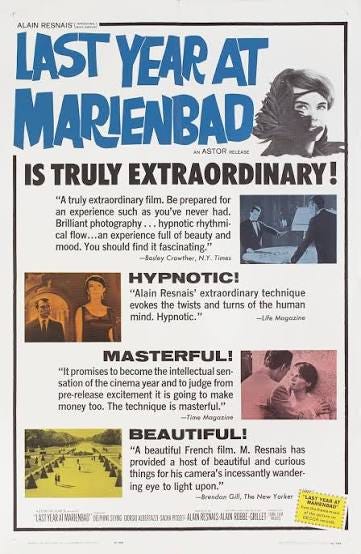
By its example, Alain Resnais’ and Alain Robbe-Grillet’s film (and the screenplay for it), LAST YEAR AT MARIENBAD, demonstrates that our definition of story—i.e., that it must be, among other things, transformative—is valid. This film seems to deliberately set out to refrain from audience engagement and any resonant illumination of meaning with its viewers. It emerged out of the film and literary French Nouvelle Vague/Nouvelle Roman (New Wave/New Novel) movements that, on the film side, saw Francois Truffaut, Jean-Luc Godard, Claude Chabrol, Jacques Rivette, and Eric Rohmer (those five, at least) move from film fandom and written criticism to filmmaking. Resnais was part of the so-called, “left bank” of the French New Wave, alongside Agnès Varda, Chris Marker, and Jacques Demy. Some would say MARIENBAD might be the first example of a so-called narrative form of “pure cinema,” in that it apparently eschews traditional narrative filmic concerns and motivations (and, thus, meaning) in favor of… I can only speculate: feelings? emotion? dreams? random thoughts? And its reception by its world audience mostly—you can’t displease everyone—ratifies this view.
The film, by its reception and experience in release, may well be an exception that validates (proves) the rationale in our series of articles, i.e., that films must resonate with audiences:
According to the Internet Movie Database, in the 65 years, or so, since its release worldwide, it has grossed a total of $223,111! That’s ALL ticket sales, and ALL non-theatrical sales, I believe. That’s every theater in the world, all television sales, all VHS, DVD, and Blu-Ray sales, all streaming, every college and university film program, and every film society full of cineastes, over more than half a century! Even its opening weekend in the US and Canada, despite the critical and festival raves, grossed only $15,485! Granted, tickets cost about $0.50 cents back then—so, maybe 31,000 people across all of North America? Of course, lack of financial success doesn’t invalidate art. But it’s crucial in helping it to achieve a long life reaching audiences. Jean-Luc Godard’s BREATHLESS, widely touted as the quintessential French New Wave film, released a year earlier, only managed to double those numbers. Francois Truffaut’s 1959 New Wave film, THE 400 BLOWS only performed about 50% better. While still nothing to cheer about, both of those come closer than MARIENBAD to conventional narratives. Resnais’ 1959 film, HIROSHIMA MON AMOUR only did a bit more than half as well as MARIENBAD. So, in the most magnanimous view, weighed against what was probably a pretty small budget, I suppose it could be seen as a very, VERY modest success. And, too, it was nominated for an Oscar, a BAFTA, won the French Critic’s award, received several festival nominations, and the Venice Film Festival’s top prize, The Golden Lion, among other accomplishments. But total viewers over 65 years must also serve as a valid indicator of success or failure because films are made to put “butts in seats,” not hang on gallery walls or in Renaissance churches, or get sold to billionaires.
Rather than provide another structural analysis like the others in this series, here is a discussion I’ve published in another version elsewhere (with some new additions) on the film, its creators, and its screenplay:
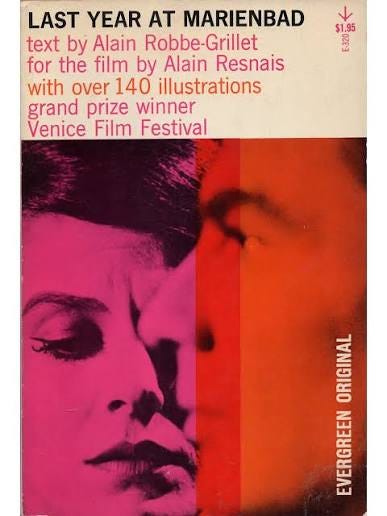
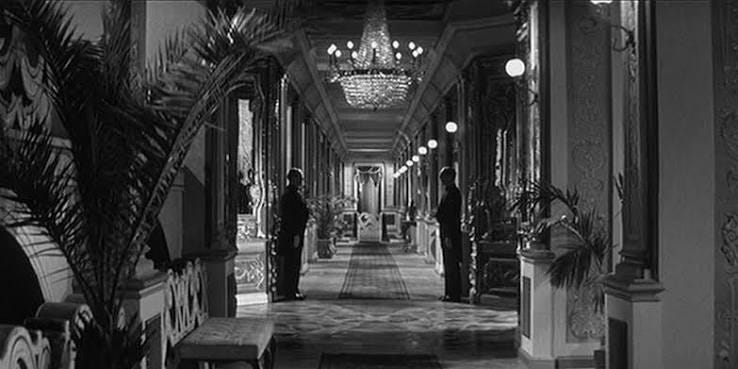
LAST YEAR AT MARIENBAD (French, 1961, black and white) has been hailed as a breakthrough approach to filmic narrative. It presents a dream-like scenario of some people at a huge, classically-accoutered, baroque hotel somewhere in France.

A man, un-named, and identified in the script only as “(X)” tells a woman, also un-named, and identified in the script as “(A)”, that he wants her to leave with him, as he claims they had planned, “last year at Marienbad”.
She, at first, denies she ever met him, and spurns him. But he persists, presenting various recollections, details, and even a photograph, that eventually result in her agreeing to go with him. However, complicating this is another man, also un-named, and identified in the script as “(M)”, who is in a relationship with her now, and may or may not be her husband. That question, in fact, would eventually have to become obvious to us, as viewers, in any conventional similar narrative. So, it’s a deliberate withholding of key information in MARIENBAD.
The tale is not much, just a pursuit of a man for a woman. But, the way this is presented, the formal stylistic approach, is “everything” when it comes to whether the film succeeds or fails in achieving any goal of capturing and holding an audience. (And, as we’ve indicated, that’s a reasonable requirement for a theatrical feature film.) The events and scene juxtapositions are such that chronological ordering is absent, much like some dreams and memory can function. The characters, rigid and always formally-dressed, behave emotionlessly, inscrutably, almost as though they are automatons. The setting is similarly formal: classical and stark, beautiful but cold—dream-like, as though drawn from memory. The resulting film, then, because of the stylistics, has the effect of deliberately keeping us at a distance. The characters (and, so, any presence of their deeper motivations) remain for us as mere objects and, so, purely visual elements, rather than people we begin to know. They’re not people who fascinate us, people who compel us to keep watching, and, thus, people in a narrative yielding significant and resonant meaning. The seemingly randomly-assembled, sometimes elliptical and/or non-causal events have the effect of similarly distancing us from the man’s pursuit of the woman. Nothing draws us in, other than the question of, will she or won’t she? The film amounts to a chess-board, and the people on it: the pieces. And, that, deliberately so.

Having gone on record preferring films with significant and universally resonant ideas, realistic complexity, and transformative meaning that I can relate to in my own life, but also ambiguity, that challenges me, even as the films entertain me, I find MARIENBAD’s deliberate disengagement with its viewers to be… (because it is deliberate), therefore… successful. And that, I believe, is responsible for the film failing to worthily join the first films in that New Wave of cinematic narrative revolution. Despite the critical fervor around it, the film, in fact, never, in its time, quite as dogmatically, spawned others with its dream-like cinematic approach, even by Resnais and “New Novelist,” Robbe-Grillet (though some approached it: Resnais’ own MURIEL and, maybe Truffaut’s JULES AND JIM, Bunuel’s BELLE DE JOUR, and Fellini’s 8 1/2).
The comments by the filmmakers ahead are fascinating in their single-minded focus on transforming and expanding cinema (rather than their characters, and so, their audience) while ignoring the afore-shown basic economics, and the narrative and dramatic requirements of the medium. Picasso and Van Gogh bought (or, in some cases, made) their own paints. They bought their own brushes and canvas. They didn’t rent gallery walls, they sold their paintings, when they could, direct to buyers. (It’s true, Van Gogh may have only sold one of his paintings, The Red Vineyard.) While it’s also true some painters once had financing patrons, it wasn’t for commerce, it was mostly for prestige by wealthy art-lovers, social-climbers, or for the Church. Today’s film financiers, on the other hand, invest in filmmakers’ films to make a profit, or, at worst, break even. And our raising of that observation, that reality, is not being unfair, or “cheap,” when it comes to making a film with “other people’s money”. So, “revolutionizing cinema” is not a film financier’s primary goal. And while painting is an art, first, and, at best, a business, second, the economic reality is, films are—like it or not—the reverse.
In INTERVIEWS WITH FILM DIRECTORS, Edited by Andrew Sarris, The Bobbs-Merrill Co., 1967, pp. 439 - 46, director Alain Resnais, in speaking of his remarkable and supposedly “seminal” film, LAST YEAR AT MARIENBAD, discussed his approach to its conception and style of discourse:
“For me the film is an attempt, still very crude and primitive, to approach the complexity of thought and its mechanism. But I stress the fact that this is only a tiny step forward by comparison with what we should be able to do someday. I find that as soon as we delve into the Unconscious, an emotion may be born... I believe that, in life, we don’t think chronologically, that our decisions never correspond to an ordered logic. All of us have ‘clouds,’ things which determine us but which are not a logical succession of acts arranged in perfect sequence. I am interested in exploring that universe, from the point of view of truth, if not of morality.” (my italics)
The preview trailer for the film presents the film as a possible fantasy of the man, (X’s), subconscious desire to pursue (A), and indicates that it’s for the viewer to decide. In other words, where a traditional film might commit to the action of the story as a hypothetical and fictional reality, MARIENBAD does not, and, instead, urges the viewer to take a position on the question of whether it’s a reality or a fantasy. This is similar to some video games that allow for alternate scenarios or endings based on decisions of the player.
Again: “I am interested in exploring that universe (“thought”), from the point of view of truth, if not of morality.”
This implies that Resnais and Robbe-Grillet have positions on the question of reality (and, so, truth) vs. fantasy (as a product of “thought,” and its effect on morality), but they will not divulge it. And when he uses the term, “exploring,” it suggests he considers that as primary, rather than any conclusion he might have on the question of reality or fantasy. So, the journey’s “the thing”. But, if the exploration is what matters, wouldn’t it need to be supported by our interest? Wouldn’t the “journeying viewer” need to explore out of such a compelling need? So, then, is the journey of the film of any value to us? Are we, beyond resolving (X’s) pursuit of (A), interested in these people, who, what, and why they are about? Or, are these unnamed people just being re-arranged on the deck of their creators’ cinematic '“Titanic”?
Perhaps his use of “morality” refers to the possibility (X) and (A) had an extra-marital affair the previous year at Marienbad. (His use of the term isn’t really clear.) It seems to me the dichotomy drawn is between reality and (X’s)—or our—fantasies. Resnais may be on to something, though. Perhaps the question of morality is referring to the ethics of taking another man’s woman. And, it seems to me that standard Hollywood and traditional movie narratives of the period were all about Resnais’ use of the word, “morality”. Most Hollywood films of the time seemed obsessed with moral (rather than merely ethical) sorts of questions. Everything from SOME LIKE IT HOT, to LOLITA, THE MISFITS, HUD, COOL HAND LUKE, WHO’S AFRAID OF VIRGINIA WOOLF?, and on through to THE GRADUATE and BONNIE AND CLYDE, had, as pivotal elements, ethical questions filtered through moral (i.e., Judeo-Christian) viewpoints, if only to, by casting aside any prior oppressions, counter them. So, Resnais prefers truth to morality. Why? Perhaps because truth appears constant, objective, and immutable, while morality seems relative, subjective, and ephemeral: mine is not yours (though, maybe it once was). Or, is it? The truth is… that truth, too, is relative. Just watch Kurosawa’s RASHOMON. Or Antonioni’s BLOW-UP.
Resnais is interested in telling his truths at the speed of, and in the manner of, thought. He likens it, not as extruded through the standard Hollywood narrative’s toothpaste tube, in a linear progression, cause-to-effect-resulting-in-new cause, new effect. His “truth” is not an effort to reproduce a reality down to the smallest detail and character motivational wrinkle. Rather, he sees thought as a cloud within which the mind apparently wanders, making sense of it (or not) as it will. Dreams always seem more reasonable to us while dreaming them than they do when we are awake and recalling them. So Resnais wants to explore film narrative as dreams. Why? To get at “truths” we otherwise might never realize? Or, to escape truths we otherwise might have to confront? Dreams are safe because they’re not real, and they imply whatever the dreamer (or the audience) chooses to infer. So, depicting real life as a dream makes it a safe exploration. And worthwhile, too, apparently. After all, as we’ve said, there are no real consequences. And, yet, as we’ve shown, without any substantive meaning, it may just end up dabbling in whimsy.
In the Introduction to the published text of the script for the film, Robbe-Grillet writes:
“Everyone knows the linear plots of the old-fashioned (read that, Hollywood) cinema: which never spare us a link in the chain of all-too-expected events: the telephone rings, a man picks up the receiver, then we see the man on the other end of the line, the first man says he’s coming, hangs up, walks out the door, down the stairs, gets into his car, drives through the street, parks his car in front of a building, goes in, climbs the stairs, rings the bell, someone opens the door, etc. In reality, our mind goes faster—or sometimes slower. Its style is more varied, richer and less reassuring: it skips certain passages, it preserves an exact record of some unimportant details, it repeats and doubles back on itself. And this mental time, with its peculiarities, its gaps, its obsessions, its obscure areas, is the one that interests us since it is the tempo of our emotions, of our life.” (my italics)
These insights are all very interesting, very intriguing, and certainly worthy of exploration. The ponderous elements in movies he mentioned, of “going through doors,” “exiting buildings,” “driving a car,” “entering another building,” etc. are rarely seen today in films without some important plot reason behind their inclusion. And this is mostly thanks to the French New Wave and its use of what became known as “Jump Cuts”: the narrative “jumps ahead,” past what’s considered irrelevant detail. It’s one of a handful of techniques introduced by the New Wave movement for which we can genuinely thank them. For me, however, MARIENBAD, with its antiseptic people in their antiseptic relationships in a massive, antiseptic (and somewhat empty) hotel, becomes “a bridge” not only “too far,” but “a bridge” to the wrong destination. If, for no other reason than to hold its audience, it should have captured us through its characters so that we desire and care to learn the meaning of their fates.
Later, Robbe-Grillet continues on his rationale for abandoning traditional narrative forms:
“A brief synopsis is enough to show the impossibility of using it as the basis for a film in traditional form, I mean a linear narrative with ‘logical’ developments. The whole film, as a matter of fact, is the story of a persuasion: it deals with a reality which the hero creates out of his own vision, out of his own words. And if his persistence, his secret convictions, finally prevail, they do so among a perfect labyrinth of false trails, variants, failures and repetitions!”
And, so, there it is, “the man behind the curtain”:
“…it deals with a reality which the hero creates out of his own vision, out of his own words.”
So, he just exposed their hand: The film’s narrative is a “creation” by (X)! So, then, it’s (X’s) fantasy which he is trying to bring to life (to a dream’s “reality”, to become the “truth” within the dream) by “conning” (A)! He never met (A) “last year at Marienbad”. And yet, Robbe-Grillet refers to this fantasy of (X) as “a reality”. He, explicitly states and certainly means “(X’s) reality,” his false “reality”. So, then, the “morality” question is about (X) lying to (A). And the film is a dream about the “con” of (A), based on that lie, in the “interest of a dreamer’s ‘truth,’” (X’s) hoped-for successful “conquest” of (A), rather than any “morality” (such as behaving himself).
A “brief synopsis” does show the inadequacy of using his scenario as the basis for a feature-length film exhibited for mainstream audiences. Why? First, because it’s an experimental film trading within the arena of traditional cinema, before traditional audiences, no matter the preview trailer’s wholly inadequate warnings. Many will have not seen the advertising. Others will miss its signalling. Second, the film’s “persuasion” is, without more, narratively insufficient for a traditional feature film’s scope. Without more story support, such a non-traditional, experimental narrative must inevitably lose its larger, inevitably mainstream audience in short order. If it’s the story of a dream, the film would need some post-dream narrative material to, in effect, modify or “comment” on the dream. But there is none. The film is non-traditional, stays in the dream, is ONLY the dream. And the audience is expected to stay aboard, stay engaged. Some may, some do. But… for the rest of us, thanks to his anti-narrative stylistic approach, with its missing and, so, inadequate narrative tissue, and, as we’ll show, its failure to be transformative, in my view, it subverts his “dream”-film’s success.
So, to describe the film, briefly, the structure is:
1.) A year ago, at a luxury hotel, a man (X) claims he met a woman (A); they meet again, now, at a different hotel, and, according to him, a year earlier, they made a date to meet here and then go away together; but… there’s another man (M), perhaps her husband, perhaps just a lover; (X) begins to attempt to persuade (A) that she agreed to go with him;
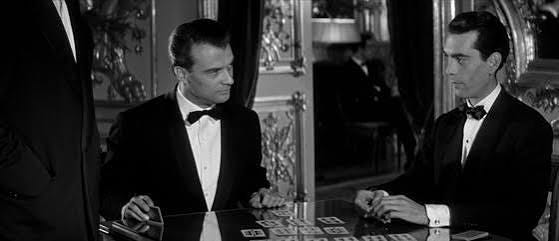
2.) She, at first, denies even meeting (X); he pursues her, reminds her of various details of their earlier meeting: what she said, the setting, the people around them, he shows her a photograph of them together; she says she can’t remember; she resists his advances; it continues; more details of a year earlier; more resistance; the sequences of scenes are NOT in chronological order, but seemingly randomly-assembled; eventually, as they all move around in the hotel with little to do, (X) competes in a leisurely game with (M) and loses; (A) seems to want to be with (M), but he has become ambivalent, aware, now, of (X), and perhaps thinking he has, because of (X), lost her; so we are in stalemate; then, finally, (A) agrees to go with (X), but… not for another year (back to Marienbad, perhaps?)
3.) So, for now, (A) holds out for (M), and, the pursuit intensifies; then, when (M) doesn’t appear at the appointed time (A) had arranged with him, she changes her mind and accepts (X); so she leaves with him; (M) arrives moments after they are gone; Fin.
And, so, rather than being a “revolutionary” New Wave narrative, MARIENBAD is, instead, a classically-designed, three-act, physical-level structure (per our multi-level model, see Part 5), spiced with an occasional non-causal assembly, and hurt by almost robotic, questionably-motivated, characters (without even names!). And the deeper structure? Non-existent. With the characters at an unreachable distance, and the causality arbitrarily shuffled, and so, inscrutable, any meaning-level structure is absent. The juxtaposition, while dream-like, renders any causality there might have been less effectively. The story is a mystery, but only… for the mystery’s sake. All transformation, then, is on the surface, on the plot level: the third act becomes as traditional as they come: Boy gets girl. But, why? What made her agree to go with him? Do we know what it means to any of them? Does it mean anything to us? Were we able to intellectually, and, most importantly, emotionally invest in the characters?
As for the time juxtapositions: they don’t amount to anything more than keeping the audience off-balance, not knowing what to expect and countering any predictability. Yes, they “evidence” a dream. But such a device implies a need for pay-off, some kind of catharsis, ahead. The action of the story is: connection, pursuit, resistance, and, ultimately, capitulation causing irony. Had there been no time juxtapositions, the events would be utterly conventional and, thus, mundane: a “persuasion” that drags on, until… it succeeds. With the time juxtapositions, the events become deliberately confusing, thereby amplifying audience interest in resolving them, but for no narrative, character, or dramatic purpose (other than being “dream-like” for the dream’s sake), ending in the same ironic and mundane result. With the audience off-balance, there’s an artificially-generated (and, so, manipulatively dishonest), urgency in resolving things. All that, apparently, done in the name of revolutionary cinema. Can anyone explain any character, dramatic, or narrative reasons for the precise placement of each time-juxtaposed scene at the point they are placed in the film, rather than arbitrarily plucked out of that dream-like thought cloud? Are our dreams arbitrary? Or, are they guided by our “unconscious”? And, so, can a filmmaker become his own film’s—and so, the audience’s—“unconscious?” (Comments invited)
From the Sarris interview, Resnais continues:
“For MARIENBAD, we (Alain Resnais and Alain Robbe-Grillet) made a complete chronology on graph paper. And we always said before beginning any scene with the actors: ‘This scene follows, on the level of the montage, such and such a scene, but in terms of its degree of reality, it follows another scene which will appear much later in the film.’” (so, why placed there, and not two scenes later? Or, one scene earlier? Because it’s the closest one to (X) at that moment in his dream-cloud?)
He goes on:
“Moreover, very often, I would film a bit from the preceding scene, in order to work from the continuity and not from the cue (the start of the scene) itself. Of course, this chronology was established once the scenario (the script) was finished. For example, all costume changes naturally correspond to different pieces of time. This is certainly not the key to the film, if indeed there is one.” (brackets and italics, mine)
Ahh, you don’t have one, do you? So, you are acting as (X’s), and so, the film’s (and our own) “unconscious”, while all along (X) is, as Robbe-Grillet revealed in that slip earlier, really trying to make his fantasy a reality, a “truth,” and not for any “moral” reason (such as protecting her). And… “the key” to the film is something you never planned to reveal.
“But, it is true that we could re-edit the film so as to restore the chronological order of the scenes. We might imagine, for example, that the film extends over a week, or at least that everything which is in the present takes from Sunday to Sunday inclusive. Which doesn’t keep Robbe-Grillet from saying: ‘Perhaps it happens in five minutes.’ This is consistent with the dilation of time in dreams, insofar as we understand the mechanism of dreams.” (my italics)
Again: “But, it is true that we could re-edit the film so as to restore the chronological order of the scenes.” This is not unlike what was added (as an “Easter-Egg”) to one of the DVDs of Christopher Nolan’s MEMENTO, where, the backwardly-ordered film sequences were re-edited into chronologically-forward order, resulting in a mundane narrative, and rendering the original story’s truths as uninteresting due to their boring commonality, their clichéd lack of distinction in the crime genre, and their near-predictability. For MEMENTO, the released film’s as-released narrative order, allowed me to relate to Leonard’s (the protagonist’s) plight, to, in effect, walk in his shoes, and understand, perhaps even condone, his actions. In that form, it was a subjective narrative. The chronologically-ordered, and, so, objective version, only kept me distanced from Leonard’s experience and made me a mere spectator of what was also just a “sordid” and “mundane” crime. And with MARIENBAD, the juxtaposed chronology becomes merely an artificial (and, so, dishonest, ignoble, and manipulative) device (because it’s just that: a device) to hold me longer while I try to make sense of things. “But,” the cineastes cry, “It’s French!”
Well, there is this: Would there have been a David Lynch body of films, or a MEMENTO, without a LAST YEAR AT MARIENBAD?
“New Novelist” and co-screenwriter, Alain Robbe-Grillet adds:
“Very curiously, the people who reproach MARIENBAD for being ‘contrived’ are those who accept as spontaneous works which respect fixed rules of contrivance, recipes, norms. And these people reason as if there were a previously existent reality and as if it were no more than a question of finding the forms which would make a good understanding of the story available to the public.”
You know, I find such arguments (using comparisons such as, “‘the people’ who [do thus and so] are the [same] people who [do this other similar, and so, logically-equivalent ‘thus and so’ that is just as bad or worse; therefore, they’re hypocrites]”)… those arguments?… Well, I find such arguments to be lazy and, when held to the light, impotent. The tactic, itself, is specious, mere rhetoric! How do we know they are the same people? Such debaters should be asked: “Where’s your data?” “Are they really the ‘same people’ as the others you claim?” “Name some names!” “Is there really a correlation there, at all?” And, so, have you an argument, “at all”? But, of course, you may not, it’s just clever but baseless rhetoric to shore up a faltering defense.
And this is reminiscent of our point, above, on dis-honest audience manipulation. “Contrivance” doesn’t just exist because someone, filmmaker or critic, calls it out. All of cinema is contrived (just as all communication, including cinema, is manipulative, a “persuasion”). So, as with (X) for (A), the filmmakers are persuading us to go with them, and they offer their game of time juxtapositions in order to capture us, to win us over through confusing us. The question becomes, why? Is there a nobility? Is there a noble honesty to the contrivance? Is there, as I said, a “pay-off”? Or, is it subversive for artificial, manipulative, extraneous, and therefore, dishonest, and ignoble purpose (i.e., “revolutionary” for the revolution’s sake)? The test of contrivance in the cinema, as with manipulation, is whether it achieves an honest, organic-to-the-piece, noble, and valuable result (i.e., that “pay-off”). And all that, efficiently. Contrivance alone, as with manipulation, on its face, is not ill-intended, not a hanging offense. Contrivance as an external, synthetic and cinematic (editing room) construction is, in this case, not the same as an internal, writer-conceived, structural assembly of story events for an organic, story-telling purpose. The former, as opposed to the latter, by amplifying and extending the story’s “persuasion” through an artificially-juxtaposed narrative, with no internal story reasons beyond the dream state (for the dream’s sake), is dishonest.
At another point in the interview, Resnais adds:
“One must know to what extent one can share one’s subjective reality with ‘everyone,’ in the sense that we all have two eyes, hair, a thought, etc. One arrives quite naturally at the notion of a planetary Unconscious.” (my italics)
So, in the film’s narrative, we (audience, filmmakers, and, crucially, MARIENBAD’s characters) resonate together on the inside merely because we look alike on the outside?
And:
“When I see a film, I am more interested in the play of feelings than in the characters. I think we could arrive at a cinema without psychologically definite characters, in which the feelings would have free play in the way that, in a contemporary canvas, the play of forms becomes stronger than the anecdote.” (my bolding and italics)
So, here we get to “the crux of the matter”:
His “play of forms” (the “feelings”? Or the objects—those “forms”—within those images) becomes stronger than “the anecdote,” (their attempt at a story). The comparison to his cited related art-form, the hypothetical painting on the “canvas,” is telling. There is no real comparative equivalence. A painting’s “canvas” is not an “anecdote” (a reality, a “truth”) in the same nearly tactile way that a “film” inescapably is, due to its photographic quality of realism, and its story-like effect. A painting’s “canvas” with the paint humanly, and so, personally, subjectively-applied, is, therefore, an interpretation. That canvas, depicts a moment, an observation (by the painter, offering, at most, a limited “meaning”-full comment). A film, however, goes further. It is (as mechanically-rendered, and so objectively-realized) depicting an, admittedly consciously-chosen, series of events leading to that chooser’s result. A film’s “play of forms” isn’t “momentary”. The film’s “play” has (or ought to have) an apparent, significant, and conclusive, meaning, not just that ambiguously “chosen result,” yielding, as it does, merely a product that is “chic for chic’s sake”.
And, whose feelings are we talking about? The characters’? The filmmakers’? The audience’s? Well, according to Robbe-Grillet from earlier, the “feelings” are (X’s), and only (X’s)--not (for moral reasons) (A’s). This is (X) self-servingly “realizing” his desires at (A’s) expense. With MARIENBAD (and its “morality”), remember, we were just entering the “swingin’ ‘60s” (thanks to the arrival of “the pill”). “Do your own thing” was “in the air”. So, I guess, “love the one you’re with,” even if she’s with him. The film’s cinematic revolution, then, is a sexual one (and that, mainly (X’s), because it’s his “creation,” his “reality”).
But, if we can’t relate to the characters (and their desires), because they are cold, distant, and impenetrable (or, because it may be (X’s) fantasy—remember, without our reading that interview, it is not revealed), we can have no empathy (or desire in common with (X)). So, no “planetary Unconscious,” after all—it refuses to, and cannot “resonate” for us. So, then, for us, rather than solely, the filmmakers, the film inevitably falls flat. The filmmakers’ “psychologically indefinite” characters’ “play of feelings” fails to reach us. So, why should we have ever cared?
It’s not the same as watching VERTIGO’s Jimmy Stewart and his secret pursuit of Kim Novak, with its implied eventual discovery. In that film, because of that implication, we are pulled into Stewart’s obsessive desire for her through his vulnerability and the mystery of her ghostly appeal. (Today, we are aware of Hitchcock’s sexual obsession with blonds; it came through strongly in his films, VERTIGO, in particular—see my article) Resnais, on the other hand, gives us no ability in MARIENBAD to feel obsessive attraction to (A), nor to empathize with (X) and his desires, be they fantasy (morally safe) or reality (the film’s “truth”). Resnais, while claiming he’s interested in the “play of feelings,” chooses consciously not to generate that same interest in us. How much do we really care (beyond the tactical, the question of (A’s) fate) about the knights, bishops, and rooks on the chess board? Yes, we want to take the queen, but do we question (or “explore”) why we care? Or why she might? And, in MARIENBAD, there is no checkmating king. (X) could have been the attacking king, and (M) might have been the defending king, but, other than the little game they play, they do not significantly interact. (X) only prevails with (A) against (M) by default. So, likewise, there is no decisive winning (and no gaining of significant meaning). And so, have we become, then, the pawns, sacrificed for the filmmakers’ indulgence, their persuasion-game?
Finally, if one merely holds MARIENBAD up to the light, the narrative logic falls apart. Consider: if it’s not entirely a dream, the absurdity of the premise is inescapable. Show me a normal, functioning woman who wouldn’t recall such an event, “last year at Marienbad”. Women, probably moreso than men, are attuned to relationships, especially those that portend life-altering outcomes. It’s incredible, at least, to me, that the filmmakers expected their audiences to accept it on its face at all. Is there a woman among my readers here, who can honestly say she might not have recalled such an event in her recent past? So, then, in any reality, the plausible explanation is that she remembers, and she’s changed her mind but doesn’t want to humiliate him. And that begs the question why (X) doesn’t just reluctantly accept it. Instead, he behaves as though he only needs to help her remember it! And that calls into question (X’s) common sense, if not his sanity.
And if the film is wholly (X’s) dream, even the dream-logic falls apart. Remember, (X), in this dream (that is the film’s entire narrative), either believes his fantastic assertion (that, thanks to Robbe-Grillet’s reveal in his earlier comment, we’ve learned is actually false), or the intent of (X’s) dream is not a conquest, but, instead, a deception. And yet, somehow, even here, it’s not ridiculously transparent to (A)? So, then, contrary to Robbe-Grillet’s statement of their intent, (X’s) assertion of their prior meeting must, instead, in his dream (because it is (X’s) dream and would follow his dream-logic’s desire), be true. Yet, then, (A) denies it. Why? In the dream (X) wants her! It is (X’s) dream, after all! Such a dream would have her accepting (X’s) assertion on its face. The only reason she denies having agreed to meet him is that the filmmakers, not the dream, require it to maintain the film’s pursuit, the film’s imposed narrative. And, then, because (M) is late, without a second thought, and, yes, returning now to dream-logic, she capitulates. And yet, unlike a man’s dream, in winning (A), (X) doesn’t explicitly triumph over (M)! Which is it, a dream or reality?
The weight of evidence, while weak, points to the narrative as being (X’s) dream. So, if the entire film is that dream, a dream that is, ultimately, as all dreams are, of no real consequence, it’s become a trifle, what, for lighter fare, has been called “a shaggy dog story”. Anything else could only be described as filmmaker hubris, an arrogance where men, as the filmmakers’ assumed-dominant sex, would naturally attempt such things, and women, all women, would naturally fall for them, despite their natural intelligence and inherent common sense.
I’ve tried to “go the extra mile, here, and give the film (and its creators) space to win me over (rather than win over me — by taking my ticket’s payment, and my willingness to emotionally invest). I’ve dug up director and writer interviews from sources stretching almost all the way back to the film’s release. I’ve assessed its experience in the marketplace. I’ve read the original screenplay and the accompanying notes and comments. I’ve read viewer reviews, and I’ve compared it to other works by the filmmakers’ peers and New Wave colleagues. But the performance data, viewer reviews, my structural breakdown, those extensive comments by the filmmakers, and our questioning of them, have not convinced me that the cineastes, the critics, the IMDb viewer reviews, and the Venice Film Festival were correct in their enthusiasm. So…
I found LAST YEAR AT MARIENBAD to be tedious, ponderous, non-engaging, unrewarding, both absurd and trivial, and massively overrated (it rated 7.6 out of 10 on IMDb with about 27,000 people scoring!). At best, it’s a 94 minute film that’s 84 minutes too long. A 10-minute short film posing the question of the fantasy or reality of a man’s desire for a woman is valid and suitable for “exploration”. A feature-length version, at least in this case with its amnesiac (or stereotypically illogical) woman, its fantasizing, masturbatory man, and its makers’ logically-malleable narrative rigor, is not. So, then, yes, I found it lacking. And the reason is the same one at the heart of many, if not most, of the failed films out there (for me, at least): I couldn’t relate to the characters, their plight did not sufficiently engage me, and worst of all, I found it logically implausible. I didn’t care what their “play of feelings” were. When Robbe-Grillet says “…a cinema without psychologically definite characters, in which the feelings would have free play…” I find that, with no evidence for them, no engagement with them, said “feelings,” if they really are there at all, remain, as I said, impenetrable, invisible, and, therefore, irrelevant.
That’s unlike what Christopher Nolan achieved in the “as-released” edit of MEMENTO (as shown in our analysis of it in Part X). Just as with VERTIGO, I could relate to Leonard’s feelings, as the result of the action and people I experienced through my investment in the outcome: when he sets in motion the murder of Teddy at the end, and from the various character betrayals throughout. This is because, thanks to the reverse ordering of the scenes, I was put into the same predicament he was. And something similar happened for me with David Lynch’s LOST HIGHWAY. In MARIENBAD, I felt nothing for the character of (X’s) desire to leave with (A). Neither did I care about (A’s) initial unwillingness or eventual capitulation, other than feeling sorry for (M) “missing the boat” with (A).
And, so, the filmmakers’ “experiment” was to see if mere thought could engage us on its own, with no protagonist (or audience) transformation, and therefore, no audience investment in the characters, nor the events that affected them.
Is it not apparent that the value of any thought is meaning? Without that support, it’s mere day-dreaming at best, hallucinatory stream-of-consciousness (or “Unconsciousness”) at worst.
So, for them, the mere “thought” was apparently sufficient. Otherwise, why leave the characters unreachable, un-named, cold, and emotionless? In fact, what appeal, what magnetic attraction, did (X) have that made (A) capitulate to him? Was it, that he was merely the last man standing? Think about it: we come to our own dreams with familiarity and pre-conceived notions, in many cases, of the people in them. Most of them are not inscrutable strangers to us. Many we know. So Robbe-Grillet and Resnais, with a calculated, anti-narrative, revolutionary zeal, chose to, in their interest in “truth” over “morality,” distance us from their characters (!!!). And, so, their result:
Perhaps less than half-a-million viewers in more than half a century.
And, worse, no further experiments with that “thought cloud”.
And, worse, still, 40 years until the next experimental, narratively revolutionary film.
MARIENBAD attempts one thing—to make that “persuasion,” that pursuit capture us; but then, does the opposite, by failing to provide any depth of reason for it, any logical support for it. It is effectively done-in by a kind of stylistic antipathy, a self-loathing, self-destructively imposed by the filmmakers apparently in the name of some cinematic revolution.
And, yet, still, despite all this, I find MARIENBAD’s narrative approach, as an intellectual exercise, fascinating and worthy of extending to cases where the events are compelling, engaging us on an actual emotional, relatable and universal level. Imagine a favorite film in which the emotional stakes are universal and powerful, told in this manner. Imagine characters we cared about, loose in Resnais’ and Robbe-Grillet’s filmic world, that dream-like “thought-cloud”. Perhaps the closest we’ve come to this in popular cinema is with some of David Lynch’s works (LOST HIGHWAY, MULHOLLAND DRIVE, INLAND EMPIRE, and, of course, ERASERHEAD). But also, the afore-cited MEMENTO. If the narrative continued on the tangent created by the dream-like juxtaposition of normalcy with normal-seeming abnormality, it could produce effects that would rival, if not equal, our own dreams (and, so, our own nightmares). And they would compel us and intrigue us to re-visit again and again.
“I want to know what happens next, not what happened, last year at Marienbad.”
---I.A.L. Diamond (Billy Wilder’s screenwriting partner)
Or… then again, perhaps NOT! #
That sums up our discussion of story structure and how and why it matters. I invite comments and challenges to these ideas, and I will respond where possible.
You can find my books on film at the links embedded in the titles:
LATERAL SCREENWRITING - Using the Power of Lateral Thinking to Write Great Movies
THE LAST REVEAL - Movies, Screenwriting, and the Decline of Western Cinemazation
_____
“Before I came here I was confused about this subject. Having listened to your lecture I am still confused. But on a higher level.”
---Enrico Fermi