

(For reference see the earlier Parts, 1 - 7)
We continue identifying the story structures in films from Alex Epstein’s list of films with no structure:
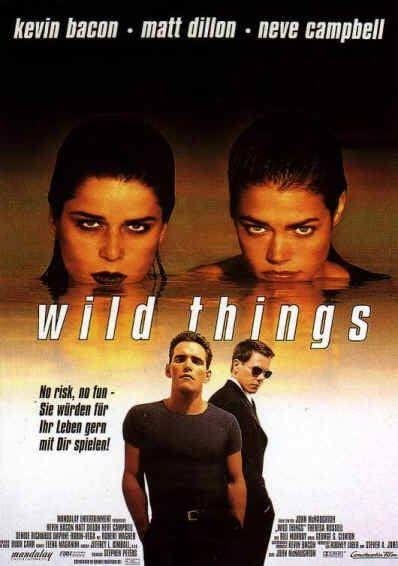
WILD THINGS
Q - Whose (and what) story is it?
A – Suzie Toller’s (her manipulation of a criminal conspiracy in 7 acts).
This is a movie of twists and reversals. Every time you think you know what is going on, a new revelation shows you that you are wrong. Many people praise this film, based on checks on the web. Unlike Epstein, I don’t think this is a “superbly written” script. Why? Because there are so many twists in such short order that the viewer stops caring what happens, knowing, eventually, that after a few more minutes, it will all change again anyway. It is simply too cute for its own good. It is trying to out-CHINATOWN, CHINATOWN, out-BODY HEAT, BODY HEAT. And the characters end up amounting to no more than chess pieces being moved on the film’s board. So, while it has surprises, it has no sympathetic protagonist because it eliminates them all through each successive reversal. I was waiting, as Suzie sailed away at the end, for the Bill Murray character to be revealed as the lover of Suzie, or maybe that he and opponent lawyer, Robert Wagner, were gay lovers who kill Suzie from a 2-man submarine as she tries to sail away at the end, leaving them with the money, only to... You get the idea: we could keep this going until there were literally no characters left to be revealed.
The Physical Structure consists of 7 acts:
Act 1 – (1” – 16”) – The players are all introduced except our “heroine,” Suzie Toller (Neve Campbell) in an opening scene at the high school auditorium where Sam Lombardo (Matt Dillon) is a Guidance Counselor introducing Police Sgt. Ray Duquette (Kevin Bacon), to talk about sex crimes. Student, Kelly Van Ryan (Denise Richards), is in the student audience. Even this opening scene, it seems in hindsight, is too “trumped up” to be believable, but they have to get everyone registered in order to get the conspiracy going. Kelly manipulates Sam into letting her come over, ostensibly to wash his car for a school fund raiser. She wheedles her way into his house, later leaves, and then tells her rich mother that Sam raped her at the 16 minute point in story time.
Act 2 – (16” – 34”) – The accusation gets around, the police are brought in, and Duquette is told to bring his boss “a case.” Sam hires a lawyer, Ken Bowden (Bill Murray), loses his current girlfriend, the daughter of Kelly’s family’s lawyer, Tom Baxter (Robert Wagner), and is attacked on the road at night by Kelly’s mother’s pool boy. Duquette visits Suzie, a low-life friend of rich-girl Kelly’s as part of his investigation, whereupon she says Sam raped her, too, and uses the same detail Duquette heard from Kelly, that there is no physical evidence establishing the rape, a deliberate action supposedly by Sam who explains it to the “victim” with similar language in each rape at the 34 minute point in story time.
Act 3 – (34” – 50”) – The case proceeds to court where after some proceedings, Lombardo’s lawyer, Bowden breaks Suzie on the stand and she admits she lied and says Kelly lied, too. The case is thrown out. The parties meet at Sam’s lawyer’s office and settle for $8 million to avoid a lawsuit. But Sam is tainted, so he has to quit his job at the school and leave town. Then the crime is revealed as being a conspiracy engineered by Sam with the two girls to get the mother’s money. It appears Sam and the girls will run off together. This is at the 50 minute point in story time.
Act 4 – (50” – 69”) – Duquette then is shown to have figured out that Lombardo and the two girls, Kelly and Suzie, are in cahoots, and the whole thing was a job to fleece the money out of Kelly’s mother. Duquette has no evidence, so he begins to watch the girls, believing they are the weak link that will give away the crime. He goes to Kelly and tells her he knows and that she should watch out because three’s a crowd. Then he does the same thing with Suzie, but suggests that Sam and Kelly will dump her. Suzie then races to Kelly to confront her about this, followed by Duquette, who videotapes their meeting at Kelly’s pool. The girls have a fight, but then make up and make love. Duquette and Lombardo have a meeting at headquarters where they have an argument and Sam threatens Duquette. That night, Lombardo meets Kelly and Suzie, and after she is drunk, Lombardo kills Suzie off-screen while Kelly is at the car. Together, Kelly and Lombardo bag the body and dispose of it. This is at the 69 minute point in story time.
Act 5 – (69” – 81”) – Duquette finds the murder scene after getting a tip from Suzie’s mother about her hired hand finding teeth embedded in a boat. Duquette’s partner Det. Gloria Perez (Daphne Rubin-Vega) stakes out Lombardo and then is discovered. He then tells her that Kelly killed Suzie and provides support to make it a real possibility. Duquette goes to Kelly at her house and in a confrontation, she shoots at him, not mortally. He puts two bullets into her in “defense,” killing her. This is at the 81 minute point in story time.
Act 6 – (81” – 90”) – Duquette is summarily fired from the police force. Then he is revealed as in cahoots with Lombardo. They go sailing while they must wait to get access to the money. Out on the open sea, Lombardo engineers it so that Duquette is thrown off the boat. But Duquette manages to hold a line and pulls himself back aboard, whereupon, as he is about to go after Sam, Duquette is shot and killed by a spear gun wielded by Suzie, somehow alive again, but now as a blond. This is at the 90 minute point in story time.
Act 7 – (90” – 94”) – So Sam and Suzie engineered it all. Since they are out in open water on Sam’s sailboat, we can’t believe little non-sailor Suzie would try to kill Sam, too, or can we? As they drink a toast to their good fortune we see that Sam’s drink was spiked with poison by Suzie. Sam dies, and Suzie is left with sole remaining access to the money. In a coda it is revealed that Suzie has a 200 I.Q., so could easily have engineered the whole thing as well as taught herself how to operate a sailboat and navigate back to shore. The film’s story ends at the 94” point in story time.
The Logical Structure is in 3 parts:
Part 1 – (1” – 34”) – A criminal conspiracy is shown in which a girl, Kelly Van Ryan, accuses a guidance counselor, Sam Lombardo, at their school of rape. As the story develops, a second girl, Suzie Toller, also accuses him. Suzie, then, emerges out of the shadows as a co-conspirator, it seems. This is at the 34 minute point in story time.
Part 2 – (34” – 71”) – The police in the form of detective Duquette and his partner, investigate the accusations. There is commonality to the two girls’ stories. A trial begins whereupon Sam Lombardo’s lawyer breaks Suzie on the stand, and the accusations are established as lies. The trial is thrown out. To avoid a lawsuit, Kelly’s mother pays off Sam. But Sam is tainted and must quit his job and leave town. Then the conspiracy is revealed: Sam and the girls are in cahoots to take Kelly’s mother for the settlement money. This is the Mid-Point, 50 minutes into the story. Police detective, Duquette, has figured it out, however. But he has no proof. So he starts to watch them. He begins to play one girl against the other to see if they will expose the conspiracy by running to Sam who now lives temporarily in a motel. The girls fight, but then make love, confirming their collusion to Duquette. But it’s not enough. Lombardo and Duquette have a confrontation setting up animosity between them. Then Lombardo goes to see the girls and seems to kill Suzie while Kelly is at the car. We see them prepare the body for disposal. In truth, however, unknown even to Kelly, the un-harmed Suzie has now gone into hiding. This is at the 71 minute point in story time.
Part 3 – (71” – 94”) Duquette, investigating, finds the murder scene. Lombardo tells him Kelly did it. Duquette goes to Kelly and they argue whereupon she shoots him. He kills her in defense. He turns out to be okay. Duquette is fired from the police force. Then it is revealed that he is partnered with Lombardo, and they were in it together all along. Having to wait to get to the money, they go out sailing on Lombardo’s boat. Sam tries to kill Duquette, but fails, and just as Duquette is coming after him, he is killed by Suzie, now revealed to be alive after all. As they sail off, Sam drinks a mickey prepared by Suzie, dies, and she is left with sole access to the money. The film ends at the 94 minute point in story time.
Conclusion – The breakdown is proportioned at 35% - 39% - 26%, almost in thirds. No one in this movie was sympathetic for long. Beyond the fact that it was trying too hard, more than once it had scenes between various co-conspirators that would likely not have happened the way they did because the only people present who needed to be fooled were the audience. So the characters wouldn’t have spoken to one another as they did. That is, unless each one, in turn, only knew so much. But that begs the question as to why any of them would believe that the treachery stopped at them. The character relationships had so little motivational development beyond the profit and sexual, that no reasons for such trust were ever established. And this, in turn, demonstrates the difficulty in doing a convincing 7+ act story full of twists and reversals in 94 minutes. Producers, directors, and studios are so obsessed with keeping it moving that the very substance that might have made it worthy of moving is either stripped away or never conceived of to begin with.
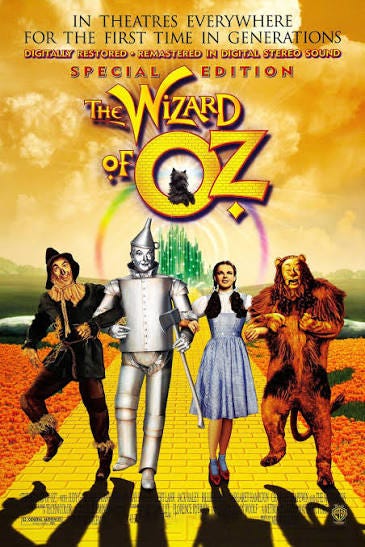
THE WIZARD OF OZ
Q - Whose (and what) story is it?
A – Dorothy’s (her search for home).
The Physical and Logical Structures are each in 3 identical and corresponding parts:
Act 1/Part 1 – (1” – 18”) - Dorothy lives in Kansas with her dog, Toto, Aunt Em, and Uncle Henry, and dreams of faraway places; Miss Gulch, an ugly old spinster hates Toto and gets an order to have him removed; Miss Gulch takes Toto away, but as she rides away, Toto escapes and runs back to Dorothy; still, Dorothy might lose Toto to Miss Gulch, so she decides to run away from home—this is the Inciting Incident; she sets off on her journey; Dorothy meets Professor Marvel and is shown how she has hurt Aunt Em, so she goes back; a cyclone hits, and before she can find her family in the storm cellar; she is knocked unconscious by the violence of the storm and begins to dream, concluding with her and her house falling from the cyclone at the 18” point in story time.
Act 2/Part 2 – (18” – 90”) – Dorothy dreams, whereupon she finds herself in Munchkin Land, part of the Land of Oz, greeted by the Munchkins; then she finds her house has accidentally killed the Wicked Witch of the East by dropping out of the cyclone on top of her; the Wicked Witch of the West arrives to see her sister dead; the Good Witch Glinda gives her the Wicked Witch’s ruby slippers to protect her; the Wicked Witch of the West wants the slippers; Glinda sends Dorothy on her way to the Emerald City to ask the Wizard of Oz to help her get home; She starts on the yellow brick road, and along the way is met and joined by the Scarecrow who is looking for a brain, the tin man who is looking for a heart, and the lion, who is looking for courage; after nearly being put into a permanent sleep by the Wicked Witch, but then rescued by Glinda, they reach the Emerald City and the story’s mid-point at the 56” point in story time; there they meet the people and finally the scary, great, and powerful Wizard of Oz; they ask for their desires: a way home, a brain, a heart, and courage, and the Wizard commands that they bring him the Wicked Witch’s broomstick; They reluctantly set out for her castle; the Witch sends her army of flying monkeys to capture Dorothy, and they bring her and Toto back to the castle; Toto escapes, finds the three companions, and shows them the way to the castle; they masquerade as guards and sneak inside; they find Dorothy, and set her free before she is to be killed; running through the castle to escape, they are chased and cornered by the Witch and her minions; the Witch sets the scarecrow on fire, and Dorothy splashes him and the Witch with water, putting out the fire, but causing the Witch to melt and die; The guards, happy to be free of the Witch, give Dorothy and her companions the broomstick; they return to the Emerald City and the Wizard with the broomstick; they discover the Wizard is a fake, and accuse him of being bad; he admits it, causing them to lose all hope; but then the Wizard tells them the scarecrow already has a brain but needs a diploma to prove it; the tin man already has a heart, but needs a token to remind him of it; and the lion already has courage, but needs a medal; at the 90” point in story time, the Wizard tells Dorothy that he will help her get home in his hot air balloon; she is going home!
Act 3/Part 3 – (90” – 99”) – At the balloon’s send-off, they say their goodbyes, and Dorothy gets into the balloon with the Wizard; Toto decides to chase a cat, and jumps out of Dorothy’s arms; Dorothy goes after Toto, and accidentally releases the balloon’s rope; the balloon departs, stranding Dorothy once again; Glinda appears and tells Dorothy she’s always been able to go home, she just has to know it inside; Dorothy realizes it’s true, and that her true destiny is in her “own backyard”; she clicks her heels together and wakes up back home with her family at her side. The film ends at the 99 minute point in story time.
Conclusion – This is about Dorothy’s journey to find home. The transitions are present, but skewed from classic, Fieldian structure, with the first part ending only 18” in; the second ending 90” in; and the story ending 99” in (a breakdown of 18% - 72% - 10%). Each minute, in effect, represents about 1% of the story. But, it is obvious that the story is Dorothy’s search to get back home—that’s what motivates her to find the Wizard, and it is articulated by her arrival in Oz—establishing her problem; her achieving a way to get home by getting the witch’s broomstick back to the Wizard—establishing how she can finally resolve her problem, and her arrival back home at the end, re-joining friends and family, effectively solving her problem.
_________________________
As I’ve said, for physical-level structure, while everyone should use what works for them, I prefer using the “Sequence Approach” (described in Paul Joseph Gulino’s book) over Syd Field’s unwieldy use of acts, plot points, mid-point, and pinches. Field breaks the story model into almost (but not quite) the same number of parts as the sequence approach does, but without the rational and logical support. There is a hierarchical value in using Field’s approach in that it establishes relative degrees of rank for each part in relation to the story as a whole, but the names are slightly confusing as he says there are many “plot points” in stories, but stresses only two, Plot Point I and Plot Point II; he uses the term, “pinch,” but hardly establishes any good reason for the otherwise confusing name, and then abandons the notion in later books. And, as I said above, he gives no significant meaning support for the parts into which he divides his structure.
It is better, then, to just locate each portion of the script in relation to the others by, as Gulino does, the use of a letter designation. I should note that the reason Field started off with just a three part model, then added the mid-point, and then added pinches to that, in each successive book, and since then seems to have forgotten pinches, was likely that he was struggling the same as Epstein with the fact that there was a three-part structure present in stories with greater or lesser so-called acts, so the conclusion was that there must be some better way to modify the three part paradigm or discard it. What neither of them understood was that they were not describing a three-spatial-dimensional (plus time) model! Instead, they were struggling with, as many as a five dimensional model (including the temporal—signifying that meaning-change over time, and an emotional/intellectual spectrum of Sub-logical levels (see Part 12) modifying the deep structure meaning level where the protagonist’s internal transformation resides). So, they were, instead, trying to fit it into those three static spatial dimensions (without the temporal dynamic one, nor the others described ahead). In Field’s and the other “gurus’” (Vogler, Hauge, Truby, et al) case, this was by modifying and/or adding parts. In Epstein’s case, it was by abandoning them entirely and choosing a kind of creative anarchy over understanding.
This struggle is at the heart of why, beyond the profit bandwagon, there are so many screenwriting books out there: nobody could get a handle on structure. The moment someone found a model that seemed to describe all stories, someone else found a story that didn’t seem to fit. That is epitomized by the Field-Epstein debate, but shows up over and over in other books and articles (Field vs. Vogler; Field vs. Hauge; Field vs. McKee; Field vs. Siegel; Field vs. Epstein; Field vs. Snyder; Field vs. John Truby and his 22 Step (!!!) approach) and in screenwriter comments in interviews.
Why should we care?
This question is Epstein’s (and many other people’s) misunderstanding, crystallized. It is true, if story structure were so broadly variable that it included Epstein’s no-act, Siegel’s 9-act, Truby’s 22 steps, and everything in between—in other words, if it had so little consistency that literally any story could have what could be called “structure,” and that was the end of it, then, and only then, there would be no real value to it. It would not be useful because we could not apply it toward future stories as we were conceiving them with any consistency. So we have to ask ourselves, why talk about story structure in the first place? There is only one reason, the shockingly obvious one:
To better understand and tell stories!!!
Well, duhhh!!!
If, as I contend, structure resides on at least two levels, the surface or physical level, and the deeper or logical level; and if the deep structure model is consistent, from film to film (i.e., you can see an Arc of Protagonist Transformation/Non-transformation), then three-part, logical level structure has value! This is because it can be used as a tool by writers to evaluate their ideas’ suitability as stories. It can be used to understand how to best tell their stories. And, by staying focused and centered, pinned to the Arc of Transformation, writers can better, more efficiently, and so, more effectively, write them.
Both surface, physical-level structure, and deeper, logical-level structure are useful. One helps writers find a way to tell the story, and the other helps writers find a way to tell the truth. #
(Stay tuned as we extend this discussion of story structure to controversial films beyond Alex Epstein’s list in Part 9.)
Please Re-stack if you found this article of interest.