

(For reference see Parts 1 - 10)
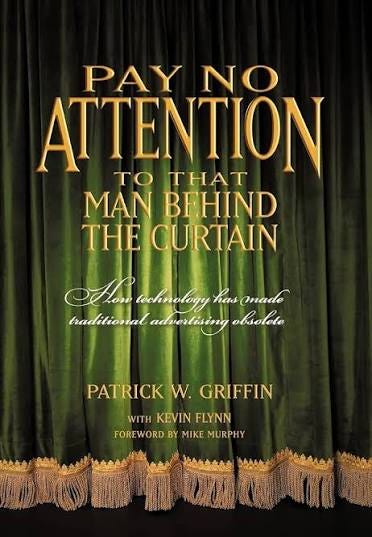
The Man Behind the Curtain
So, just as is the Wizard in THE WIZARD OF OZ,
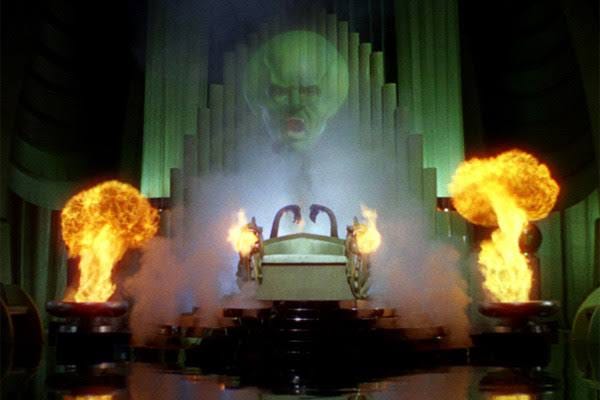
structure is kind of a “man behind the curtain.” It’s there, but disguised. One day it looks like a bum with rags and no shoes; and on another it’s Sir Walter Raleigh, wearing a gigantic plumed hat. Yet underneath it all, it’s just a man. Comedian George Gobel, when asked by talk-show host, Johnny Carson, how he was doing, said, “D’ja ever feel like the whole world was a tuxedo, and you were a pair of brown shoes?” Writers on screenwriting have, now, for decades been failing to see structure even as it stood before them. Every once in a while, “a pair of brown shoes,” i.e., someone with unique insight, would come along and point it out: Linda Seger (though seemingly unaware of its importance) in the ‘80s, and Dara Marks more recently. But few ever seem to get it. Even in the 4th edition of their excellent book, Alternative Scriptwriting, p. 307, authors Ken Dancyger and Jeff Rush, miss it even as they see it:
“A number of writers have experimented successfully with structure. The most commercially successful experiment is Richard Curtis’s [“five-act”] FOUR WEDDINGS AND A FUNERAL [1994].
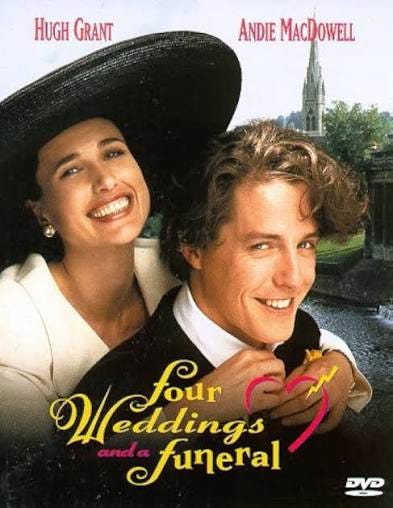
An argument can be made that this film actually follows three-act form—boy meets girl, boy doesn’t want girl, boy finally decides he really does want girl. But we would like to suggest that, on another narrative level, Curtis does organize the entire story around a series of special events—weddings, proposed weddings, and a funeral. By doing so, he has contextualized the personal issue (commitment to a relationship) into a social context—that is, the weddings and the funeral...”
And later,
“The challenge to storytelling conventions of structure comes from the theatrical device of organizing the entire story around five social events. Superficially, the implication is five acts, but actually, the film neatly divides into three acts, with the turning points just after the two characters have slept together for the first time: the female lead, Carrie (Andie McDowell), poses the issue of commitment, and Charles rejects it. The next turning point occurs after Carrie’s marriage: Charles confesses his love for her, but now she is married and the possibility of a relationship has never seemed more distant. The dissonance between the formal structure of the film (five acts) and the dramatic structure (three acts) makes the film seem novel and inventive.” (italics, mine)
They get it, and yet... they don’t! As can be seen by my italicized passages, they can see what we here call the physical and logical levels, even dichotomize them, naming them “formal” and “dramatic,” respectively, but they reject the legitimacy of the multi-level concept by dismissing the physical level (their “formal” level) as “superficial.” Instead they over-intellectualize the dichotomy by pronouncing it as “contextualized,” and “dissonant,” and therefore, “more powerful,” whatever that all means. As can be seen in the analysis of ALL THAT JAZZ
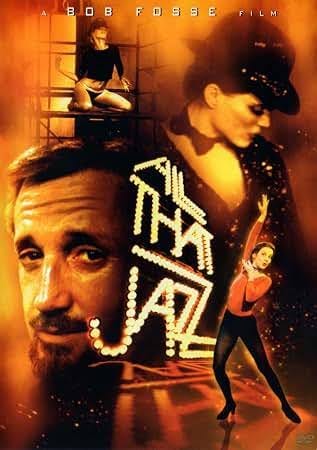
(not to mention, the works of William Shakespeare!), organizing a story around five physical-level structural components is hardly groundbreaking or “experimental.”
Perhaps William Froug said it best when he wrote:
“The best structure is whatever you decide it is for whatever story you happen to be telling at the moment. Your structure should vary to fit each story. One size does not fit all.”---Zen and the Art of Screenwriting 2, p. 154.
Someone suggested to me that MY DINNER WITH ANDRE
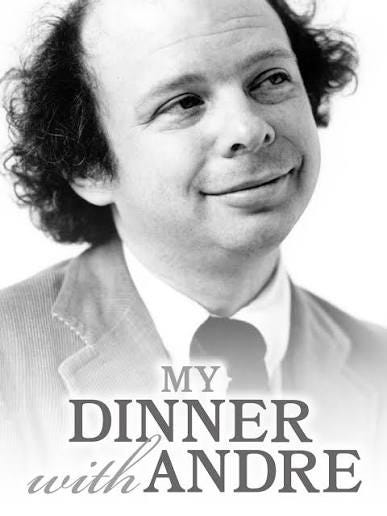
seems to be structure-less as it apparently has only a single act. But, while that initially appears true, it actually exhibits classic 3-act surface-level and deeper-level structure. Act 1 happens before the film starts, but is alluded to by Wallace Shawn as he strides toward his dinner date with his old acquaintance, Andre. Act 2 is the dinner itself. And Act 3 is Shawn’s conclusions immediately after. The meaning of re-connecting with Andre for him is implied, rather than explicitly stated. So, while not proportioning anything close to Field’s definition, the “story,” if not the film telling it, effectively fulfills the requirements for our view of multi-level structure with three identically-corresponding parts in both the surface and deep structures.
Should the reader want to nominate a film that manages to meet my definition of a “movie” (all mass-audience, narrative fiction, feature-length, theatrical, straight-to-video, and streamed films exhibited to enlighten and/or entertain for profit), and, yet, does not fit my multi-level structural model as outlined in the previous pages (SYNECDOCHE, NEW YORK? BLOOD OF A POET? EL TOPO? THE FORBIDDEN ZONE? (XI-1)), please comment. I would love to put it to the test, and should I agree with the reader, I will include an analysis of the film(s) in a future article with credit to the reader(s).
So, what?
Controversies aside, an awareness of structure is good only to writers. As long as it works, audiences don’t care. To be sure, audiences would rather not know the structure of a beloved story, because it takes away the magic created by the piece and kills it. So, structure is for writers. It is useful, as we’ve pointed out, for conception, for efficiency, and, later, as the story is written, for unity, and for focus. For audiences, then, it is valuable to the extent it works to yield its magical results. It is important not just to help writers work their way through huge blocks of narrative plot-line as the screenwriting priesthood’s surfacists (sure-fascists?) are content to believe. It is valuable because it explains its subject to its creators. And, thanks to such functioning on the deeper level of meaning, it helps audiences in understanding their own lives. So, as stated earlier, and because it’s really on-point: “Both surface, physical-level structure, and deeper, logical-level structure are useful. One helps writers find a way to tell the story, and the other helps writers find a way to tell the truth (XI-2).”
The test of a theoretical model, a paradigm, is the extent to which it covers the wild variation found within the phenomenon it is meant to explain. Seen without the crucial elements of the unifying, broadly-defined, transforming protagonist, and a temporal environment which allows for non-linear time and meaning-only causality, the Aristotle-Field and the Campbell-Vogler models fail to explain films like ANNIE HALL, NASHVILLE, PULP FICTION, and MEMENTO.
My goal with all this is not to replace some earlier writer’s “guru-status” with my own. In fact, I’ve found merits in virtually all of the many books advocating a particular screenwriting method. Instead, I’ve tried to show why each of them has points and insights about screenwriting that work, while, at the same time, failing to explain the broad variety of screen stories encompassing the length and breadth of the subject. It shouldn’t need to be stated that only a view that can make sense of all (or most all) of them has the power to contribute to the subject as a whole. The notion of the surface and deep structures, that is, the physical and logical structures, succeeds at this as only it could. So, I advocate a view that uses what works for me concerning notions of screenwriting, and I discard what doesn’t. But, similarly, I am interested in discovering a model that best explains its subject. Just as atoms were once thought to be the fundamental building-blocks of matter, and have since been replaced by sub-atomic particles (XI-3), the major screenwriting paradigms are, in this view, seen as components of a larger model, one which has the power to spread out widely and contain the wild variance among successful screen stories as have emerged thus far in world cinema.
If writers are confused as to which structural approach is correct for their stories, they need only remember to ask themselves whose (and what) story their tale is, and how that character must grow.
With those questions answered, the structural signposts of the story are either in-place, or can be determined. And then they have the one structure that matters most for the success of their work, the deep or logical structure. From there, they can examine their narrative and begin the process of building its parts toward its eventual visible structure, the surface-level physical structure, be it David Siegel’s nine-act model with two goals and a reversal, the musically-inclined sonata-allegro form found in the work of Stanley Kubrick and others, the archetypal story assemblies of George Lucas ala Campbell-Vogler, or the three acts of Aristotle-Field functioning about the transforming hero.
So, is there a model from among all the variations that is best? I submit that there is no correct structure when one is on the physical level, unless it is the correct one for that writer, with that story, on that day. On the other hand, when on the deeper, logical level, there is only one correct structure. It is the three-part model, embodying a transformation of meaning through its hero, and within the minds of its audience, supporting and unifying the story as the surface-level physical structure can only mirror or take its own path. It’s the one we’ve practiced all along, ever since those cave walls, so very long ago. #
“Anyone who isn’t confused really doesn’t understand the situation.”
---Edward R. Murrow
(Stay tuned for a final addendum to our discussion of story structure in Part 12)
——-
XI-1 - Several truly unorthodox films have managed to secure theatrical releases, often challenging the boundaries of narrative, cinematography, and audience endurance. These films frequently blend avant-garde techniques with surrealism or extreme genre experimentation.
Here are some of the most notable examples of unorthodox films released in theatres:
Holy Motors (2012): Leos Carax’s film follows a man who plays multiple, disparate roles over the course of a single day, ranging from a motion-capture actor to a dying old man. It is considered a surrealist masterpiece and a deeply unconventional narrative.
El Topo (1970): Directed by Alejandro Jodorowsky, this film is a surrealist acid-western. It is known for its bizarre, dream-like imagery, breaking traditional western conventions to explore philosophical themes.
Hardcore Henry (2016): Shot entirely from the first-person perspective (POV), this action film unconventionalizes the viewer experience by making them the main character throughout a high-octane narrative.
Russian Ark (2002): Directed by Alexander Sokurov, this film was shot in a single 96-minute take inside Russia’s Hermitage Museum, featuring thousands of actors, representing a massive technical, unorthodox achievement.
Eraserhead (1977): David Lynch’s surrealist horror film is known for its industrial, nightmarish atmosphere and non-linear, dream-logic narrative, breaking from standard horror tropes.
Escape from Tomorrow (2013): A surreal horror film that was famously shot guerrilla-style inside Walt Disney World without permission, giving it a unique, subversive quality.
Sorry to Bother You (2018): Directed by Boots Riley, this satire blends absurdism with social commentary, evolving from a dark comedy into an increasingly bizarre, surrealist sci-fi in its final act.
The Lobster (2015): Directed by Yorgos Lanthimos, this film presents a highly unorthodox, deadpan world where single people are transformed into animals if they fail to find a partner, exploring themes of love and society.
Man Bites Dog (1992): A Belgian mockumentary that takes cinéma vérité to its most extreme point, following a film crew that begins to aid a ruthless serial killer.
The Forbidden Room (2015): Directed by Guy Maddin and Evan Johnson, this film is a chaotic, psychedelic collage of lost films and surreal dream-logic narratives.
Greener Grass (2019): A surrealist, absurd comedy that takes a dark, highly stylized look at suburban life, presenting a world that behaves entirely according to its own bizarre rules.
Possession (1981): Andrzej Żuławski’s film blends psychological horror with surrealism, noted for intense performances and a deeply unsettling, unconventional plot.
The Act of Killing (2012): A documentary that forces perpetrators of the Indonesian genocide to re-enact their crimes in the style of their favorite American films, creating an deeply unsettling, surreal, and disturbing viewing experience.
Dogville (2003): Directed by Lars von Trier, this film features a minimalist, theatrical set (a stage with chalk lines for houses) to tell a dark, allegorical story.
A Girl Walks Home Alone at Night (2014): An “Iranian Vampire Western” that blends genres, styles, and cultures, creating a unique atmospheric experience.
These films are generally categorized as art-house or avant-garde but were nonetheless given theatrical releases, catering to audiences looking for experiences far outside the mainstream.
XI-2 – Director Rouben Mamoulian, in a session with students and members of the American Film Institute offered a great lesson of truth in art: “Let me ask you all a question. You probably know The Thinker, the great statue of Auguste Rodin. Will you show me how he sits? Let’s see. Without exception all of you are wrong. It never fails. His man is sitting, believe it or not, with one elbow on the opposite knee. It’s not natural or comfortable, but aesthetically and artistically it has a focus. It has design and rhythm and power. So what is unnatural becomes true, and you can apply this idea to any kind of a scene. You can put everything upside down or reverse it, provided what it does is sharpen (italics, mine). In your desire to express love or hate or doubt, whatever it is, you ask yourself, ‘How can I express this more acutely?’ Then you’ll wind up with a gesture that is not natural, but perfect as an expression of that thought.” (i.e., reality’s truth in your fictional lie)
One of the greatest examples of cinematic truth is the shot in VERTIGO (Re-purposed in Steven Spielberg’s JAWS when, at the beach, the Chief realizes the shark is attacking) when Jimmy Stewart looks down the stairs in the bell-tower, and things seem to distort and extend, beyond what’s real, and yet we’re seeing it. And it’s the truth of what he’s feeling at that moment. Director Alfred Hitchcock puts us inside Stewart’s head.
In a session at the American Film Institute, Hitchcock described how he came to shoot it: “That effect took thirty years to get. It really did. When I was making REBECCA, I had a scene where Joan Fontaine is supposed to faint. I explained to [producer, David] Selznick I wanted to get the effect of her looking and everything seeming to go far away. Where I got the idea from was at the Royal Chelsea Arts Ball in London on New Year’s Eve. I remembered at a certain time during the evening everything seemed to go far away. And I asked for this effect and they said they couldn’t do it. I tried again about five years later. For VERTIGO they tried different effects, and finally it was arrived at by a combination of a dollying in and a zooming out. When the head of special effects came to me, I said, ‘how much was it going to cost?’. He said, ‘fifty thousand dollars to put a camera high and take it up and zoom it, because of the enormous rig’. I said, ‘But there is no one in the set.’ Why didn’t they make a miniature and lay it on its side? ‘Oh, I hadn’t thought of that.’ So they did it, and it cost nineteen thousand dollars.” Conversations with the Great Moviemakers of Hollywood’s Golden Age at the American Film Institute, pp. 272.
XI-3 - Thus far, from protons and electrons, through muons and quarks, and right down to eleven-dimensional quantum foam on a scale that is, incredible as it seems, smaller than the atom in the same proportion as the planet Jupiter is larger than it.
(Stay tuned for a final addendum to our discussion of story structure in Part 12)