

(For reference, see each of the earlier parts, 1-4)
“Design is not just what it looks like and feels like. Design is how it works.”
---Steve Jobs
“Because we do not understand the brain very well we are constantly tempted to use the latest technology as a model for trying to understand it. In my childhood we were always assured that the brain was a telephone switchboard. (’What else could it be?’) I was amused to see that Sherrington, the great British neuroscientist, thought that the brain worked like a telegraph system. Freud often compared the brain to hydraulic and electro-magnetic systems. Leibniz compared it to a mill, and I am told some of the ancient Greeks thought the brain functions like a catapult. At present, obviously, the metaphor is the digital computer.”
---John R. Searle, Minds, Brains and Science
“Computers are useless. They can only give you answers.”
---Pablo Picasso
Structure: The Elephant In The Room
As we have said, story structure has become a riddle. We have bona fide experts, people with solid credentials, telling us story structure is critical. Many argue that story structure comes in 3 or 4 or 5 or 7 or even 9 acts! Others proclaim story structure to be a myth.
Set-Up: Blind Man’s Bluff
They say that we shouldn’t care about the structure in our stories.
New writers go from expert to expert, book to book, screenwriting boot-camp to guru seminar, never getting to a truth they can use. The answer eludes them.
So what is going on? Who is right? The answer, I will show, is everyone. Everyone is right. And, no one. No one is right. First, structure is a riddle, now it’s a paradox. Or… maybe not.
In the modern age, as we have established, Hollywood story analyst Syd Field identified, and, in a series of books, laid the ground-work for a structural model of screen stories. Field referred to it as a “paradigm,” three connected parts, proportioned approximately in a 25/50/25% relationship. Borrowing from the first wave of screenwriters (who, in turn, had borrowed from classic drama and Aristotle), he called them “acts,” functioning in the story as “set-up, confrontation, and resolution.” He numbered these acts 1, 2, and 3, and he separated them with “plot points,” 1 and 2. He said that they were story events on which the story pivots as it plunges forward into each successive act. Later, he identified a “mid-point” that had the effect of amplifying the story’s momentum toward resolution. He found all movies had this arrangement. And he saw that it was good.
But then, others saw movies that didn’t seem to fit. The acts proportioned differently, and worse, sometimes there seemed to be more than three of them (!). Some among the fresh new experts identified a transformational “character arc” for the protagonist that, they said, was utterly necessary for a successful story. Then others after them found successful stories with non-transforming protagonists (!!). What was this thing called story structure, anyway? (!!!)
New “paradigms” were developed. Some looked to classic music, some to classic myth. Others found eight or even more components. Many theorists built flocks of followers who, in turn, duly considered any theory but theirs heretical! The world was thrown into chaos. Screenwriting anarchy loomed. Syd Field’s books were proclaimed evil! All screenwriting books were to be banned! (Except, maybe… Blake Snyder’s. We’ll take a vote) And, now… as a result… only good films will be made, only those that we like. (V-1)
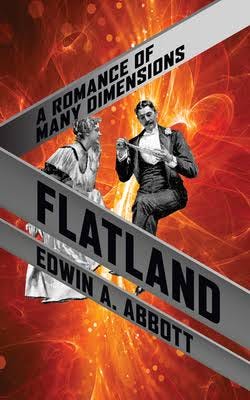
There is a classic book, Flatland, by Edwin A. Abbot, published in 1880, that tells the story of a two-dimensional being, a square, living in a two-dimensional world, who discovers he actually inhabits three dimensions, and that he is really a cube. It has a profound effect on his understanding of his world and his view of his own potential. It is required reading for many math and physics students.
Screenwriters, take heed: many of you are flatlanders. But know that you and your stories live in a multi-dimensional, multi-level world.
One is reminded of the story of the blind men all describing an elephant by feeling parts within their reach. One describes the trunk, a different fellow the ear, and another the tail. None can get it truly right. If there was a way to take the best of each description of the “story structure elephant,” what might it be?
As it happens, there is a way of looking at structure which allows this, and we will examine it in the next section.
On The Levels
Computer networks are designed according to topologies: notions of the layout of the computers on the network in relation to one another. Since they are connected by wires and components which channel the wires in occasionally deceptive or unexpected ways, networks are said to have topologies which are both physical and logical. The physical corresponds to the layout as it looks, while the logical is the layout as it functions on the wire. A network can look like a ring, but function like a star, for example, where a managing “central point” on the ring interacts (to and from) with each of other managed “end-points” on the ring. The essence of it is that the logical is the topology which matters in analyzing the success or non-success of the network, but that the physical is important and necessary due to the environment in which the network must function. The logical, then, is concerned with the data (or meaning), that which is carried; and the physical is concerned with the carrying of that meaning.
This amounts to a multi-dimensional model, two diagrams (the ring and the star), with the hardware effectively living in the first, second, and third spatial dimensions, and the software living in the first, through third spatial dimensions (and time, now added as a fourth, temporal dimension). One can adequately describe the hardware portion of the network in only three spatial dimensions. But to understand how it works carrying that data (or meaning), one must add one more dimension, time, to separate it from that otherwise static diagram to a second, effectively dynamic diagram (with the hardware being anywhere in space; but, now, time, to temporally extend the first three spatial dimensions and allow for evolving data (or meaning).
The parallel of computer network topologies to screenplay structure as it is argued today, while not a precise analog, is, nonetheless, startling. Structure can wear a jumpsuit (no act/1 act), slacks and a shirt (2 act), a three-piece suit (3 act), or, like Diane Keaton in ANNIE HALL, a free-form, layered/accessoried look (4 - 9 act and beyond), but, deep down inside, it still needs to be a single, unified, transforming story. Skeletons all look pretty much the same, after the clothes and the skin are removed, but inside the bones, the DNA tells a different story, and each skeleton is unique.
So, the physical structure of screenplays can do “the carrying” up on the surface level in any grouping of components which the writer deems necessary and which allows the story to succeed (always a subjective issue, but, for our purposes, success is defined as when a significant consensus agrees on its success or failure in the marketplace, the combination of box-office receipts and favorable opinion, taken together, or in lieu of one another). The logical structure of screenplays, on the other hand, succeeds at a level below the surface, i.e., in three parts, where the meaning is found (V-2).
Screenplays can be further broken into (and I am not making any of these up, they are all in various “paradigms” offered by “my way or the highway” theorists, gurus, and otherwise serious screenwriting writers, including me):
Plot Points, Mid-Points, Pinches, The Inciting Incident, The Call to Action, Defining Moments, The Moment of Enlightenment, The Awakening, Movements, Complications, Reversals, Arrivals of the First or Second Goals, The First or Second Turning Points, and on and on and on…
…but its primary and universal structure remains the three parts, Field’s acts, and Aristotle’s beginning, middle, and end. And the value of this is two-fold: it offers writers the ability for quick analysis of both existing stories (for study) and their own story ideas; and it offers the potential for audience illumination and growth.
Make no mistake, the physical and logical structures are always both present in serviceable works. Sometimes the logical exactly corresponds with the physical. In the worst examples of these cases, the skeleton is effectively on the outside, plainly in evidence. This is akin to those tall buildings of the “form is function” Le Corbusier school of architecture epitomized by such buildings as the John Hancock Center in Chicago (with the girders themselves seeming to form the design of the surface skin of the building). And, as the Le Corbusier school has now been abandoned by modern architecture due to, among other reasons, what is seen as a stark and barren soul-less-ness, so, too, are the films which epitomized the worst structure-on-the-surface school of screenwriting, those forgettable films of the past 40 years, the ones written just after all those surface-level only screenwriting theories became required study.
I refer, of course to the plethora of films (many from the 1980s and ‘90s but some still emerging as this is written) built around contrived and superficial situations and characters, often involving beer-drinking slackers, body-switching, gender-switching, talking or adult-behaving babies, ghosts with unfinished business, gross-out movies, and the many preposterous fantasy-based tales, often involving a magical charm, talisman, or spell, and set in contemporary California-styled suburbia. While some of these worked (BIG, SPLASH, GHOST, GROUNDHOG DAY, and THE HANGOVER, for example) and blazed the way for those that followed, the imitators were usually poorly thought-out variations with otherwise excellent physical structural appearance, but having little or no transforming and illuminating logical structure.
I submit that when the deeper logical structure (three parts functioning about the growth of a protagonist), is missing altogether, the story, despite a perfectly executed physical structure (complete with multiple acts, movements, and plot points, but not functioning as the result of a protagonist in ascendant or descendant flux)... that story... effectively fails.
Yes, But Does the Arc Float?
The way to test the notion that a story’s structure is tied to the protagonist is to:
Pick a successful story, ask oneself whose story it is (and what, in a few words, that story is), and then chart the arc of transformation which that character, the protagonist, undergoes.
This is the most important question to ask in determining a potential story’s structure. The question of “whose” story identifies the deeper logical level structure, and the question of “what” story it is, identifies the surface-level, physical structure. In order of importance, I place the deeper level first, and the surface level second (and in parentheses) i.e.:
“Whose (and what) story is it?”
In this way we embody what I call Multi-Level Structure: one question of six words describing at least two levels: the deeper-first, strategic, big-picture, the meaning (seeing “the forest”), always in three parts; the surface-second, tactical, the detail (seeing “the trees”), usually in three parts.
The goal is to see how it assembles. When this is done, invariably one finds the deeper structure assembles into three primary parts, three stages of the growth of the hero (or non-growth of the hero in spite of the need for it—in such a case, the growth is present, but it is solely in the audience’s understanding at the hero’s expense). These three parts are:
The burdening of a hero with an all-important, potentially transformational, dilemma.
The now-burdened hero’s escalating contention with and struggle to resolve the dilemma.
The hero’s resolution of the dilemma, throwing-off the burden, thereby gaining illumination and growth.
Three parts (in the deep structure), then, each dependent on a changing, growing, hero or audience.
These correspond, of course, to Syd Field’s 3 acts (set-up, confrontation, and resolution), and so to Aristotle’s beginning, middle, and end. I would put the part 1/part 2 transition at a point immediately after what Field identifies as “Plot Point I,” This can sometimes come a bit earlier than Field’s act 1/act 2 transition, (page 30 of his idealized 120 page paradigm—these hard page counts seem to have been discarded by the 2006 edition of Screenplay). But it is instantly recognizable once one filters it through the criterion of whose story it is. Lew Hunter, despite being a past Co-Chair of UCLA’s MFA in screenwriting, in his, Lew Hunter’s Screenwriting 434, Perigee, 1993, p. 20,
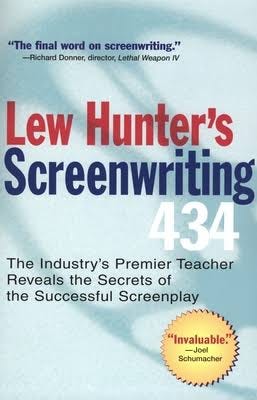
nevertheless puts the transition on page 17 of nearly all scripts (which he says should all number 100 to 110 pages)!!! To be fair, he qualifies it with “approximately.” While he identifies this as the Act 1/Act 2 transition, it is clear that what he is actually referring to is the so-called “Inciting Incident” that appears somewhere in Act 1 of most well-told screen stories, and precedes the actual Act 1/Act 2 transition. So, he is far more rigid about page numbering than Field, calling any script over 110 pages “excessive,” anything over 130 “obscene.” For me, this is emotion getting in the way of objective evaluation (executive bedtimes, script guru turf protection—the author’s friends, perhaps?), though, to be fair, Hunter’s book is otherwise quite useful. Whatever page it falls on, however, this (in Field’s definition, following Plot Point I) is the moment when the hero takes on the dilemma and is set upon the course of change.
The value to writers of this insight of the 3 parts tied to the hero’s growth goes beyond the very useful fact that writers can examine their formative ideas and see whether the potential for the transformational growth of a protagonist is present. Additionally, the knowledge that the structure must develop, support, and never stray from the dramatic elucidation of this hero’s transformation will aid writers in staying on course, centered, and progressing toward the satisfactory resolution of their stories. Still, the prospect of a story idea which promises resonance can point writers to only their best ideas. Armed, then, with an accurate understanding of the story’s deep structure, the application of a surface-level physical methodology suited to the writer and the work can then serve its own useful purpose: aiding in the actual writing of the now conceptually-unified story.
A writer on Substack, Wahab, wrote an interesting piece on structure that applies to articles, essays, treatises, and theses, i.e., non-fictional works on any subject meant to make a case for a particular position. In the footnote below, he offers a great summarization of what we, here, see as the “surface” or “Plot” level, and below it, I expand on the premise to add a “Meaning” which adapts from the essential thesis of these articles on story structure (V-3).
Let’s Test It
Is this notion of structure valid? I can only suggest that it be tested against successful films. It should be done, however, with the reminder and caveat that the protagonist can be a person, a couple, a group, a location, even an ideal of sorts in the guise of a metaphor. One screenwriting “authority” has a book and a well-frequented website where he writes about “The Myth of Three-Act Structure.” He calls it a “myth” because of his failure to recognize any notion of structure as a function of character. As do many of the gurus and the rest of the screenwriting priesthood, he sees only the physical level, and when he tests certain films against this, for him, some films seem to come up short. He lists various successful pictures which he says fail to exhibit “three-act structure” (thereby, presumably, invalidating the model), including ALL THAT JAZZ, SPARTACUS, FORREST GUMP, APOLLO 13, THE WIZARD OF OZ, WILD THINGS, ANNIE HALL, and A HARD DAY’S NIGHT.
I submit that if one considers each of these films from the standpoint of the growth of the protagonist, and one accepts that the protagonist may be a person, a couple, a group, a town, or a metaphor, among others, one can find three parts, unified by a transforming protagonist (or a transformation of audience understanding at the hero’s unchanging expense), in each of them. His larger point is, “So what?” In effect, what does an understanding of story structure do for us as writers? The answer is that it helps us to understand whether in the conceptual stage we have a viable story at all. And, later, it helps us to keep our story on track and unified as it progresses toward resolution. These aren’t trivial. An understanding of our concept of deeper, logical-level structure helps us to avoid lots of unnecessary effort, and it enables us to better understand story itself as our medium of expression. Finally, it helps us fashion stories into the best expressions of their central ideas possible. #
(Stay tuned for Part 6)
Please Re-stack if you found this article of interest.
_____
V-1 - See Part 2, Footnote II-1, in which director Darren Aranofsky calls Syd Field’s books on screenwriting “evil”. And in Part 3, Footnote III-1, director Alexander Payne suggests writers shouldn’t read books on screenwriting. These comments, while perhaps, well-intended, calling for fresh, original films, are incredibly misguided. They’re wrong in the same way that free speech (as “bad” speech) has been under assault in the modern culture since the Covid Pandemic. Urging people not to read books is a step away from banning them. This is not a Hollywood party where shooting from the hip is, if not de rigueur, at least common. You’re not provoking peers over weed and a glass of Pinot, Mr. Payne. You’re speaking for publication.
The 17th Century Puritans advocated destroying the works of Shakespeare. Until 1966, the Catholic Church had its “Index Librorum Prohibitorum” (Index of prohibited books). And various groups, both religious and political, advocate the same thing today.
Just as with so-called “bad” speech, the answer to “bad” thought is not “no” thought, it’s MORE thought.
V-2 – This notion of multiple structures (the multi-dimensional model) functioning simultaneously within stories was seen at least as early as Linda Seger’s book, Making A Good Script Great, Dodd, Mead & Co., 1987, p.4. One might question, however, whether Seger grasped its profound value to writers and its equally profound importance to the audience, since it was noted but never explored.
V-3 - Wahab’s Substack Article:
“You’ve been starting at the wrong level.
“You open the document, write a hook you like, and keep going. The sentences get better as you go. By the end, you have something that reads nicely paragraph by paragraph. Then you look at the whole thing and realize it doesn’t go anywhere - the argument wandered, the sections repeat, the ending doesn’t follow from the beginning.
“So you edit. For hours. Trying to fix the structure through sentence-level work. It never quite comes together, and you ship a piece that reads okay in parts but doesn’t hit as a whole.
“The problem is that you tried to write before you had a structure. And structure is not something you can retrofit through editing - it has to be decided before the sentences get written, because every sentence you write pre-structure is a sentence you’ll either have to kill or awkwardly repurpose later.
“What structure actually is
“Structure is the sequence of claims the piece makes, in the order it makes them, with the specific job each section does for the reader. It’s not “introduction, body, conclusion.” It’s: “…
First I show them this specific thing.
Then I reframe it as something else.
Then I prove the reframe.
Then I show the implication.
Then I give them the move.
“Five sentences. That’s a structure. Writers who ship consistently write that outline first - five sentences, one per section, each naming the specific job of that section - and then fill it in. The writing is faster, the piece is tighter, and the final draft doesn’t need the structural surgery that eats most editing time.
“Writers who don’t do this are rewriting the same piece three times, because the first and second passes were discovering the structure through brute force. Writing is how you discover the point of your piece, yes - but there’s a specific moment, usually around 30% in, where you have found the point, and from that moment on you should stop drafting and go write the five-sentence outline before continuing.
“The move
“For your next piece, stop as soon as you can state the point clearly. Then write the five-sentence outline. Then finish the draft.
“Your draft will go faster. Your edit will be shorter. And the piece will arrive at an actual destination, instead of wandering until you force it to end.”
_____
My Response:
As I’ve stated, determining the protagonist (him/her/they/it, etc.) and how that protagonist transforms (or doesn’t despite the need for it) determines the story’s deep structure.
In the case of Whahab’s thesis here, I would say that my multi-level notion still applies, and that the deeper level below the 5-sentence “Plot Level” he summarizes beautifully above is the “Value” or “Meaning Level”. The “Protagonist” of an article or essay is “Value” which “gains” through “Meaning”. And the transformation the “Value/Meaning” undergoes is “Validation” through “Illustration” resulting in “Understanding”. So, in every article, essay, treatise, and thesis-sized non-fiction work, there is also a second, “deep(er) structure” that functions as the”Meaning Level” of the piece.
(Stay tuned for Part 6)