


Structure: A Dissent – I
“Theory: when you have ideas. Ideology: when ideas have you.”
---Unknown
“In theory, there is no difference between theory and practice; in practice, there is.”
---Chuck Reid
“I learned very early the difference between knowing the name of something and knowing something.”
---Richard Feynman
First, a definition (or, perhaps, “the name of something”):
“Structure: The way in which parts are arranged or put together to form a whole.”
---The American Heritage Dictionary, 4th Edition.
(This article is the first in a multi-part series on describing story structure in a way that, unlike almost every earlier attempt, covers the length and breadth of stories, be they in film or text. I want to credit one of my teachers in college, Patricia Mellencamp for inadvertently putting me on the path to this series of articles and their siblings in my books and other articles. Had she not assigned me a paper analysing a film’s “structure” [in the Claude Levi-Strauss defintion], and my inept result [attempting to analyze the film’s “story structure”] I would never have embarked on the journey that led me to my concept of the “Multi-level Model”. So, thanks, Pat! )
“Grok”-ing Structure (I-1)
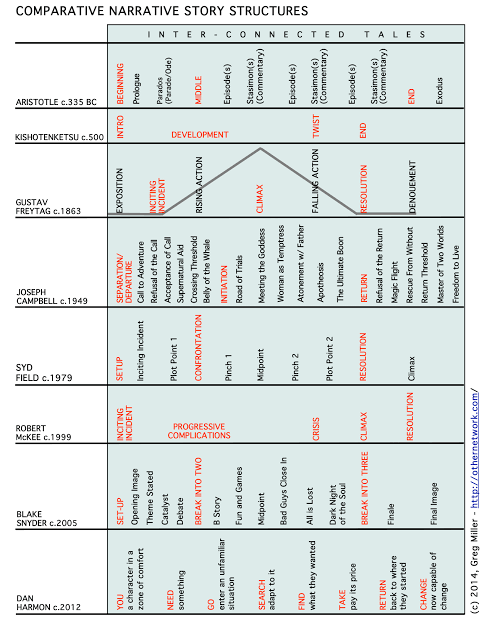
Structure has become such a thorny issue in screenwriting circles that we need to demolish all of the mis-understanding and build a definition of structure that actually works for writers. First, we need a serviceable description of what true story structure is. Then we need to employ it in a model that encompasses all of narrative film (indeed, all of stories). The truth is, this has never been adequately done. I realize that may seem arrogant. So, let’s test it. Let us see if, after I have put this claim up against every so-called “structure-less” movie I could find, it doesn’t hold up. (See my analyses ahead in future segments) For the record, my definition of a “movie” is: all mass-audience, narrative fiction, feature-length theatrical, and multi-part streaming series, exhibited to enlighten and/or entertain for profit. (For brevity, we will focus on movie stories, but the positions we will take can be extrapolated to all stories, adjusted for scope.)
There has been a great deal of confusion as to just what the term, “structure” refers to when it is applied to screenwriting and story-telling. Many students of the form regard structure as merely the manner in which story plots are put together. This, as I will show, is due to widespread misunderstanding and multiple conflicting definitions of the term in several books on writing over the past 50 years, and in numerous university curricula around the world, not to forget that dictionary definition.
Before we concern ourselves with structure, however, we must have a definition of story itself. And, in our case, the dictionary is not much help, because despite multiple attempts, it fails to offer anything specific enough to apply to screenwriting yet distinctive enough to exclude the typical newspaper article or child’s bedtime tale. What we need is something that fits good movies as we know them. While everyone knows a film story when they see one, in order to advance our arguments about the nature of structure we must establish as a platform, a defined and relevant narrative concept that story structure, then, supports. Consider:
In an article entitled, The Secrets of Storytelling: Why We Love a Good Yarn (Our love for telling tales reveals the workings of the mind), Jeremy Hsu writes:
“To study storytelling, scientists must first define what constitutes a story, and that can prove tricky. Because there are so many diverse forms, scholars often define story structure, known as narrative, by explaining what it is not. Exposition contrasts with narrative by being a simple, straightforward explanation, such as a list of facts or an encyclopedia entry. Another standard approach defines narrative as a series of causally linked events that unfold over time. A third definition hinges on the typical narrative’s subject matter: the interactions of intentional agents—characters with minds—who possess various motivations.” --- Scientific American, September, 2008.
For our purposes, the third definition is the most persuasive. We will consider widely-accepted stories that challenge or even defy the first two definitions’ listing of facts and requirement of causality: these might include such films as LAST YEAR AT MARIENBAD, MY DINNER WITH ANDRÉ, PULP FICTION, MEMENTO, and various films by David Lynch. But our concern is not merely conceiving stories. We need to conceive good stories. It is my contention that at least one essential characteristic of a good story is that it is transformative. In other words, through the transformation of one or more of its characters (or solely the audience), it has the potential to transform us (our understanding).
Jake over at BigRedStripe.com defines story in only 19 words:
A story is about somebody who wants something badly, has trouble getting it, and either gets it or doesn’t.
That covers a story’s surface level, Plot, well, but there are arguments and conditions that can challenge it. And, critically, it ignores the deeper, more important level, Meaning, the “point” of the work, the element that Plot illustrates, the reason it’s there at all! Let’s consider another definition:
A story is a narrative recounting of one or more events—usually causally-linked and in sequential order—unfolding over time, with at least one primary character, who, with an audience, through interaction with that narrative’s world, experiences an internal transformation in understanding—or absent the character’s transformation, the audience’s alone—thereby achieving some measure of story value.
Admittedly long-winded and ponderous, I contend that it nonetheless accounts for the wide variation in the bulk of filmed and published narratives (thus far described as “story”) that matter. And, more importantly, it paves the way for an understanding of a description of structure that matters.
A contender for the shortest story ever written is this one, 6 words attributed to Ernest Hemingway (actually mis-attributed, as he was 7 years old when it first appeared):
"For sale: baby shoes, never worn."
Does that fit our definitions above? Not explicitly, no. But it implies a GREAT deal that is left unstated. As such, it can fit either definition implicitly. The reader must infer a full story implied by those 6 words. As such, the reader (the audience) must become an active participant in order to derive meaning from them.
Echoing others before her, author and screenwriting consultant, Dara Marks has pointed-out in her book, Inside Story, structure as applied to storytelling can be seen to function on both the plot level, and on a deeper emotional/intellectual level.
So, stories tell of events which their characters experience. This is the plot level. They also tell of the growth (or non-growth) of their characters as the result of experiencing these events. This is what might be seen as Marks’s emotional/intellectual level. A principle reason we continue to enjoy stories today, often watching the same film over and over, and despite the similarities one bears to another, is that we find things in successful stories which go beyond the surface events. These resonate within us, relate to our concerns, and inform us of truths which we can apply to our own lives. We can even evolve in our understanding of the same film through successive viewings over time. So there are at least two structures: the plot structure, operating on the surface, among the events of the tale, something I will call the physical structure; and something operating on a deeper, interior level, within its characters’ and audiences’ heads, something I will call the meaning, or logical structure. This is because plots are essentially just narratives with beginnings, middles, and ends. Stories, on the other hand, are what narratives mean to us. And stories have structure, too... meaning structure, as embodied by the people in them.
A caveat: this discussion of structure (in the parts ahead) applies to feature theatrical and television film stories. I’m referring to single-sitting-viewing-experience films, NOT web-based short videos, or television series’ meta-stories spanning multiple episodes, seasons, or entire series. While there are structural similarities in these variants, they are not constrained by the same factors. In the case of television series’ meta-stories, casts are often larger, events can span greater narrative real estate, and oftentimes, multiple stories are told simultaneously, each of which has its own structure operating: “wheels within wheels.” However, the ideas here can be extrapolated to all stories with adjustments for the variations as described.
Screenwriting, perhaps to a greater extent than story-telling generally, depends upon surprise, the unexpected, unpredictability, to achieve its results. This is because, ideally, movies must run from beginning to end with no breaks. They must hold the audience, compel the viewer to stay to find out what comes next. It follows that the richer a story is, the more potential there is for such surprise elements to occur. Stories that function merely on the surface or plot level fail to take advantage of the emotional/intellectual potential found latently present within them. The screenwriter can tap into this level and make use of it to parallel, echo, amplify, undercut, or even subvert the events ostensibly driving the tale up on the plot level.
Screenwriter, William Goldman has written that “screenplays are structure”. Adventures in the Screen Trade, Warner Books, 1983, p. 460.
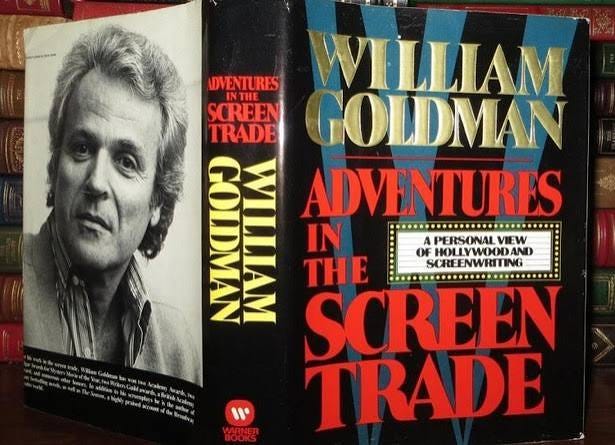
He has gone on to indicate that because of time constraints—movies often telling novel-size stories in 90 to 120 minutes of screen time—there is only room for material in a screenplay that directly advances the story through the essential story elements: theme, premise, plot, character, dialogue, and action. No elaborate descriptions, excessive multiple viewpoints, endless diary entries, internal monologues, etc. The art lies in telling your fiction in such a way as to create the illusion of reality through artifice and calculation. He’s saying that there’s room only for the essentials in telling your movie, and, to the extent you wrap your truths in lies un-recognized and in the guise of a fictive reality, the movie succeeds. He’s right about keeping it lean and almost visibly structured. Interviewed in Backstory 2, p. 70, screenwriter/director, Richard Brooks (THE PROFESSIONALS, IN COLD BLOOD) echoed Goldman, saying, “...if the structure is not right, you can have forty great scenes in a movie and still have no movie. Structure is the beginning and end of a movie.” And, in the same book (p. 20), screenwriter, Leigh Brackett (THE BIG SLEEP, THE EMPIRE STRIKES BACK) said, “…I don’t think there’s anything better than screenwriting to teach you the construction of a story.” In a conversation with George Stevens, Jr. at the American Film Institute, director Elia Kazan goes deeper:
Kazan - “One of the best laws of structure is ‘unity from climax’ from John Howard Lawson’s book on screenwriting, which says that if you know what the climax is going to be, you know you’ve got to get there, and so everything is determined by the climax you’re going to arrive at.”
Stevens, Jr. - “Do you think in movements as opposed to acts?”
Kazan - “No, in inner acts that cause behavior as opposed to “movements”. If you think of people as changing things, as dynamic rather than static [i.e., as we’ll show ahead, TRANSFORMATIVE], you have to have structure [to separate the changed parts] [French New Wave director, Jean-Luc] Godard, for example, shows people in a static state. They are in conflict but in a static state. I don’t see life [with its progression] that way.” ---Conversations with the Great Moviemakers of Hollywood’s Golden Age at the American Film Institute, p. 405; (my bracketing).
Perhaps one of the best, most concise, and, as I’ll show, most accurate definitions of structure is from Walter Brown Newman (Screenwriter, ACE IN THE HOLE, THE MAN WITH THE GOLDEN ARM, CAT BALLOU, and the script known among many as “The Greatest Film Never Made, HARROW ALLEY):
“It has to do with decisions on the part of your leading character [i.e., protagonist]. The beginning has to do with the first big decision he makes that starts the story going. And the middle has to do with some of the decisions he faces because of the initial decision he made. The end is the result of all those decisions.”---Zen and the Art of Screenwriting 2, pp. 130-31; [and so, the protagonist transforms] (my bracketing).
Structure, however, is not the end-all, be-all of screenwriting. In the earlier volume, Zen and the Art of Screenwriting, 1996, Silman-James Press, p.15, author William Froug points out:
“...we teachers and professional writers have emphasized structure so fervently and convincingly that structure has become the god of screenwriting. This fixation has led to a mound of look-alike screenplays that could reach to the top of Arnold Schwarzenegger’s bankroll. This addiction to structure ‘über alles’ puts aspiring writers into a mechanical mindset before they conceive the first idea...” and later, “It’s all about structure, so they say. They’re dead wrong. Structure (i.e., craft) follows art, not the other way around.” (I-2) (So structure is for writers: the more the audience sees the structure, the less the audience experiences the story’s fictive reality.)
So, while structure has become a kind of Holy Grail in screenwriting, it has its place in the form’s hierarchy of importance. For audiences, it’s nothing. It should not be seen or even sensed by them. But for writers, as Froug says, after the subject itself, it is paramount. This is because it can help them to improve the piece. For them, there are two reasons to gain an understanding of story structure:
to both, better write,
and, to write better;
to improve the process,
and, to improve the product.
If a structural model can be found that can apply to all or even most stories, it will benefit writers to know and apply it to their story ideas. I will show that, despite the myriad (and, ironically, mostly valid) story models out there muddying the waters and confusing new writers, there is, in fact, a single model that can be applied consistently across the length and breadth of storytelling. And this is no small thing. #
(Stay tuned for Part 2)
Please Re-stack if you found this article of interest.
If you are interested, here are links to my books on film:
THE LAST REVEAL – Movies, Screenwriting, and the Decline of Western Cinemazation (Non-fiction)
LATERAL SCREENWRITING – Using the Power of Lateral Thinking to Write Great Movies
(I-1) – “To grok (pronounced /grɒk/) is to intimately and completely share the same reality or line of thinking with another physical or conceptual entity. In {science fiction author, Robert} Heinlein’s view, grokking is the intermingling of intelligence that necessarily affects both the observer and the observed.
From the (Heinlein) novel (Stranger in a Strange Land):
The Oxford English Dictionary defines grok as “to understand intuitively or by empathy; to establish rapport with” and “to empathize or communicate sympathetically (with); also, to experience enjoyment.”
In an ideological context, a grokked concept becomes part of the person who contributes to its evolution by improving the doctrine, perpetuating the myth, espousing the belief, adding detail to the social plan, refining the idea or proving the theory.
Robert A. Heinlein originally coined the term, “grok” in his 1961 novel Stranger in a Strange Land as a Martian word that could not be defined in Earthling terms, but can be associated with various literal meanings such as “water”, “to drink”, “life”, or “to live”, and had a much more profound figurative meaning that is hard for terrestrial culture to understand because of its assumption of a singular reality.
According to the book, drinking is a central focus on Mars where water is scarce. Martians use the merging of their bodies with water as a simple example or symbol of how two entities can combine to create a new reality greater than the sum of its parts. The water becomes part of drinker, and the drinker part of the water. Both grok each other. Things that once had separate realities become entangled in the same experiences, goals, history, and purpose. Within the book, the statement of divine immanence verbalized between the main characters, “Thou Art God,” is logically derived from the concept inherent in the term grok.
Heinlein describes Martian words as “guttural” and “jarring.” Martian speech is described as sounding “like a bullfrog fighting a cat.” Accordingly, grok is generally pronounced as a guttural “gr” terminated by a sharp “k” with very little or no vowel sound.” – Wikipedia. So, for all you sophonts out there who can grok it, check your memes at the door.
(I-2) – Elsewhere in the book (p. 55), Froug interviewed celebrated screenwriter, Bo Goldman (ONE FLEW OVER THE CUCKOO’S NEST, MELVIN AND HOWARD, SCENT OF A WOMAN, etc.), who says on the subject of art vs. craft, “I never saw a lawyer in my life until I started making some money, and then I got one lawsuit after another (laughter). And I remember one of these lawyers, representing someone who’s coming out of the woodwork claiming I’d just stolen their life, said something about my ‘craft.’ Well, you know, it’s not a craft. Whenever I hear the word craft, I think of a rainy day at Camp Wigwam, where you throw darts and make leather pouches. It’s not a craft, it’s an art. It takes the sensibility of an artist. And a lot of great writers who are novelists or journalists can’t do it.” (italics, mine) On the other hand, screenwriter Philip Dunne (THE ROBE, TEN NORTH FREDERICK, THE AGONY AND THE ECSTASY) in Backstory 1, p. 166, said, “I agree with my old friend Jo Swerling, one of the earliest screenwriters, who said screenwriting is not so much an art as like fine cabinetmaking. I think that’s right. Nunnally {Johnson} used to use that analogy, too... We never claimed to be artists, but we thought we were good craftsmen.”
(Stay tuned for Part 2)
Please Re-stack if you found this article of interest.