

(Excerpted from my book, LATERAL SCREENWRITING - Using the Power of Lateral Thinking to Write Great Movies)
“We do not remember days, we remember moments.”
---Cesare Pavese
“Good writing takes more than just time; it wants your best moments and the best of you.”
---Real Live Preacher, RealLivePreacher.com
“The right man is the one that seizes the moment.”
---Johann Wolfgang von Goethe
Writing Gooder
When I was a literary agent, I saw thousands of book manuscripts and screenplays. Some people, upon hearing this, winked knowingly and said something like, “Almost all bad, eh?” I would nod sadly, and change the subject.
The truth is, however, it’s not so simple. A great many of the manuscripts I received over the years had qualities about them which were solid, even strong. Many novels were perfectly submit-able, many screenplays produce-able, if not for the problem that they were, in the end, no better than what had already been done by established pros.
When I explained to these writers that they hadn’t a chance if all they wanted to do was write to that level, they wondered if I was mad. They’d cite example after example of similar or even poorer works in the marketplace. Their implication was that these succeeded, so theirs ought to succeed, too.
They failed to realize that most such examples were by writers enjoying long-term editor relationships, multi-title deals, hard-won name-recognition in the field, and known productivity and reliability within the industry. Others were the result of plain dumb luck: the right submission to the right editor, on the right day. Taking on a new writer is a big unknown to publishers and agents. How will they behave? Will the relationship be difficult? Is there more where that came from? Such factors make the difference between two otherwise equal books or scripts. When one is by an unknown writer, and the other is by an established pro, the professional wins. When one finds an editor up on the right side of the bed one morning, it gets a favorable look.
The answer for new and emerging writers is to write better than the competition. And the competition is not another new writer. The competition is that established professional.
The question then follows, how does one write “better?” It may well be that the new writer is competent as concerns the technical side, his grammar, his syntax, his facility, his efficiency. Among those cases I referred to above, this was so. The answer, then, lies within the text, in its story.
I am not suggesting, here, that new writers find completely new and original stories to tell (though I would’ve certainly taken one had it ever come along!). No, I am suggesting new writers find new and more potent ways to tell the same tales we’ve told ourselves since the beginning. I am referring to employing new and different scenes, points of entry, varieties or facets of character, insights, and conclusions. Perhaps the common feature all of these have is...surprise. Don’t show me the “same ol’-same ol.’” Surprise me!
You Got a Moment?
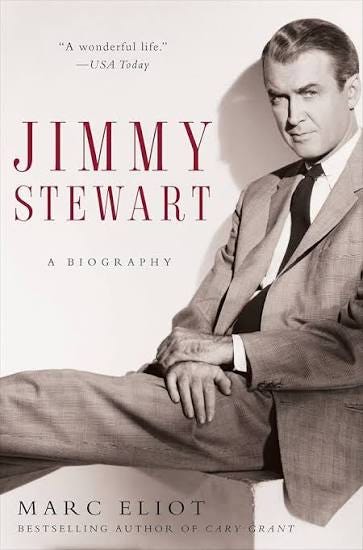
Over 30 years ago Jimmy Stewart was interviewed by Peter Bogdanovich for Esquire Magazine.* (Footnote1) At the end, he said something that has stuck with me for all these years:
“An’ that’s the thing,” said Jimmy Stewart, “that’s the great thing about the movies... After you learn—and if you’re good and Gawd helps ya and you’re lucky enough to have a personality that comes across—then what you’re doing is—you’re giving people little... little tiny pieces of time... that they never forget.”
It’s been said that the most profound things are also the simplest. Well, in those simple words, this great actor nailed it, not just for acting, not just for films, but for the arts, perhaps even communication. I believe this insight is true for all of human interaction.
I try to tell writers to give us all moments in their works, story moments which capture us and transport us toward the deeper truths in ourselves. It is then that the story connects, that the story resonates within us. A few of these in a work of fiction, and the rest of the story may well take care of itself.* (Footnote 2)
Think back to your favorite novel or film. When you call it up from memory, what do you recall, the totality of it, or individual unforgettable moments? When I think of the first scene in Isaac Asimov’s Foundation series of novels, I always see that incredible spaceport on Trantor at the center of the galaxy. I envision a city—conceived decades before STAR WARS’ Coruscant—so large it entirely covers the planet’s surface, and ships that fly indoors. It is science fiction at its grandest, a moment I will never lose. Another example which haunts me still is humanity’s transformation at the finish of Arthur C. Clarke’s, Childhood’s End.
When we think of our favorite films what comes to mind? How about Butch and Sundance jumping from that cliff in BUTCH CASSIDY AND THE SUNDANCE KID? Maybe it’s Dustin Hoffman at that church window crying, “Elaine!” in THE GRADUATE,

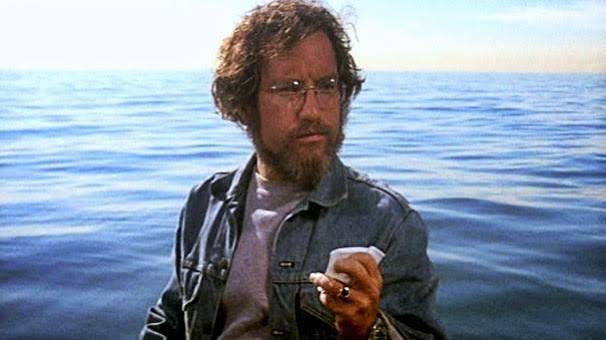
or Richard Dreyfuss singlehandedly crushing that styrofoam cup in JAWS.
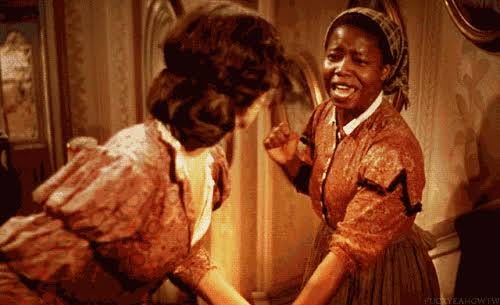
What about Butterfly McQueen saying, “I don’t know nothin’ ‘bout birthin’ no babies...” in GONE WITH THE WIND?
Indeed, the best books and movies are chock full of such moments. I think back to Alfred Hitchcock’s great film, NORTH BY NORTHWEST (written by Ernest Lehman), and it seems almost to be nothing but those kinds of movie moments: the opening kidnapping scene; the killing at the U.N.; the attack by the crop-duster; that hilarious auction in which Cary Grant low-bids himself into the hands of the police and out of harm’s way; and that literally “over-the-top” end-battle for the country on Mt. Rushmore across the faces of the presidents.
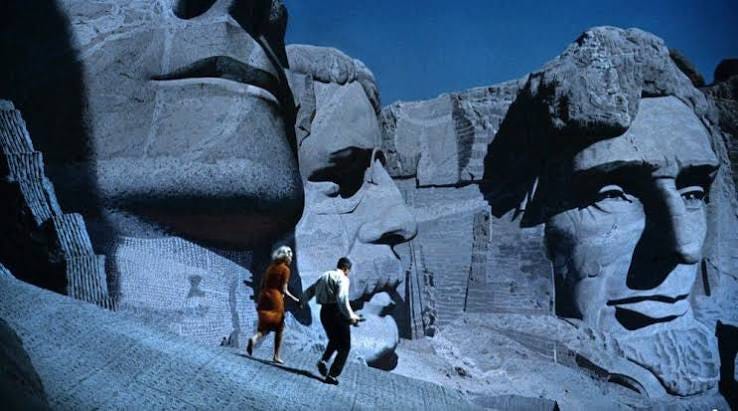
Writers can do no better than to aim for moments in their stories as fresh, visceral, and memorable as these.
Who Are You Talkin’ To?
So how can writers find these “moments” in their stories? There are, in fact, techniques writers can employ toward achieving those “pieces of time” which can make the difference between a serviceable story and a saleable, even wildly successful one.
The first thing writers need to do is re-connect with their audience, to recognize that they are serving someone, and success depends on engaging and holding them through to the story’s end.
A story is not a sheaf of manuscript paper or a series of images on the screen. It is, rather, the narrative running within the heads of its audience. The extent to which that story maintains a vivid and compelling focus dynamically unfolding within the minds of that audience determines its chance for success. In this way, story is actually an ephemeral thing, it is a function of its audience.
When readers and film-goers describe the stories they’ve read or seen, they speak in dynamic terms, what happened, what was said, what they thought was about to happen, active terminology. Even more revealing, audiences refer to stories only in context to themselves, only as an event in dynamic exposition, being seen, heard, or read by them.
Neither story nor audience really exist when not engaged. They are either mere potential or mere artifact when disconnected from one another. They are effectively trivial when not in context, and they can only transcend the trivial by the achievement of the story resonating within the mind of each member of that audience.
Consumers, that meta-audience out there, invariably describe the work in active story terms. Implicit in this is the action of the story’s unfolding, that quality of dynamism I’ve identified. Conversely, writers often ignore the dynamic, and refer to the “book” (seeing it on the shelf) or the “script” (seeing it as typed pages), employing static, rather than dynamic terminology. Why?
Perhaps one reason is that most writing texts and classes focus on the document, that which is written, the pedantry, without the dynamic component, and audience-free. They see the story as the end rather than the means. This, in turn, yields a static result, stories having all the buttons, but pushing none. Perhaps this is a reason why some say writing can’t be taught.
If you listen to successful novelists and screenwriters, or read their interviews, you find the element of the audience recurring in their words over and over. They are keenly aware that if their work does not play, ultimately they will have to pay.
John Brady, in The Craft of the Screenwriter, p. 304, describes a scene in the first draft of Paul Schrader’s, TAXI DRIVER, in which Travis, confronted by a mugger, responds, “I got no more reason to live than you got to kill me,” and then blows him away.
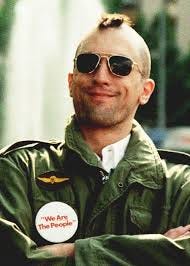
When asked why such a strong line was cut, Schrader responded, “That’s what was wrong with it. That line was much too much on-the-nose. I mean, that line would have died in a movie.” Schrader isn’t writing for the line, he’s writing for the audience. He knows that writing “on-the-nose,” doesn’t ring true for his audience. People don’t sum themselves up like that in the real world. Schrader wisely realized his author’s voice was showing.
The Rules of Engagement
Dynamism results in engagement with the audience. Engagement is the product of interest. How is interest achieved? Perhaps the foremost reason is something I’ll call audience investment. The audience invests its attention or commits its interest because it desires something in return: entertainment value, and/or a more substantive return on the investment, illumination. For writers, audience investment is like money in the bank. The audience has a stake in the outcome, either an emotional stake (expecting entertainment) or an intellectual stake (expecting illumination).
There are at least two components to this investment concept, character-based and situationally-based investment. When it comes to characters, these stakes are won through elements like design, casting, and likability. They are also attained through generating audience sympathy and empathy with the characters, or giving their characters attributes which make them unique and vibrant. Situational-based audience investment is won through similar, even parallel means, things like unique setting, appeal, or point-of-entry, identifiability, fascination in something unknown or forbidden, etc.
The immutable and thorny truth for the writer is that the audience enters the narrative experience not merely hoping that these elements of engagement are present, but expecting them to be there. For writers and audience, these are the rules of engagement, the result of an implied agreement, a kind of literary or dramatic contract between them.
And this, in turn, gets us to the key issue, the primary goal. The writer’s primary goal is to meet or exceed the audience’s expectations, expectations defined by those rules of engagement, and implicitly guaranteed by the literary or dramatic contract the writer makes with them. By the mere act of publishing or releasing his story, the writer promises a successful storytelling experience. He must then deliver it to its audience’s satisfaction.
Audience investment is nowhere more easily achieved than at the beginning of a story. Here, the audience is both receptive and willing to offer its investment capital. At the outset, it both desires a good story experience, and is eager to understand it, to resolve unanswered questions about the work. At the outset, it has only goodwill toward the story because few, if any, pre-conceptions have been formed, and no conclusions have been reached.
Audience investment at the beginning of stories is more important because space is limited, every opportunity must be put to use. Multi-tasking story openings for both exposition and audience investment delivers more bang for the buck. Earlier investment results in greater overall audience capture, yielding more total investment capital.
So, what techniques can be utilized to achieve audience investment? Writers must focus on their story’s situations and characters and manipulate their audience for a mutually positive result. They must direct their audience’s story experience, manipulating these willing participants toward a desired end. Let’s get something straight. While there is bad audience manipulation, all audience manipulation isn’t bad. Communication is manipulation. The operative term, then, is “mutually-positive” manipulation.
Situational audience investment results when writers generate interesting and compelling situations. The first and foremost of these in any story is the overall premise. This is the story’s general and over-riding situation. There are lesser individual situations within it. The key to generating audience investment in a situation is unpredictability, surprise, such that in retrospect it worked positively, even inevitably, for its audience and therefore for the story. Repeatedly surprise your audience in a positive manner and you hold it from moment to moment.
Lateral Moments
One of the first things writers can do to write those moments which result in audience investment is to administer what might be termed, the test of the moment. When they are conceiving their story, perhaps only in note stage, perhaps in draft stage, writers should ask themselves if the scene or the line or the character at hand is too pat, too facile. Can it be written in another way, or from another direction, or with other people which will make it better? Is there an approach to the material which will, at minimum, freshen an otherwise impotent moment? Can it be made to take hold of your reader’s waning attention and, once again, nail it to the page? Can it take what might have been the most familiar of moments and turn it on its... well, you get the idea.
Lateral thinking offers writers the opportunity to systematically generate story moments. By thinking laterally, they can find unique and innovative solutions which transform their writing and make it unlike any other. Writers often want to enter their stories by setting up everything, establishing a situation, introducing the central character(s), etc. Audiences don’t need that in the beginning. To be sure, it helps to connect the dots and understand the people, but it can be left for later, served via spoon in dribs and drabs, while the story is kept relentlessly driving forward. What audiences are looking for is interest, reason to stay and watch. A lateral analysis of your story can suggest avenues toward generating such interest. What will your dilemma be? Might we embody it in the very opening of the tale? Might we show it in action? Hooking our audience right at the start achieves the kind of investment to which I have referred.
Situational audience investment can be achieved by choosing a particular point-of-entry for a scene or even the whole story, immediately hooking and holding them. Many writers say they try to enter their stories and scenes as late as possible. This sharpens the moment’s potency, and is used to cut extraneous material, to utilize only what is actually needed.
Consider the first line of James Patterson’s novel, Kiss The Girls: “For three weeks, the young killer actually lived inside the walls of an extraordinary fifteen-room beach house.” I don’t know about you, but I’m hooked, my investment has been made, and I am ready for sentence number two.
Robert Benton’s screenplay of Avery Corman’s novel, Kramer vs. Kramer enters the story at the moment the Kramers split up. Corman’s novel enters not long before that. Many other writers might have established a stable family life in their opening, in order to contrast it with the subsequent break-up. But the writers know that this is the father’s story, it is about his journey, and for him, the break-up is the start of his difficult climb to single parenthood.
Perhaps the greatest example of this approach to openings is Anthony Shaffer’s amazing stage-play, Murderer.
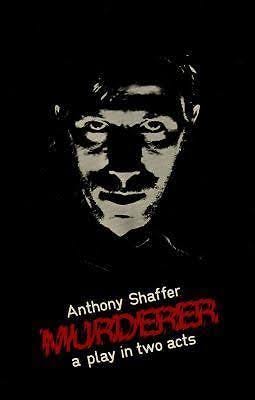
The curtain rises, and minute after minute, the audience watches, mouths agape, as, silently, a killer drugs a young woman, strangles her, dismembers her corpse, and carefully wraps her limbs and torso in butcher paper. All this plays out in excruciating detail for half-an-hour before the first line of dialogue is finally heard: “Open up. Police.” That is Anthony Shaffer’s point-of-entry.
As mentioned elsewhere in this book, Stephen J. Cannell, creator of numerous hit television series, has said that one way to overcome writer’s block when writing a story is to ask yourself what your villain is up to. This can also work for finding a different point-of-entry. Perhaps you have exposition or character development to communicate, and you had planned to do it through a scene with the hero. But then you realize that for various reasons you can’t put it there even though the information is crucial at this point in the story. If you get it across through a scene with your villain, you restore your scenic rhythm, and you get the material out through different and innovative means. Your point-of-entry has moved, and your audience’s investment is rolled-over to the next scene.
Another way situational audience investment can be generated is by writing situations which are familiarly mundane in an otherwise unfamiliar and non-mundane setting or story. This creates an opportunity for audience identification in an otherwise alien setting. In 2001: A SPACE ODYSSEY, two crew-members don’t trust one another. The only problem is that one of them is a computer, and it controls every system on the ship.
Still another technique is to write bizarre, silly, or absurd situations, creating audience curiosity, or laughter, thereby compelling the audience to satisfy its curiosity, or look for still more entertaining humor. In Donald Westlake’s hilarious John Dortmunder novels, we read along in stitches as the motley-est crew in crime runs its latest scam. In Drowned Hopes, they go after buried money, the only problem is that it has been covered by a reservoir, and is under 50 feet of water. In The Bank Shot, they decide to rob one of those temporary trailer banks by towing it away! These, of course, are full story premises.
Examples of absurdity at the moment level are found among those scenes we described from NORTH BY NORTHWEST. Would-be spy, Cary Grant is almost killed by that crop duster armed with a machine gun! Later, Grant hilariously and absurdly humiliates himself out of trouble at that auction. Then, there is that point in JAWS that we mentioned earlier when Richard Dreyfuss responds to Robert Shaw’s crushing of the beer can by crushing his coffee cup. It is funny, but it also restores balance to an audience unsettled by Shaw’s terrifying story of the U.S.S. Indianapolis.
And so, writing disturbing situations generates unsettled feelings, and keeps the audience off-balance, seeking settlement, a restoration of balance. Robert Bloch’s and Alfred Hitchcock’s PSYCHO with the mystery of Norman Bates’s mother comes to mind. Similarly, writing frightening situations generates fear, creating a need to lay it to rest, or to ride the roller-coaster again, an emotion-based stake.
Shirley Jackson’s classic novel, The Haunting of Hill House, and Robert Wise’s superb film of it, THE HAUNTING, are bench-marks in their genres, truly disturbing, truly frightening, while practicing the technique of “less is more.” Director Wise cut his cinematic teeth in the forties working on no-budget horror films for Val Lewton.* (Footnote 3) He learned, better than anyone since, that the additional element of the audience’s imagination can make the cinematic whole greater than the sum of its parts.* (Footnote 4) By showing us the successively more bizarre and dramatic effects of the entity in control of Hill House, he never actually has to show us their source, the entity itself. His success is purely the result of audience investment in his film, gained scene-by-scene, moment-by-moment. This is, perhaps, the best example of how the audience plays a contributing role in the success of the writer’s search for and generation of audience investment.
One kind of intellectually-based stake is generated by writing a situation that fascinates, creating interest in learning more and satisfying intellectual needs. Examples of this are Michael Crichton’s novel and the film made from it, The Andromeda Strain. We read along or watch, fascinated, as scientists desperately try to contain an alien biological outbreak in a super-secret and cutting-edge (for its time) laboratory before they’re all killed.
Introducing a third element to a two-element scene can make all the difference sometimes. Alfred Hitchcock has cited the case of a scene wherein two people are sitting at a table talking. Nothing compelling there. But, introduce the additional element of a time-bomb concealed under the table-top, ticking away, unknown to any but the audience, and your audience investment is achieved. Of course, it should go without saying that the bomb should relate to the story. That scene in the restaurant in WHEN HARRY MET SALLY where Meg Ryan vividly demonstrates her acting ability to Billy Crystal would not have been nearly as strong without the third element of being set in a restaurant full of riveted voyeurs.
Character-based audience investment arises out of interesting and compelling characters. First among these are the protagonist and antagonist. As with situationally-based investment, the key to generating character-based investment is surprise, to subvert expectations by providing characters never before seen, or familiar characters with significant and unexpected twists. When Arthur Conan Doyle created the character of Sherlock Holmes, we had never before seen such a protagonist (Edgar Allen Poe’s August Dupin, notwithstanding). And when Doyle put his great creation up against Professor James Moriarty, the first of modern fiction’s great criminals, Holmes had met his match.
In fact, one method for gaining audience investment in the fate of your protagonist is to put him or her up against a superior villain. Just as with David and Goliath, a superior villain sows seeds of doubt within the audience. In the STAR WARS films, Luke Skywalker must defeat Darth Vader, the supreme dark Jedi Knight, someone powerful enough to have defeated Luke’s mentor, Obi-wan Kenobi. The fear of a similar fate, achieved through moments like Obi-wan’s death, and Luke’s lack of confidence, maintains audience investment through all three films.
As with situational audience investment, investment rooted in character can be intellectually-based, emotionally-based, or both. It can be generated by creating characters who are humorous, providing entertainment value, and a need in the audience for more of the same. Mel Gibson in the LETHAL WEAPON films is hilariously off-the-wall, simultaneously an effective cop, yet high-strung and unstable. He offers both entertainment value, and the potential for illumination.
In CHINATOWN, writer Robert Towne manages this wonderfully. In that scene where Jake Gittes tells his off-color joke while being overheard by the woman who is about to sue him, Towne both entertainingly humanizes his detective, and launches Gittes’s intellectual dilemma. Had Gittes merely walked in and been slapped with the lawsuit, it wouldn’t have had the impact it had through his unconscious humiliation. When she confronts him, he is at his most vulnerable. It increases his need for redemption, and it personalizes his motivation, ultimately leading to his falling in love with her.
Another approach is to create characters that are flawed, or have a significant weakness, thereby humanizing them and creating empathy, sympathy, curiosity, or sometimes even fascination within the audience. A kind of amateur ineptness was deftly injected into his mysteries by Arthur Conan Doyle when he introduced Sherlock Holmes to Dr. Watson. The good doctor represented all of us in the audience who are not detectives, by translating, defining, and highlighting by way of contrast, Holmes’s expertise.
Two classic examples, literary and cinematic, of this “weakness” are James Grady’s and Lorenzo Semple Jr.’s inexperienced “Condor,” (played by Robert Redford) in the book and film, Six (or THREE for the movie) Days of the Condor. He wasn’t a field-operative, he read books for the CIA. Now, however, he is forced to put all that theory into practice in a hurry. Clint Eastwood’s cop in TIGHTROPE fascinates us as he hunts a sexual predator while finding himself falling victim to his own sexual dark side. I wonder if some of us don’t also feel a resonance of sympathy or even empathy as we watch this disturbing film.
In the film, HARPER (based on Ross MacDonald’s Lew Archer novel, The Moving Target), Screenwriter William Goldman wanted to avoid the familiar P.I. story opening in which the hero is summoned to the prospective client who states the case to be solved. During the opening credits, Goldman shows us Harper (Paul Newman) getting up after a particularly wicked night. He stumbles about his darkened kitchen, looking for the coffee filters, and when he discovers he’s out, he pauses over the trash can for a moment, arrives at a tough decision, and then removes yesterday’s filter and puts it into the coffeemaker.
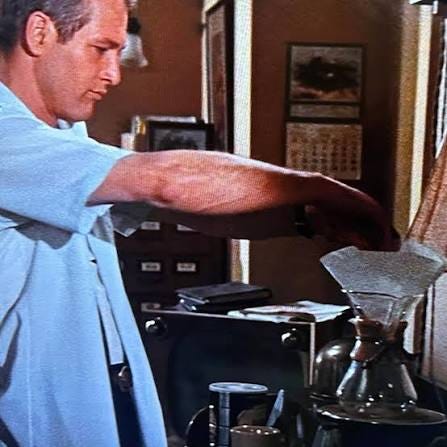
With that very human demonstration of weakness, Goldman’s audience is hooked. Haven’t we all, at one time or another, considered such a thing? We identify with Harper completely. The moment resonates within us. He is one of us. And so, we care what might happen to him during the events ahead. Our hopes and fears are invested in him. All achieved in a single opening moment.
Still another technique is to arm characters with unexpected expertise or ability, creating interest within the audience to know or see more. We saw this in an entire fiction category, mystery-suspense, as it opened up to include women sleuths thanks to writers like Agatha Christie, and much later, Sue Grafton and Sara Paretsky, among others. In films, a young and precocious Matthew Broderick amazes us (or did when personal computers were still brand new) as the kid computer hacker in WARGAMES. And Jamie Lee Curtis surprises us with her natural spying abilities as they emerge in the film, TRUE LIES.
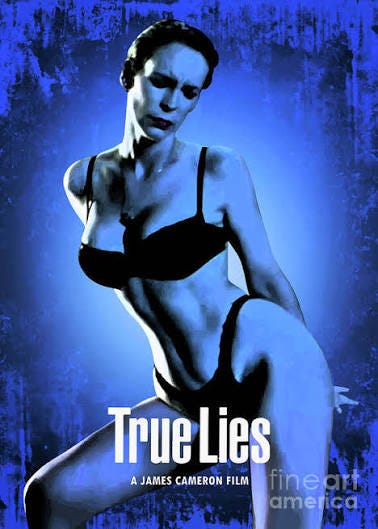
Who’s the spy, now?
As we’ve seen, these methods and others like them give audiences reasons to pay their investment capital to works which serve them in the fashion they desire most. They are tools which have the ability to make good stories into great stories, trivial works into resonant, even transcendent ones.
Beyond Good and Gooder
New writers must look beyond simply fashioning serviceable, workmanlike stories with technically sound beginnings, middles, and ends. They need to look for the spark that can ignite their situations and characters, make them potent, and that will startle us in their innovation. By seizing the moment, by creating people and situations we don’t expect, by making them interesting, compelling, and simultaneously unforeseen and yet inevitable through techniques such as these, writers give us those “little pieces of time.” And in so doing, they lay the basis for engaging, holding, and ultimately satisfying an audience which expects nothing less. #
“There is no happiness. There are only moments of happiness.”
---Spanish Proverb
Please Re-stack if you found this article of interest.
Footnote 1 - Pieces of Time, by Peter Bogdanovich, Dell, 1974.
Footnote 2 – Or NOT! In Francois Truffaut’s book-length interview with director Alfred Hitchcock, Hitchcock, Simon & Schuster, 1967, p. 109, in discussing SABOTEUR, Hitchcock said, “‘But looking back... I would say that the script lacks discipline. I don’t think I exercised a clear, sharp approach to the original construction of the screenplay. There was a mass of ideas, but they weren’t sorted out in proper order; they weren’t selected with sufficient care. I feel the whole thing should have been pruned and tightly edited long before the actual shooting. It goes to show that a mass of ideas, however good they are, is not sufficient to create a successful picture. They’ve got to be carefully presented with a constant awareness of the shape of the whole. And this raises a big problem in American film-making, the difficulty of finding a responsible writer who is competent at building and sustaining the fantasy of a story.’”
Footnote 3 - Former editor (along with director, Robert Wise) under legendary 1940’s producer, Val Lewton, director Mark Robson (PEYTON PLACE, FROM THE TERRACE, VALLEY OF THE DOLLS) described a technique he came up with in the sound editing room for the low-budget Lewton horror films:
“In each of these films we had what we called the ‘bus’, an editing device I had invented by accident, or possibly by design, on CAT PEOPLE, that was calculated to terrify people and make them jump out of their seats.
“It derived from a sequence in CAT PEOPLE in which a girl was walking through the transverse in New York’s Central Park, imagining that she was being followed by somebody or something one supposed could be a cat of some sort, a leopard possibly, though one couldn’t tell. Looking over her right shoulder in terror, this girl backed away from the mysterious sound, ready to accept anything that might jump on her. From the other side of the park a bus came by, and I put a big, solid sound of air brakes on it, cutting it in at the decisive moment so that it knocked viewers out of their seats. This became the ‘bus’, and we used the same principle in every film.” – The Celluloid Muse: Hollywood Directors Speak, p. 237.
Footnote 4 – In Screenwriters’ Masterclass, p. 25, screenwriter Ted Tally (SILENCE OF THE LAMBS) recounted how “Jonathan (Demme) was told once by Roger Corman, ‘The scariest shot in all of movies is the camera approaching a closed door, that you know somebody’s got to open it. The anticipation is much scarier than anything, it’s the most terrifying shot in the movie, it’s not expensive, it’s not special effects.’”