

At Halloween, Hollywood trots out its newest creepy entries. Despite the Oscar success recently of SINNERS, horror films almost never get respect from mainstream Hollywood. One reason is that they so often go “over-the-top,” in their sensational end-result. Another may be that they are seen as blatantly manipulative, i.e., pandering. But, if you consider their success records, they are probably single-handedly responsible for keeping Hollywood studios afloat. And this goes all the way back to Universal’s FRANKENSTEIN, reputedly having saved the studio from imminent bankruptcy.

THE BLAIR WITCH PROJECT cost $60,000—some sources say $35,000—but to be conservative, I’ll use the higher number—and is listed at $248,639,881 for its box-office gross. That’s an R.O.I. (Return on Investment) of 414,449%! Costing a reported $15,000, PARANORMAL ACTIVITY’s worldwide gross was $193,355,933. That’s an R.O.I of 1,289,040%!!! That makes it the most profitable film of all time. Some say AVATAR, but their biases are getting in the way of the facts. The James Cameron film may win by total dollars earned, but as for profit R.O.I., it’s the former. And, unlike SAW, another popular horror entry from that era. P.A. does it with nothing more than clever manipulation of its audience.
For me the most interesting question that arises is why don’t more filmmakers and producing studios understand this? Even when they re-make a classic like THE HAUNTING:
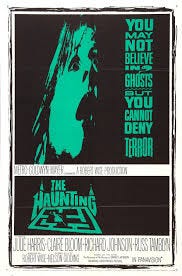
…they ignore what worked and slather on the special effects, the technology, and the silliness. The result is something so shrill it’s beyond belief. The series adaptation of the same story, at least, stayed closer to the “less is more” maxim.
Let’s get something out of the way. I used the “M” word above: “manipulation.” The PC adherents consider anything that manipulates the audience to be dishonest and therefore bad.
NEWS-FLASH: ALL COMMUNICATION IS MANIPULATION!
Anyone who thinks that the latest commercial entry from Hollywood is manipulative, while that recent winner at Sundance that came out of nowhere, that film that is so “personal,” so “refreshingly honest,” is not manipulative, is fooling himself. (Interestingly, BLAIR WITCH was a Sundance dark horse hit; it needed an independent film festival to get noticed).
Personal cinema is no less manipulative (nor less artificial) than any other cinema, including SAW. In fact, it is a good deal less honest about its manipulation than pornography! Personal films are not documentaries of personal experiences or sensibilities; they’re not didactic narratives or objective reporting. They are, instead, dramatic expression, and, therefore, they are just as subjective as the more commercial film product out there, if not more-so.
By their unique specificity, rather than a more common—and Hollywood-preferred—universality, personal films express a “reality” that is usually foreign to wider audiences and, therefore, less accessible than any found in the commercial product. They manipulate their audiences by persuading them to become interested, to identify the commonalities they inevitably share, and to like their heroes and dislike their villains. This is true whether the villains are people, simply plights out of life, or the merest ideas. Just like their studio-based Hollywood cousins, they manipulate their audiences to watch, breathlessly, as they plunge their characters and their audience’s biases into jeopardy or doubt, and ultimately to, then, desire satisfactory resolutions. So, manipulation is persuasion. And no matter how you dress it, persuasion is sales!
The real question, then, is whether the manipulation positively serves the story, whether it positively serves the audience. If said manipulation acts in service to the filmmaker’s intentions, and they are artistically reasonable and ethical as evidenced by a generally satisfactory result, then such manipulation is valid and acceptable. Notice that I did not say the result had to achieve its ends through honesty. Deception is an axiom in art. The question, rather, is, “Does it serve the work effectively and to the benefit of a satisfactory audience experience?” So, while there is bad audience manipulation, all audience manipulation isn’t bad. As we’ve said, all communication is manipulation. The operative term, then, is manipulation that is “mutually-positive”—for the story, and for the audience.
Scary movies succeed for the same reasons all movies succeed: they satisfy their audiences. Audiences aren’t satisfied by ever-larger explosions, ever-more diabolical torture devices. They are satisfied by having their expectations exceeded, by being happily or thrillingly surprised, by being entertained, not shown a demo-reel of new technology. They’re satisfied not by the quantity of blood, but instead by the quality of the experience.
So, how to achieve said quality? It’s a well-known principle that fear is far worse before the fearful event than it is during. That implies that what goes on in the audience’s mind is far more powerful than what goes on before its eyes. JAWS Director, Steven Spielberg, withheld the shark’s appearance until well into the film for two reasons. The prop of the great white shark almost never worked, so he simply had to work around it. And… he knew the audience’s imagination would generate suspense far better than he could with a rubber shark. As the Carly Simon song goes, “Anticipation… It’s makin’ me crazy.”
So, what’s scary?
In SCREENWRITERS’ MASTERCLASS, Kevin Conroy Scott, Ed., Newmarket Press, 2006, p. 25, screenwriter Ted Tally (SILENCE OF THE LAMBS) recounted how:
Jonathan (Demme) was told once by Roger Corman, ‘The scariest shot in all of movies is the camera approaching a closed door, that you know somebody’s got to open it. The anticipation is much scarier than anything, it’s the most terrifying shot in the movie, it’s not expensive, it’s not special effects.’
Anticipation.
(And when that door was closed separating Kay from Michael at the end of THE GODFATHER, Francis Coppola flipped it and turned it into profound tragedy. No green screen or explosion needed.)

Former editor (along with director, Robert Wise) under legendary 1940’s producer, Val Lewton, director Mark Robson (PEYTON PLACE, FROM THE TERRACE, VALLEY OF THE DOLLS) described a technique he came up with in the sound editing room for the low-budget Lewton horror films:
“In each of these films we had what we called the ‘bus’, an editing device I had invented by accident, or possibly by design, on CAT PEOPLE, that was calculated to terrify people and make them jump out of their seats.

“It derived from a sequence in CAT PEOPLE in which a girl was walking through the transverse in New York’s Central Park, imagining that she was being followed by somebody or something one supposed could be a cat of some sort, a leopard possibly, though one couldn’t tell. Looking over her right shoulder in terror, this girl backed away from the mysterious sound, ready to accept anything that might jump on her. From the other side of the park a bus came by, and I put a big, solid sound of air brakes on it, cutting it in at the decisive moment so that it knocked viewers out of their seats. This became the ‘bus,’ and we used the same principle in every film.”
---THE CELLULOID MUSE: HOLLYWOOD DIRECTORS SPEAK, Charles Higham & Joel Greenberg, Signet, 1972, p. 237.
Surprise.

I remember seeing John Carpenter’s original HALLOWEEN on initial release with a group of friends from college. I had the unfortunate luck to sit next to a woman who felt the need to grip my leg above the knee as the film progressed. I recall that by the end of the film my leg had what appeared permanent nail impressions that had come through my denim pants enough to draw blood. Like a virtuoso conductor, writer/composer/director Carpenter brought his audience to the brink over and over, from slow build to pay-off, again and again, so that by the end we felt exhausted by the experience. And bloodied.
Rhythm, Timing.
A few years later, a friend described seeing Wes Craven’s film, A NIGHTMARE ON ELM STREET. He praised it for its genuinely fresh visual approach, describing a dream in which a menacing figure had grotesquely long and frightening arms as it emerged. The effect was at once new and uncannily weird.

Fresh. Different. Weird.
I took these influences to heart when I wrote my first (unproduced) horror screenplay, THE JUPE, about an old and haunted movie theater.
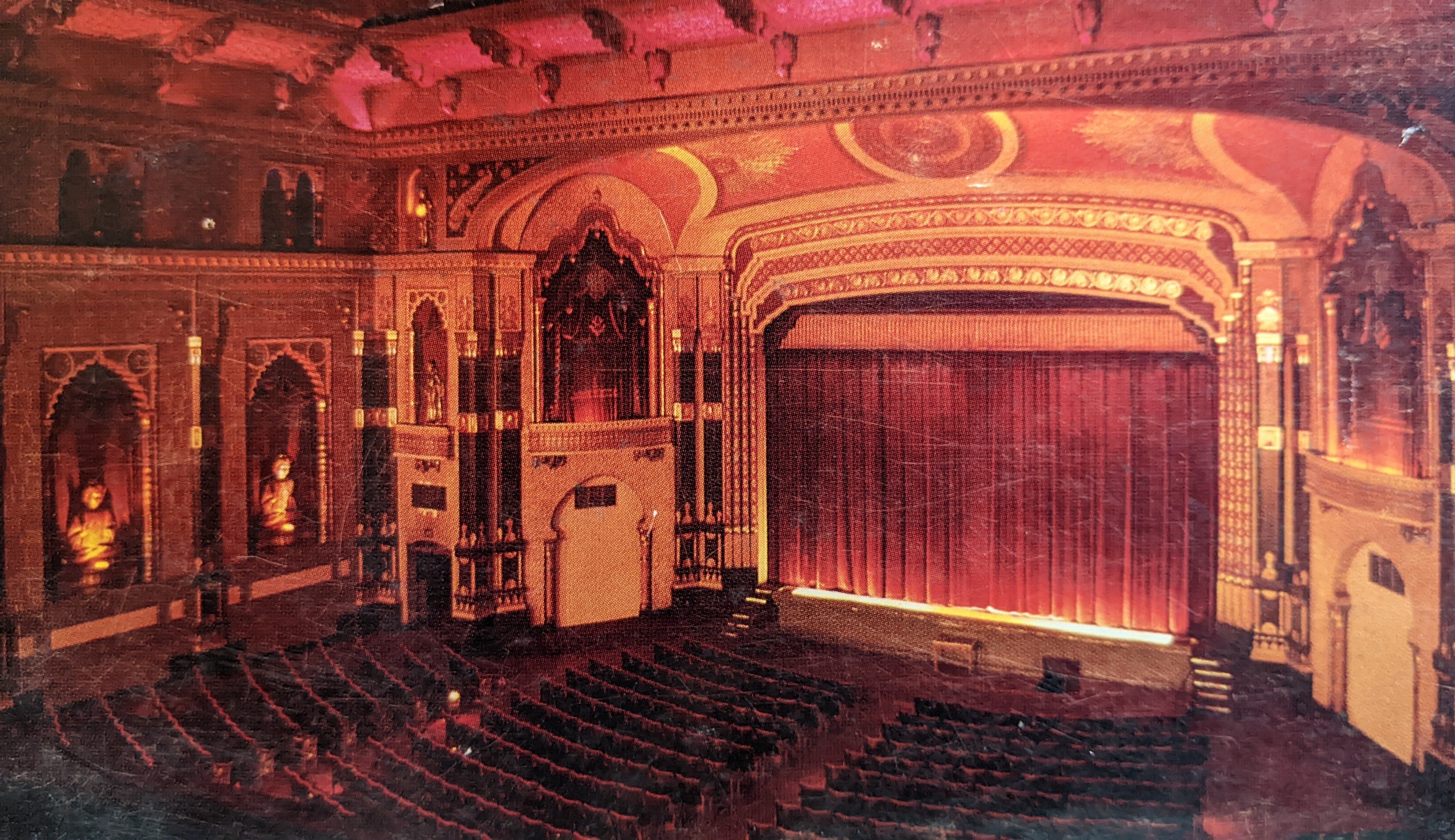
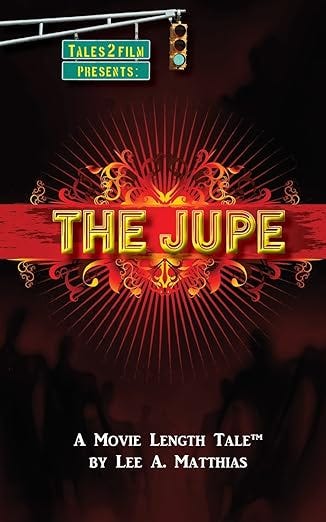
In designing my tale, I looked for events that I’d never seen before, that were chilling, but then, also, strange; I tried to orchestrate the rhythm of the narrative to build to crescendos; my shocks tried to come out of nowhere, but remain nonetheless logical and believable; and I tried to set up situations wherein my audience’s expectations would grow to the point of no return. I even paid homage to Val Lewton by finding a way to work in a “bus”. When I had a table reading of the script, one person, an old theater manager, couldn’t close the place alone for 6 months. Unusually, the script—”THE SHINING in a movie palace”—was entirely written in the projection booth of the theater it was set in, “…in the night …in the dark”. (I was a projectionist during college in that theater shown above.) Many nights over that period, while writing, I scared myself so badly that I almost could not leave the booth and make my way down through the balcony and out of the empty old theater. The script has a sense of place that I’ve never equaled since. And, while it’s never been produced, an adaptation was published:
I guess I’m glad so few films are genuinely scary. See, it’s rhythm and timing again. The bad ones serve as the valleys before the run-up to those terrifying peaks. #
Please Re-stack if you found this article of interest.