

Attention! – This is NOT about the new film, OBSESSION, by writer/director Curry Barker. It is, instead, about the 1976 film, OBSESSION, from director Brian De Palma and writer Paul Schrader.
In my piece on Alfred Hitchcock’s 1958 masterpiece, VERTIGO, I discussed, among other things, how the film’s power is sourced in our need for second chances. This was something echoed in my quoting of Martin Scorsese’s observations about VERTIGO’s film score by Hitchcock’s (and, yes, Brian De Palma’s) favorite composer, Bernard Herrmann. Everyone who has ever loved and lost will resonate with this idea of the second chance.
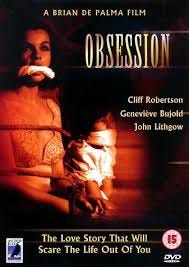
In the early 1970s, as the story goes, the so-called “movie brats” (1) met and hung out at Julia and Michael Phillips’ beach house on the California coast. Classic movies and the major auteur directors ruled the dialogue. Somewhere in all that chaos, Brian De Palma and Paul Schrader attended a rare screening of Alfred Hitchcock’s VERTIGO (it had been tied up legally with four other Hitchcock films and hadn’t been shown in several years), and, over dinner at Musso & Frank’s, discussed its ideas and power. They began hatching a film that they, at first, called, DÉJÀ VU. It had the major themes of VERTIGO, but it took them further, indeed, to forbidden and questionable places. Primary, among them, was this notion of the second chance.

CAVEAT -- For the actual and full cinematic experience, I strongly urge that you see (or revisit) De Palma’s and Schrader’s OBSESSION before reading further or basing your evaluation only on our description of the script’s inevitably inadequate words on paper. The purely cinematic touches by De Palma’s narrative and visual approach, Vilmos Zsigmond’s lush cinematography, Bernard Herrmann’s self-described “greatest” film score, Paul Hirsch’s superb editing, and the three principle actors’ measured yet luminous performances, all elevate the Schrader screenplay from an inspired blueprint to a grand amplification of its VERTIGO source. Re-watching and re-considering the film after 50 years post-release, I believe it to be a stand-alone masterpiece, easily on a level of equivalency to VERTIGO, particularly thanks to Brian De Palma’s directorial contributions to Paul Schrader’s superb final draft script (spoilers ahead).

Paul Schrader took their thoughts and ideas from that dinner discussion and wrote a 133 page screenplay called DÉJÀ VU, the as-labeled “original draft” of which was dated 1, May, 1973 (2). Beyond its VERTIGO source, Schrader’s Calvinist upbringing filtered through his rebellious sensibilities, undergraduate (Calvin College) and graduate (UCLA) education heavily informed the story, perhaps not in the way his educators would have preferred:
Initially set in New Orleans in 1956, it follows real estate businessman, Michael Courtland, at his tenth anniversary party of his marriage to wife, Beth, having met at a church and then wed in post-war Italy.

After the party, he discovers his wife and 9 year-old daughter, Amy, have been kidnapped. He’s shattered. When, following the FBI’s orders to deliver blank paper to the kidnappers, he loses his wife and daughter to a fiery crash during the kidnappers’ escape attempt. The burned remains end up in a family crypt on land he and his business partner, Robert Shore, owned and had intended to develop.
We move forward eighteen years to 1974. Courtland, melancholic and having never fully recovered from the loss of his family, prepares for a business trip back to Florence, Italy. While there, he visits the church where he had met his wife, Beth, and encounters a young woman, Sandra, who is the living image of Beth as she was when he met her in 1946. And, so, his love for Beth is reborn in Sandra. For him, now, years later, that second chance looms. We learn she’s a young, volunteer art restorer, repairing a Renaissance painting of the Madonna and Child adorning the wall of the church.
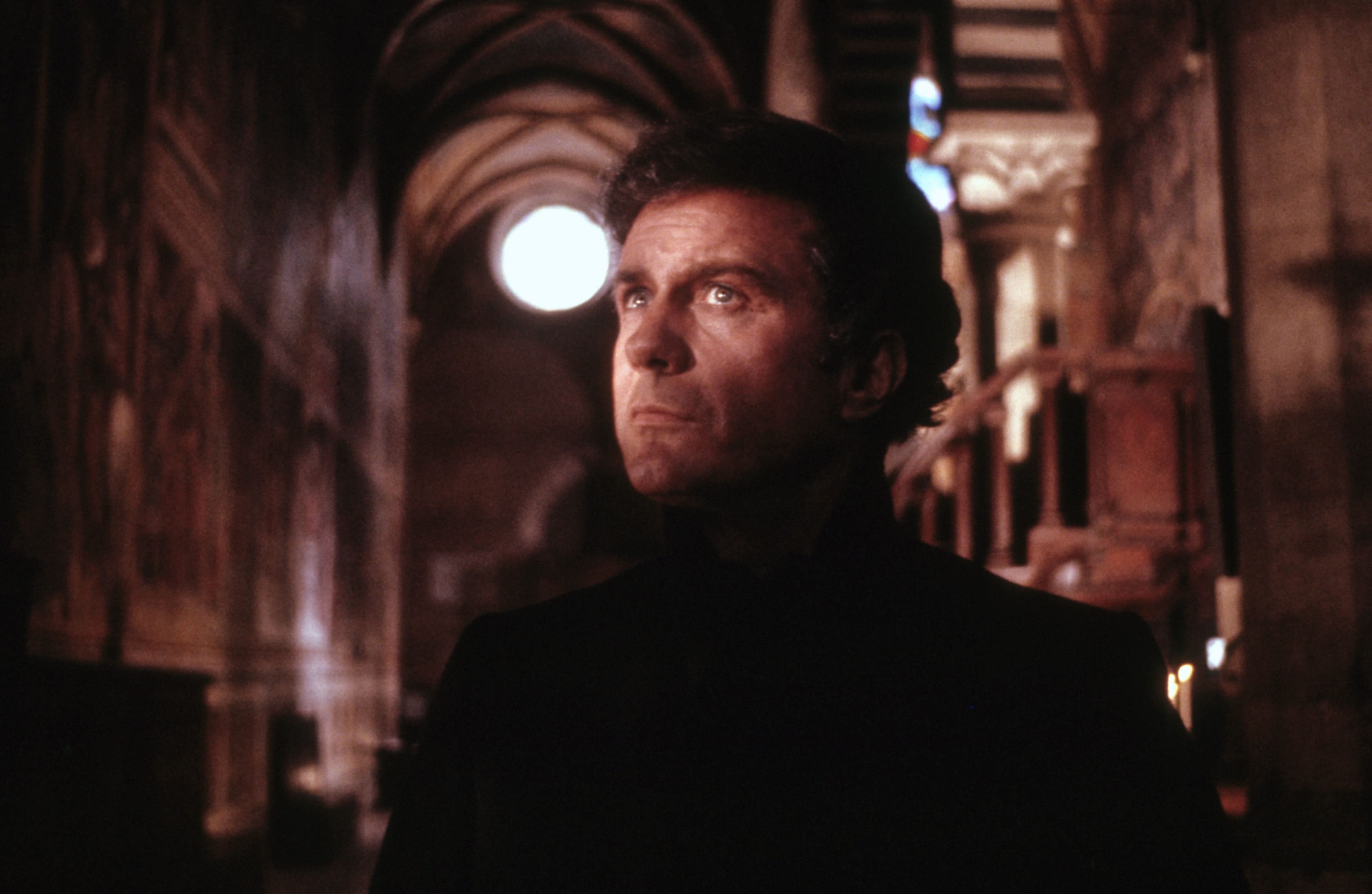
In Act 2, remaining in Florence, he gets acquainted with Sandra, falls in love, woos her, and in a matter of days, proposes. She eventually accepts. Returning, finally, to New Orleans, he brings Sandra back with him, planning a big wedding. His business partner, Bob Shore (changed in the film to Bob La Salle), and his personal assistant, Janie, are skeptical of this whirlwind romance. Jane, who has harbored a career-long unrequited crush on him, even plays a cruel joke on Courtland and his intense obsession with Sandra. And then, making it worse, she calls in the psychiatrist who had helped him recover years earlier from that loss of his wife and daughter. Enraged at this intrusion, Courtland quits his business partnership, locks himself and Sandra away in his gated suburban home, and proposes they marry immediately, instead of at that church wedding. They get a Justice-of-the-Peace and are wed right there in the house. That night, they consummate the marriage in his bed. Afterward, Sandra eerily proclaims herself to be Beth! She tells him she can prove it, and sends Courtland to the crypt where he finds Beth’s urn empty. Nonplussed, he, nonetheless returns. Then, awakening in the morning, he finds Sandra gone, and, in her place, a ransom note, horribly repeating the earlier kidnapping of Beth and Amy. This sends Courtland over the edge.
So, now, in our third and final act, he races to the office and has Shore get the business’s cash from the office safe, put it in a briefcase for him, and Courtland travels to the drop site outside the city via commuter train to ransom his bride. He tosses the valise with the money from the train exactly as he had eighteen years earlier. But, after he returns and hours pass, when she is not returned to him, he goes back to the drop site by car and discovers the cast-aside briefcase opened with some of the bills—blank again—scattered and flying in the wind, instead of the real money he thought Shore had given him from the safe.
It’s here, in the final act, that De Palma and Schrader give us the same “gift” Hitchcock had in VERTIGO:
Wherein (VERTIGO spoiler ahead), unbeknownst to Hitchcock’s hero, Scottie, the Madeleine look-a-like, Judy, is revealed to us to have conspired in the murder of Elster’s wife, and, despite it all, has fallen in love with him. So, novelists, Boileau and Narcejac’s mystery, that was, in the novel, revealed to the hero and us at the end, was elevated to Hitchcock’s suspense film, and revealed to only us in advance of the end. Thus, this provides us delicious anticipation as we watch Scottie uncover the mystery and then take decisive action leading to what is, at that point, an unknown resolution.
In Schrader’s script, Bob Shore and Sandra, at the airport, prepare for her return to Italy. Together, they’ve conspired to swindle Courtland out of the ransom money. Shore, apparently, had somehow found her while in Italy and enlisted her in his plot to wrest the partnership’s money for his own real estate venture. Shore urges her to accept payment, but she, now in love, and distraught, wracked with guilt, having realized the betrayal she just committed, at first refuses, but then, to make him drop it, she takes his money. Shore puts her on the plane, and leaves for his office.
At the ransom site outside New Orleans, Courtland, shattered again at having made the same blunder as he had in 1956 (by following the FBI’s instructions and “paying” the ransom with phony money), races back to the office and, now enraged, confronts the returned Shore, demanding the actual money. Shore claims he was protecting Courtland from losing it. Courtland believes he, himself, is now responsible for killing Sandra the same way he feels he killed Beth and Amy. He attacks Shore, and finally wrests a confession: Shore set up the first kidnapping and was responsible for the earlier deaths. And the second. Sandra was part of it! Courtland grabs a pair of scissors and stabs him to death. Dazed, now with these revelations, he goes to the crypt and finds Beth’s urn somehow actually does contain her ashes (put there, we realize, by Sandra). As he collapses to his knees from it all, the police arrive and arrest him.
On the plane, struggling with what she’s done, in and out of a hallucinatory dream, Sandra goes to the restroom intending suicide.
Back in the U.S., Courtland, initially facing a murder charge, thanks to the testimonies of Jane and the psychiatrist, is judged insane and committed to a psychiatric hospital.
Years pass. It’s now 1985. Courtland is finally released from the hospital to Jane and the psychiatrist, recovered and functional, now, at least as much as anyone could be, and, ironically, a rich man from the sale of the land he and Shore had planned to develop.
He returns to Italy, and, in Florence, goes to the church several times where, after the war, it had all started. In one of his visits, he sees Sandra… She’s sitting, staring at the same painting of the Madonna and Child that she had been restoring when they met. She’s trance-like, catatonic, and escorted by two nuns. They pull her up, walk her out of the church, and he follows them as they go to a nearby hospital. Later, inside, he talks to the head priest and learns Sandra has been in that condition since returning from America years earlier, and they know almost nothing of her past, nor how or why she is in her condition. Courtland identifies himself to the priest as Sandra’s “uncle”. He then identifies a picture they have of Robert Shore (which they had found in their otherwise unsuccessful investigation of Sandra) as her husband. Now, according to Courtland’s “story,” Shore (as her husband) is, himself, insane and hospitalized just like Sandra. The priest says they are at their wit’s end as to how to help her. Courtland explains “what little he knows,” since he was “out of the country when it occurred”. He tells the priest about a botched kidnapping that resulted in Sandra’s husband being committed.
So, the priest proposes that, together, they stage a kidnapping, recreate what had caused her condition, with Courtland posing as her husband. He would finally successfully “pay” the ransom. It could have the effect of shocking her enough to pull her out of her catatonic state, the priest argues. Courtland is skeptical, unwilling, but, after reflecting on it for a few days, finally agrees. So they recreate the kidnapping, and, as Courtland arrives with some actual money that they’ve managed to gather in a valise, Sandra responds as the priest hoped, and does, indeed, come out of it. Then, recognizing Courtland, eyes wide, she shouts, “Daddy! Daddy! You’ve paid the money!” Courtland, reeling, realizes that she’s not Sandra, not his wife’s doppelganger, that she is, in fact, Amy, the daughter he’d thought he’d lost forever. Rushing forward, sweeping her into his arms, he embraces her, embraces the second chance she indeed is, and, as the film ends, the camera circles them, around and around, the credits rolling, to Patti Page’s soaring voice:
“So I’ll keep changing partners until you’re in my arms, and then, Oh, my darling, I’ll never change partners again.”
DÉJÀ VU, as drafted in that 1973 “Original” was a cinematically ambitious, narratively daring, unabashed emotional roller-coaster of a screenplay. It demanded both vivid yet subtle direction, powerful yet haunting performances. It required that they render the emotional highs, the crushing lows, and the intimate ironies, in ways that never cross into clearly threatening sentimentality or, worse, embarrassing absurdity. Only a relatively fresh young screenwriter would have the sauce to try. Any reading without a clear awareness of its pedigree in VERTIGO, and its place in the cinematic universe, must toss it back through “the transom,” and move on to the next prospect in “the proverbial slush pile”. But Paul Schrader was no newbie. Nor De Palma. Both cheerfully put their necks on the block and dared the falling blade.
Consider: it must conceal the mystery at the heart of the plot. Then, after Courtland and Sandra’s marriage, we realize, in retrospect, that it literally depicts incest! And then, at the end, it asks us to believe that the hospital priest and Courtland would, somehow be able to convincingly recreate the kidnapping, with the resources at hand, complete with thugs, ransom money, and a hideout. Finally, it expects us to believe a performance depicting Sandra emerging out of a decade of catatonia, would believably pull off being revealed, incredibly, as Courtland’s daughter. The performances of Michael Courtland and Beth/Sandra/Amy would require dramatic ranges and technical skills equivalent to or beyond those of James Stewart and Kim Novak in VERTIGO.
All this, we are to accept.
All this, we are to believe.
No studio was interested. No independent money was available. No distributor wanted to handle it.
At first.
Brian De Palma would not be denied.
After that 1973 draft, De Palma re-worked Schrader’s script. Either he or Paul produced a new, 102 page draft. I suspect it was De Palma, because the typeface is different than the other two matching 1st and 3rd drafts; and the style is… sloppier. It was leaner. It was faster. But it couldn’t correctly number its own scenes. It still had the incest, and it still had that 3rd (recreated) kidnapping. And, most definitely, it still remained a big “ask” as far as the believability and the requirement of becoming a releasable film. But it moved, and, as a result, the costs had, to a degree, come down.
De Palma found an independent producer in George Litto (who, then, carried some heavy interest on loans for the project over the next two years). Litto found lawyer tax-shelter money in Cincinnati. (This was before that kind of financing was stopped). He found another “sugar-daddy” with money somewhere else. He even raided his savings and mortgaged his house for more. For his part, De Palma found actors in (surprisingly) Cliff Robertson, (magically) Geneviève Bujold, and (wonderfully) John Lithgow.

He even tracked down Hitchcock’s composer, Bernard Herrmann (by that time a recluse, living in England, and out-of-favor with the studios because of his legendary obstinacy), the man who had scored Orson Welles’s CITIZEN KANE and THE MAGNIFICENT AMBERSONS (!), Alfred Hitchcock’s VERTIGO, PSYCHO, and NORTH BY NORTHWEST (among many others!—De Palma’s employment of Herrmann in his earlier film, SISTERS, had renewed Herrmann’s career, and he ended up scoring Scorsese’s and Schrader’s TAXI DRIVER, too).

And finally, De Palma found a distributor in Columbia Pictures (employing a fella by the name of David Begelman, who will appear in a bit).
But, even so, the money was still too low. The explicit incest was objected-to. And even composer Herrmann told him to cut the whole third act kidnapping re-enactment. He said it didn’t work. (I agree. It was one kidnapping too far.) And all that, by the way, may have lost him Paul Schrader… at least, perhaps, for a while.
But, De Palma… Schrader… Scorsese… audiences… even the cultural zeitgeist that never stopped loving VERTIGO… maybe even VERTIGO, itself! (because it had failed financially on release)… all of us… we’ve all wanted that second chance.
So, a revised draft was written: the one that was, for the most part, shot. Dated the 17th of January, 1975, it was even more efficient. It ran only 97 pages. The incest was dropped. The kidnapping in Italy was cut. In fact, in the 3rd act, Italy, itself, was cut. In this draft, and in the film, Shore—now La Salle--and Sandra arrive at the money drop, and we learn that Sandra is not only part of the deception, but she’s Courtland’s daughter Amy (!), brought into the plot by La Salle to get the real estate development money. The reasons are complex: La Salle must have, back in Italy (before Courtland sees her as Sandra), told Amy that her father abandoned her and her mother with his failure to pay, eighteen years earlier, that she could avenge her and her mother’s betrayal; that she would be well-paid, her future in Italy set. But she realizes that she now knows her father and she loves him, and, with the ransom again, unpaid, when he doesn’t get her back, and realizes the money was never received, he’ll blame himself again! He’ll be destroyed. And… she’ll lose him, too… again. She’s overwhelmed by the guilt and the loss. La Salle, for his part, needs her to believe Courtland has, once again, betrayed her so she’ll hate him going forward, return to Italy, and never come back. So, then, after Sandra has taken La Salle’s payment (only to get away from him), she gets on the plane. But, though struggling with the guilt and the loss of her father, she is able to pull herself together just enough to scrawl out a letter to Courtland, admitting her complicity, revealing herself as his daughter, and asking for his forgiveness. But, then, after completing it, believing it must be futile: too little, too late… she crumples it up.
Sound familiar? It followed the Hitchcock (and screenwriter Samuel Taylor) example in VERTIGO where Judy writes her letter confessing and expressing her love for Scottie. And now, according to that Hitchcock suspense template, we, as the audience, know more than the hero. And we are set up, now, to watch him learn it and see what he does about it.
So, realizing she’s lost him: betrayed him and likely destroyed him… now, unbalanced, despairing, and in her futility, she decides to kill herself. But inside the plane’s cramped restroom, after cutting her wrists, collapsing and hitting the door, she’s heard and then found by a passing flight attendant. And her suicide attempt forces the plane to turn back for New Orleans.
Meanwhile, as in the earlier drafts, Courtland has killed Shore/La Salle, and, knows from La Salle’s confession that she’s complicit. He intends to catch her and end the deceptions and the torture for good. Courtland gets La Salle’s gun from his desk, grabs the new briefcase La Salle planned to take, filled with the money, and heads for the airport. There, he discovers Sandra’s plane has already left. So, now, still crazed, still enraged, he hesitates. But the woman at the gate who had told him the plane had left, suddenly gets a call, looks back at him, and tells him the plane he wanted “had engine trouble” and has returned, in fact, is already about to disembark at another gate. So, still deranged, still seething, determined to finally finish it, he heads off to kill her.
Nearing the gate, he sees her being wheeled out of the jet-way via wheelchair, her wrists bandaged, still in a daze. Running, he raises the gun. An airport cop standing right there sees it, lunges, tackles him to the ground as the gun goes off and the briefcase flies, releasing its treasure mid-flight. Sandra has looked up, sees Courtland, sees the briefcase, sees the cash swirling in the air. She gapes, a little girl again, shouts “Daddy! Daddy! You came with the money!” Rising from the wheelchair she runs for him. And, having risen to his feet, Michael Courtland finally recognizes his long-lost daughter. He bellows, “AMY!” And, now, overwhelmed, but still processing it, he gathers her into his arms, they lock together, hugging for every moment they’ve lost, spinning in near delirium. And as the money swirls about them descending in the air, and the film is reaching its end, the camera circles the other way, around and around, and Bernard Herrmann’s music plays us out.
As for Patti Page’s soaring voice? Songs are expensive.
Unlike the Hitchcock film, OBSESSION made money. Still, because of its pedigree, many people hated it. Perhaps, now, decades later, it can get the respect and appreciation it deserves. Had there been no VERTIGO there would be no OBSESSION. But, remove from memory the Hitchcock film and OBSESSION accounts for itself superbly. Outraged cinephiles accusing the film of thievery, and so blasphemy, need to step back and apply those same standards to straight mystery-thrillers, films noir, war stories, westerns, or romantic comedies. Suddenly such trope-borrowing is completely overlooked or described as legitimate “homage”. And the hypocrisy is either ignored or not even recognized.
Brian De Palma provided directorial touches and flourishes that the script, at best, only hinted at. Zsigmond’s imagery was not merely lush, it contributed to the mystery, the feeling of times long past, the old south. Ditto the production design. Robertson actually delivered an understated, nuanced performance, rather than the stiff, and uncooperative one of which he’s been accused. Bujold’s Beth/Sandra/Amy haunted us, convincingly rendering the ages each of her three characters were at, across the film. The relatively new John Lithgow created a southern, aristocratic villain few veterans could match.
So, then… David Begelman… Well, Wikipedia tells us this:
“Begelman left the talent agency he had founded, CMA, in 1973 to take over the floundering Columbia Pictures. Begelman used his package method at Columbia, dramatically changing the company’s image by producing such hits as Shampoo (1975), Funny Lady (1975) and Close Encounters of the Third Kind (1977).
“In February 1977, actor Cliff Robertson received a 1099 form from the IRS indicating he had received $10,000 from Columbia Pictures during 1976. He had never received the money, and discovered that his signature on the cashed check had been forged. Robertson’s report started a criminal investigation. The LAPD and the FBI verified that the $10,000 check was a forgery, and it was tracked to Begelman [and drawn from the profits from Robertson’s film for Columbia, OBSESSION.] He was ultimately fined and sentenced to community service and a public service, anti-drug documentary for the forgeries.
“Columbia Pictures suspended Begelman on a paid vacation and announced its own investigation. The studio discovered that Begelman had embezzled an additional $65,000 through other forged checks. However, the studio board of directors wanted to keep the matter out of the press. The Begelman scandal led to a rift between Columbia executives. Columbia Pictures CEO Alan Hirschfield was ousted from the studio in 1978 following his refusal to reinstate Begelman on moral grounds. Following a brief reinstatement, Begelman was quietly fired. The studio released a statement saying he had suffered emotional problems.
“Kirk Douglas, in his autobiography The Ragman’s Son (1988), wrote of the scandal:
“This is the town where Cliff Robertson exposed David Begelman as a forger and a thief, with the net result that Begelman got a standing ovation at a Hollywood restaurant, while Robertson was blacklisted for four years. On the bad days, you think of what Tallulah Bankhead said: ‘Who do I have to f--k to get out of this business?’
“A writer for New West magazine, working on this story, queried Begelman’s claimed alma mater, Yale University, listed in his Who’s Who entry. Yale responded that Begelman had never attended that university. The New West article said that ‘although Begelman was indicted for forgery and grand theft, the Hollywood types were more outraged that he had listed Yale in Who’s Who. Apparently they figured that everybody steals money. It was the fact that he lied about Yale that drove them crazy.’”
Later, it emerged that Begelman had forged checks with his CMA client, legendary actress, Judy Garland, in the 1960s, and even indirectly, “acting as the messenger,” blackmailed her for $50,000 with a nude photo of her that he claimed he was shown from one of her hospital stints during a drug overdose episode when they pumped her stomach.
Despite all of this, Begelman got a “second chance” when he was hired by MGM as its COO. After that, he got a third chance as CEO of United Artists. And, still later, a fourth chance running Sherwood Productions. Finally, he created his own production company, Gladden Entertainment and Gladden Productions, but after a successful series of films, he eventually ran those into the ground.
From Wikipedia, again:
“Begelman (3) became depressed over his [personal production company] Gladden Entertainment[’s] bankruptcy and [his] failure to find funding for Gladden Productions. Begelman was found shot dead in a room at the Century Plaza Hotel in Los Angeles on August 7, 1995, at the age of 73. His death was ruled a suicide.”
And so it goes…
He would have been more accurate to have named it Sadden Entertainment.#
Please Re-stack if you found this article of interest.
(1) Steven Spielberg, George Lucas, Francis Coppola, CARRIE director: Brian De Palma, TAXI DRIVER screenwriter: Paul Schrader, PATTON & APOCALYPSE NOW! screenwriter: John Milius, THE STING & MAJOR LEAGUE screenwriter: David Ward, TAXI DRIVER producers: Julia and Michael Phillips, AMERICAN GRAFFITI screenwriters: Gloria and Willard Huyck! It rivals that house in Laurel Canyon where Joni Mitchell, Crosby, Stills, Nash, and Young, the Mama’s and the Papas, the Beach Boys, and all the other California and British Invasion musical Gods passed through (even, possibly, Charles Manson!), and it makes Shane Black’s legendary “Pad O’Guys” look like a cub scout sleep-over.
(2) FYI – There’s a video release of the film available from Arrow in the UK that includes a copy of this “original” 133 page draft of the script as well as the 38 minute “making of” film offering interviews with De Palma, producer Litto, Director of Photography Zsigmond, Editor Hirsch, and actors Cliff Robertson and Geneviève Bujold, from among the special features.
(3) The sad and sordid story of David Begelman and the darker side of Hollywood big business is chronicled in depth in David McClintick’s, book, INDECENT EXPOSURE.
Just an update:
A friend said OBSESSION (1976) was a VERTIGO rip-off. And while I don't disagree that it was a different take on a similar idea, it wasn't a rip-off any more than:
MAGNIFICENT 7 ripped off 7 SAMURAI, or
BATTLE BEYOND THE STARS ripped off 7 SAMURAI, or
A BUG'S LIFE ripped off 7 SAMURAI, or
RED RIVER ripped off MUTINY ON THE BOUNTY, or
OUTLAND ripped off HIGH NOON, or
ALIEN ripped off IT! THE TERROR FROM BEYOND SPACE, or
IT! THE TERROR FROM BEYOND SPACE ripped off A.E. Van Vogt's story BLACK DESTROYER, or
WEST SIDE STORY ripped off ROMEO AND JULIET, or
7 BRIDES FOR 7 BROTHERS ripped off THE SOBBIN' WOMEN, or
THE SOBBIN' WOMEN ripped off Livy and Plutarch's ripoffs of...
THE RAPE OF THE SABINE WOMEN, or
TERMINATOR ripped off SOLDIER (Harlan Ellison's Outer Limits episode)--oh, yeah, I guess it did.
In fact, it was way less of a rip-off than those. It didn't have the same plot, just similar motifs.
And, where...
VERTIGO had a pretty cheesy psychological hallucination sequence...
and weird green filters...
and so much illogic that it could only be a dream (see my article)...
OBSESSION (1976) had no dreams...
and had no hallucinations...
and was entirely logical (yeah, maybe far-fetched, but watch NORTH BY NORTHWEST again)...
VERTIGO is about an ex-cop suffering from vertigo hired to follow his friend's wife because she thinks she's the ghost of a dead woman, then falls in love with her, only to...
OBSESSION is about a guy who loses his wife and daughter to a botched kidnapping, years later finds and marries his wife's doppelganger, and then loses her to an identical botched kidnapping, only to...
Where are they the same? I'll wait...
OK, yeah, they both had music scores by Bernard Herrmann, but even he thinks his OBSESSION score was better than his VERTIGO score. In fact, he said shortly before he died that his music for OBSESSION is his greatest film score. Better than REBECCA, better than THE MAGNIFICENT AMBERSONS, better than CITIZEN KANE, for God's sake!
So the huge volume of criticism I've seen out there condemning O for trying to be V is just... V fanboys having a tantrum.
Maybe now, 50 years after release, people can see OBSESSION as a stand-alone masterpiece...
Which it is.