

Excerpted from my book, LATERAL SCREENWRITING - Using the Power of Lateral Thinking to Write Great Movies
Is it the Chicken’s Story or the Egg’s?

I have mentioned elsewhere that I have heard many writers claim that they devise their stories from character. In other words, they have in mind a person or persons, and from that they generate a story.* (1) An example of this would be Paul Schrader’s screenplay for AMERICAN GIGOLO. It was the result of a discussion on character-types held in a class he taught. The occupation of gigolo came up. The character literally was supposed to have implied the story. Other examples of this approach are historically-based bio-pics, particularly those very loosely-based upon their source, or fictional tales like SCARFACE and FORREST GUMP.
Generally, I don’t do this (though I have in the past, and may again). I prefer to have a situation, a dilemma, or a fictional world within which to work. I like to develop a character out of the character’s potential for collision with the story so that, one might say, I can get “the biggest bang for my buck.” So, for me, the situation comes first, the character second. This is because I believe that environment, the situation, and the problems have far more potential to generate interesting stories than proto-characters in some pre-story isolation (unless they are especially unique characters such as television’s Monk, or Dustin Hoffman’s character, Raymond Babbitt, in RAIN MAN).

There’s an old truism that no matter where one goes in the world, under the skin, we are all alike.* (2) If that is so, while I admit it can and does go the other way, as a source for interesting stories, I will put my money on the problem rather than some interesting individual. But others prefer to find an intriguing character and see what happens, trusting the presence of the particular character to provide the needed audience appeal.
In my experience and observation, generating stories out of character alone* (3) often results in forcing the writer to settle for what I would term, routine plots, plots overshadowed by the character’s extra-measure of razzle-dazzle. And this is true for the Schrader film. It uses a fairly standard mystery plot, but what interests Schrader in his film is the character, the world of that character, the look of that character, and the frisson (see footnote 4 below) he inserts at the end when the gigolo gains the ability to love. Ultimately AMERICAN GIGOLO fails to stand out because the story itself offers nothing sufficiently new. We’ve seen that sort of plot many times before, despite Schrader’s injection of that character. And the look of the film got it only so far: “all flash and no cash,” “all yak and no shack.” Also, its Bressonian* (4) inspiration is missed by almost everyone, though, I suspect, for Schrader, that hardly mattered. FORREST GUMP achieved greater success, I believe, because it found a profound and universal truth out of its focus on the character, namely the values to be found in living simply, or simply living.
But writers starting from character generally don’t hold the same acceptance for starting from plot as I do for their approach. They may be rationalizing that plot-based writing undermines the truth these writers believe they are revealing about their people. If the character is formed out of the needs of the story, they might be arguing, the character does not have that quality of randomness found in reality, that quality of truth that demands, “take me as I am, no matter the result.” They seem to believe that it exudes artifice, a feeling of having been constructed, of not being real. I would counter that this is self-delusion: bad stories can come out of plot, character, or the movie you saw last week, just as easily as anywhere else. And if the story seems to them artificial and contrived, that is not the fault of the design approach itself, but rather the craft employed in said approach.
A Servant of Two Masters
Still, many writers need to believe they are writing people who, if they haven’t actually lived, would be able to, should God so choose. These writers go so far as to build elaborate back-stories for their people, filled with life experiences, set-backs, family members, and friends. They’re given flaws to hinder them in the story, and even flaws that have no apparent reason-for-being, except that a trivial flaw in the character carries just the right degree of verisimilitude: “It’s there because it’s there, not out of any story need!” cries the writer. Such flaws function just as any extraneous details do in life: because the character is real, not written. The flaw in Evelyn Mulwray’s iris in CHINATOWN, for example, may appear trivial, but serves as metaphor, a more subtle version of Achilles’ heel.

Such elements offer a quality of real life to the work. Actors love this sort of thing because it gives them sources for the detail, the business, they bring to the individual on the page. It’s, of course, obvious, however, that even this falls well short of creating living, breathing, human beings, even with the actor inhabiting the role.
All of this, I would argue, is a byproduct of the nature of cinema to create a kind of reality. Photography captures images of reality and displays them. Cinema heightens that, first with movement, and then with sound. But, the addition of artificial lighting, and then image and sound editing begins the process of deception. Artificial settings and ultimately story take it the rest of the way. These are not real events, not real problems, not real behaviors that have been recorded and revealed. And these are not real people. Most films embrace this tendency toward realism, offering stories that look like they could have actually happened. Others make their non-realities look that way, too, achieving a fantastic result. I have no quibble with any of this. In fact, I, too, embrace it. I only question the belief that, out of fidelity to them, as a writer, my highest goal ought to be to serve my characters. My highest goal is to serve my story, have my characters serve my story, and this out of fidelity to my audience. Ultimately, then, the writer serves the audience, and this through character serving story. If the story serves the character, it is the tail wagging the dog.
Characters Aren’t People, Too!
Many writers believe that characters in films can be realized as thoroughly as those in novels. On the surface it looks so. After all, once on the screen, there they are: living, breathing, walking, talking. The presence of the actor in the role is deceiving, however. Characters in films are just not that well-formed.* (5) We aren’t inside their heads, so we can’t experience the events of the film as they do. Whenever Hollywood tries to get inside a character’s head it has the effect of pulling us out of the story and the filmic reality, rather than in, making the film less realistic instead of more.* (6)
In fact, as concerns our knowing and understanding the people around us, neither are they sufficiently formed and so understood in life. Does one really know his friends enough to predict their every behavior? Does one really know oneself? At least in novels, the writer can reveal his characters’ thoughts. Movies “ain’t so lucky”—very often when they try, they look quaint or downright silly: like in those old detective movies where the private eye narrates the story: “I walked into the room, there was a thud, and my world started spinning. Then... darkness!”

CITIZEN KANE is a clinic on the impossibility of understanding character: it demonstrates that no one really knew Charles Foster Kane, not even we, the audience, after witnessing seemingly every relevant detail in his life. We had to be shown the sled before even that single relevant truth of his life became clear.

And, once revealed, was even that the pivotal insight to Kane? No, of course not! So, characters in story cannot be real. We can only make them look that way. And when that takes precedent over the story, itself, that’s, as we’ve said, the tail wagging the dog.* (7)
What’s the larger purpose of character in story? We’ve seen that it is to render a kind of reality; but, why? Not because characters are merely supposed to be real. As we’ve shown, how could they be? But also, why should they be? No, characters, despite their acknowledged prominence in stories, are still there to serve stories. The ones that get the most attention in the story are really just avatars for, and representations of, the audience! The writer’s responsibility to his characters, must, of necessity, be subservient to the larger story.
Writers: trust me! Once you get past the discomfort this may be causing you, you will feel much better. It sets you free, after all. You don’t have to artificially constrain yourself out of some misguided sense of duty to a truth that has never, and can never exist! Suddenly you can make your characters do and be everything you (and the story) need of them. You’ve had no difficulty applying this notion to the events of your story, so... have none applying it to your people!
If a Character Dies in the Woods, Does he Make a Sound?
The question remains, then: how are characters well-realized in film? Just as screenplays must render novel-length stories in a third or less space than their literary cousins, characters must be rendered in minimal yet potent detail. The notion of the iceberg-tip is apt. Much of character development in film must be implied--there, yet below the surface. And this is made possible by the illusion of reality created by the presence of the living, breathing actor inhabiting the role.

Screenwriter, Sterling Silliphant (ROUTE 66, IN THE HEAT OF THE NIGHT, CHARLY) illustrates this in his interview by William Froug in The Screenwriter Looks at the Screenwriter, p. 318:
“...at the end (of DR. ZHIVAGO, screenplay by Robert Bolt), when Alec Guinness is narrating and saying the government said no one was to come to the funeral, but thousands came, you see people walking around the coffin. He’s in the center. Julie Christie comes running across through the crowd and up to him and she says nothing sentimental, after all they’ve been through in this movie together. Russia has fallen. Millions have been massacred. These people have been through hell. Her man is dead. They’ve been lovers. And she says to the brother, ‘I knew him’ and the brother says, ‘I know.’ And she says, ‘Can you help me?’ That’s all there is to the scene. Tears you apart. Now that is writing... It strips down to its very essence the emotion of the scene... That’s Hemingway’s one-eighth theory, with seven-eighths below the surface. But to build the top of the iceberg, you’ve got to have it afloat. And it’s in knowing what you can leave out, because you know it, that you have confidence.”
It is my belief that, with a few exceptions, primary characters must first fit their roles reasonably. They must seem right for the position they occupy in the story’s universe. This does not mean they cannot have features that deviate from that requirement, but that, for the most part, they feel right for what is or would have been demanded of them before the potentially role-altering events of the story put them to the test. My exceptions to this are usually found in a certain type of comedy, where the central character is a true fish-out-of-water, and is totally inappropriate for the role he/she inhabits.* (8) Primary characters need to meet their audience’s expectations so that their suitability for their role can become a baseline from which the dilemma of the story can challenge them.
Most of what become your characters must, of necessity, be left implied. They are people that the audience, itself, is left to build. What is unseen and unknown about them becomes chosen and assigned them by the people watching them and identifying with them. In truth we know them no better than we know the trees we grew up climbing as kids: we know the branches we can depend upon, the best limb from which to hang a swing, but of the tree itself? What can we really know? So, if a character dies in the woods, does he make a sound? Even Bernie Bernbaum (John Turturro, MILLER’S CROSSING) never knew.

Do Tell
But, returning to that allusion to the iceberg, realism, immediacy, and space constrictions demand that character be revealed only as the result of the business of, and events in, the story. Therefore, it must be accomplished through some few telling details, details that imply a whole lot more where they came from. A great example of this is found in Francis Ford Coppola’s film and screenplay, THE CONVERSATION.

Gene Hackman’s character, Harry Caul, a freelance intelligence operative who eavesdrops electronically on people and companies for hire has a solitary hobby of playing a jazz saxophone. It has the effect of accentuating his utter loneliness, especially at the end when he sits in his living room playing for no one. Around him, his house has been gutted to the beams themselves--he’s searched in vain for a bug he fears is eavesdropping, now, on him. His trade is sound, so his deepest self emerges as sound.

Even his name, Caul--a covering of an infant’s head from the amnion at birth--offers comment on his character: hidden, unaware, sightless. Another example would be in Colin Higgins’ film and screenplay, HAROLD AND MAUDE, where both Harold and Maude attend strangers’ funerals for their own reasons, and Harold repeatedly fakes suicide for his mother as a last ditch bid to awaken and win back her dormant love. These are telling and behavioral details.* (9)
I should also note that I use the term, “behavior,” to include dialogue and its performance, as long as they meet those internal story needs. As such, this would include examples such as: the behavior of the characters of Radar and Lt. Col. Blake in the original film, M*A*S*H, when they talk over one another to the effect of drowning each other out—was there ever a better metaphor for the insanity of war?; the character of Woodcock in BUTCH CASSIDY AND THE SUNDANCE KID when he successively, at each new train robbery, re-warns the Hole-in-the-Wall gang of his empowerment by “E.H. Harriman of the Union Pacific Railroad” while standing inside the railcar even as they blow the door.
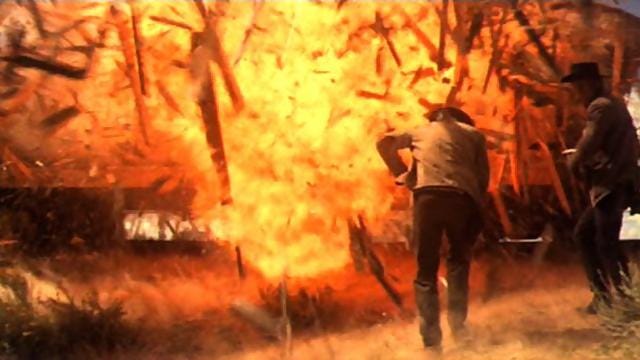
Details all, these add to each character, informing us and providing signatures of who and what kind of people they are.
Detail is the currency of character in cinema. It has the great power to inform us with sufficient information to know what is most important about them. The mirrored sunglasses of the head-guard overseeing the chain-gang in COOL HAND LUKE say in a glance all we need to know about him: if the eyes are the windows to the soul, he’s unreadable, emotionless, heartless, without a soul, the embodiment of “the system.”

The stapler that the character of Milton covets in OFFICE SPACE tells us everything we need to know to understand him: it’s one of the most trivial items in any workspace, a tool many of which are known to be poorly designed and prone to jamming. So Milton’s obsession with keeping his Swingline illustrates how powerless he is in controlling the things in his world. Even popcorn movies like the Indiana Jones films use detail effectively: Indy hates snakes, yet his weapon of choice is a snake-like whip, allowing him some measure of control and mastery over the thing he fears most. A telling detail can render people with amazing facility. But, when it comes to detail, less is more.
Speaking in Tongue
A common criticism of characters in the works of new writers is that they all talk in one voice. To most critics this means there is no discernible difference between otherwise different characters. They use similar words, similar rhythms in their speech, and they sometimes even hold similar values despite their opposing roles. Writers can spot this in their writing by listening to their dialogue in performance. Most will be amazed at how it sounds as compared to how it seemed when played only inside their own heads. I strongly recommend writers do a table-reading of the script with actors (or at least vocalize their scripts’ dialogue aloud) before the script goes out. This is an important and necessary step in the review process, and no effort is truly complete until it has been performed.
Put it on the Resumé
Other criticisms include the catch-all that the work “needs more character-development.” Having read a great deal of story analysis over the years, I have found that very often, this criticism is reader-shorthand for, “something’s missing, but I don’t know what it is.” The critical reader may be inept or he fails to connect with the piece for any number of reasons from personal taste to a bad hair day. Some inexperienced analysts look for novelistic characters in screenplays, not allowing for the effect the direction, the editing, the actors and their performances, the visual behavior and the telling detail all eventually bring to the synergy within the film. So, pointed toward their characters by the analyst without a clue, writers evaluate their people and naturally discover that more can be said about them. Really, now: is that ever not true? What story couldn’t benefit from more character development? At some point, the audience either gets it or never will!
Nevertheless, they consider the problem, and decide to put in exposition introducing back-story. This is intended to fill out and explain the character’s mysteries, to serve as motivation for them, to give them elaborate resumés, all in the belief that this will bring them to life. Instead it has the opposite effect. It slows the story down, and it very often trivializes the characters it is meant to support. This is because the manner of how the events from the back-story affected them deep down inside has not been revealed, only the events themselves, reducing the characters to psychological stereotypes. Knowing that “his father beat him” only gets us so far in understanding someone.* (10) As concerns childhood trauma, having “lived it” beats having “heard about it” by a Mississippi-mile, what with all the twists and turns such a thing could take. So, character development does not come from a laundry list of experiences or accomplishments. It comes from something else. It comes, as we’ve said, from behavior, and behavior under pressure: what they do and how they do it when it matters most. This we can see. This we can understand. This we can feel. Why? Because our own imaginations, experiences, and empathy fill in those other details. For in that moment, by manifesting that behavior, they embody a potential us. And placed in a great story, they do it better than we ever could.
Stress Out
Character development grows in direct correlation to the degree to which your character is under duress. How that character behaves when the stakes are high reveals more about him or her than any exposition could ever do. When the bullets start to fly and the allies have all deserted him, does he stay or does he go? If he stays, how does he stay? Does he take the fight to the enemy, or does he dig in and cover up? If he takes the offensive, how? What does this say about him? Is he thinking or panicked? If panicked, does he finally rise above it or freeze? And on it goes. How that character acts under those stressful circumstances is all the character development that may be necessary.
History is rife with stories of little guys emerging out of the ranks, taking the initiative, and winning the day, while some big, strong, loud-mouth cowers in the foxhole.* (11) Acts define us, not words. Have your characters act rather than wait and react. Have them take the initiative rather than receive it. The old saying that the best defense is a good offense is truer in movies than it is in football. The hero needs to stay a step ahead of the audience to keep them watching, and that generally means taking the fight to the enemy. When Warren Beatty, in THE PARALLAX VIEW, tries to join the shadow agency killing government leaders and witnesses in order to stop them from killing him, he isn’t waiting for their next move against him, he’s going after them first.

As George C. Scott said in PATTON, “If you put your hand... into some goo... that a moment before was your best buddy’s face... you’ll know what to do.”
It’s been said, too, that a person’s “character” is proved by what he does when nobody’s looking. That kind of private behavior, also used sparingly, can become another powerful technique for achieving development in your stories’ characters. For the writer, fortunately, the audience is looking. The writer is free to reveal all manner of private behavior: Paul Newman as Lou Harper in HARPER, re-using the coffee and filter from his trash;

Robert DeNiro as Travis Bickle in TAXI DRIVER staring at himself in the mirror and saying, “You talkin’ to Me?”;

Cary Grant, in HOLIDAY, alone, doing back-flips in a hallway for the sheer joy of it; Al Pacino, in INSOMNIA, as that legendary hero-cop, covering up the evidence after accidentally killing his own man because he broke police procedure. By its unseen nature, it has the power to render character in dramatic, humorous, explicit and sometimes unflattering ways. By its unseen nature it carries a quality or imprimatur of honesty, genuineness, an authenticity that brings the audience within the character’s inner circle, a confidante now, even a kind of ally. Thus won, the audience has become an advocate, and the character’s development is completed. #
Please Re-stack if you found this article of interest.
_____
1 - In Levinson on Levinson, Edited by David Thompson, Faber and Faber, 1992, p. 42, writer-director Barry Levinson said: “I don’t know how to write with an outline structure. I have to work from the characters, not a structure into which I then try and put the characters. I get the ideas in my head, and then at a certain point I begin and just go until I get to the end... I’ll play music constantly... trying to go as fast as possible, because all these voices are talking and these events happening and I’m just trying to keep up with it. In a sense I’m just taking dictation, but I have to race through because one scene starts suggesting other scenes. Sometimes I’ve had an idea, but I don’t necessarily know how to put it in, and then all of a sudden I go, wow, that will tie right into this, and this feeds into that. That’s the way I work. If I had to write an outline, then I would still be writing the outline for DINER!”
2 – Just as is narrative film structure in my definition from Part 5 of my series of articles on story structure:
“Structure can wear a jumpsuit (no act/1 act), slacks and a shirt (2 act), a three-piece suit (3 act), or, like Diane Keaton in ANNIE HALL, a free-form, layered/accessoried look (4 - 9 act and beyond), but, deep down inside, it still needs to be a single, unified, transforming story. Skeletons all look pretty much the same, after the clothes and the skin are removed, but inside the bones, the DNA tells a different story, and each skeleton is unique.”
3 – Some people have gone so far as to relegate plot to the background. Director, Howard Hawks, interviewed in Peter Bogdanovich’s Who The Devil Made It, p. 356, said, “I...decided that audiences were getting tired of plots and, as you know, RIO BRAVO and HATARI! Have very little in the way of plot—more characterization and the fun of just telling a story. And it worked out very well. People seem to like it better than the other way. I don’t mean that if a great story comes along you shouldn’t do it, but I think the average plot is pretty time-worn. TV has come in and they have used so many thousands of plots that people are getting tired of them. They’re a little too inclined to say—if you lay down a plot—‘Oh, I’ve seen this before.’ They lose interest. But if you keep them from knowing what the plot is you have a chance of holding their interest. And it leads to characters who motivate your story: it’s because the character believes a situation happens, not because you write it to happen.”
4 – Schrader has gone on record more than once, saying that French writer/director Robert Bresson influenced his own aesthetic both as a writer and a director. The end scene of AMERICAN GIGOLO is unashamedly nearly a direct lift from Bresson’s PICKPOCKET.
5 – In Cronenberg on Cronenberg, Edited by Chris Rodley, Faber & Faber, 1992, writer-director David Cronenberg said, P. 110; “Any human being is more complex than any body of work.” and then, later, P. 152, “I don’t know how many (works) it would take to equal the complexity and variety of (an artist’s) life, his or her actual inner and outer life. How many fictional novels would it take to deliver the author? Thousands. ...I think it’s possible to be a great artist and not be very self-revealing at all. If you do a Woody Allen and put yourself physically in your movies, that’s getting closer. The only reason I played a gynecologist in THE FLY was because Geena Davis begged me to. She didn’t want a stranger between her legs, and felt more comfortable with me there. And it was a very convenient place to direct the scene from. Also, to see how the effects were working. Because I was wearing a mask I thought, ‘I can always ask Bobby de Niro to dub me if I hate my performance.’”
6 - Just watch THE LADY IN THE LAKE, 1947. Shot in “1st person,” with the viewer seeing through the eyes of the protagonist; or any number of generally older films where the hero’s thoughts are spoken in voice-over narration. Such techniques have the effect of introducing a feeling of artifice in the film, undercutting the realism inherent in the cinematography and performance. In Peter Bogdanovich’s Who The Devil Made It, p. 522, director Alfred Hitchcock commented, “Young directors always come up with the idea, ‘Let the camera be someone and let it move as though it’s the person, and you put the guy in front of a mirror and then you see him.’ It’s a terrible mistake. Bob Montgomery did that in LADY IN THE LAKE—I don’t believe in it myself. What are you really doing? You are keeping back from the audience who it is. What for? That’s all you’re doing. Why not show who it is?”
7 – Screenwriter, W.R. Burnett (HIGH SIERRA, I DIED A THOUSAND TIMES, THE GREAT ESCAPE) in Backstory 1, p. 81, says, “There is practically no way you can put a real person down {on paper} because the simplest person is too complex {even} for books. So I take traits from people I’ve met and develop a character from them. You can only approximate a human being.”
8 - Examples of this would be the character of Chauncey played by Peter Sellers in BEING THERE, or Woody Allen’s character as a bank-robber in TAKE THE MONEY AND RUN. In such cases, the very point is their inappropriateness for their roles and the comedic result it creates. This also applies to dramas like A SIMPLE PLAN, BEFORE THE DEVIL KNOWS YOU’RE DEAD, even BLACK HAWK DOWN, where the point is again that the characters are not up to the demands of the problems they confront.
9 - Much non-behavioral character detail is detail I would classify as expository, detail that is fed to the audience for purely informational reasons rather than arising out of the internal needs of the story.
10 – Hollywood screenwriters used to have a term for this. They called it, “the rubber ducky,” as in, someone took his rubber ducky away when he was a child, so now he’s become a serial killer.
Alex Garland in Screenwriters’ Masterclass, p. 188 comments: “Very occasionally you need back-story and almost always you don’t; if you just cut it all out I think the film becomes more interesting because you will understand the film totally but you won’t feel like you’ve had every single jigsaw piece.”
There will, in effect, be an engagement with the audience to consider the possibilities, rather than have one simple solution support a complex point. One is open, full of mystery and possibility; the other is closed.
11 – See Gary Cooper in SERGEANT YORK, Steve McQueen in HELL IS FOR HEROES, and Audie Murphy in the film of his own story winning the Congressional Medal of Honor in WWII, TO HELL AND BACK.