

Excerpted from my book, LATERAL SCREENWRITING - Using the Power of Lateral Thinking to Write Great Movies:
So… you’re stumped for ideas? Maybe you’ve got nothing, not even something from which to begin. One approach:
Begin making side-by-side lists: lists of things in which you’re really interested, ideas and phenomena of which you’re intrigued, movies and books you really like (and in a few words, why), people you admire (or are fascinated by, and, likewise, why). Now, make half a dozen copies of these lists. Then, start drawing lines from one to another, associating them, to force a “collision of ideas.” Keep it up, over and over, until some combination gets you thinking along a path. You should be able to generate something. If not, after working the process for a while, take a break, go for a walk, read a book or magazine, surf the web, see a movie, get a Grandé from Starbucks™, anything to keep your mind active, but away from the lists over which you’ve just struggled. Come back to them later. I suspect you’ll find yourself rushing back, as you’ll have suddenly gotten an idea, and you’ll want to get it down immediately.
If still nothing comes, try working with the lists late at night, just before bed-time, when you’re tired. Then go to bed. Many writers have claimed to wake up with some of their best ideas. It’s happened to me. Once, long ago (remember the ‘80s?), I awoke in the middle of the night, sat up and thought to myself, “What if they cloned Christ from the blood in the Shroud of Turin?” This occurred to me before the appearance of the 1994 John Case novel THE GENESIS CODE, on that very subject, and even before the Michael Crichton novel about cloning something remarkable from old blood: JURASSIC PARK. I never used it in time, however.
The 19th Century writer, Gertrude Atherton, in her most famous horror story, The Striding Place, was inspired by an actual locale. As she relates in her autobiography, ADVENTURES OF A NOVELIST:
“I haunted that spot, fascinated, and consumed with a desire to write a gruesome story of ‘the Strid,’ but could think of nothing... One night I determined to try an experiment. Just before dropping off to sleep, I ordered my mind to conceive that story and have it formulated when I awoke. And the moment I opened my eyes, there it was. I wrote it out before leaving the bed.”
Some writers claim they never get blocked. I often wonder if that’s just a matter of how they look at the issue. One could take the position that if they have nothing good to say, they’ll nonetheless say something believing they’ll fix it later, and, ultimately, a good idea will come because they’re working. This approach is not without merit, if one has a “stick-to-it no matter what” work ethic.
But, say you’re somewhere deep within your story. You’ve been cruising along fine, and suddenly, WHAM! You’re stopped. You’ve hit a wall. No solution presents itself. There’s another technique that’s been suggested by a psychology PhD from the University of Massachusetts, Tony McCaffrey, and it works in almost any scenario when one is stuck. Seek the obscure, argues McCaffrey in the April 2012 issue of PSYCHOLOGICAL SCIENCE, a journal published by the Association for Psychological Science:
“‘There’s a classic obstacle to innovation called ‘functional fixedness,’ which is the tendency to fixate on the common use of an object or its parts. It hinders people from solving problems.’ McCaffrey has developed a systematic way of overcoming that obstacle: the ‘generic parts technique’ (GPT). People trained in GPT solved 8 problems 67% more often than those who weren’t trained, and the first group solved them more than 8 times out of 10.
“Here’s how GPT works: ‘For each object in your problem, you break it into parts and ask two questions,’ explains McCaffrey, who is now a post-doctoral fellow in UMass’s engineering department.
“1. ‘Can it be broken down further?’
“and
“2. -- this is the one that’s been overlooked – ‘Does my description of the part imply a use?’
“So you’re given two steel rings and told to make a figure-8 out of them. Your tools? A candle and a match. Melted wax is sticky, but the wax isn’t strong enough to hold the rings together. What about the other part of the candle? The wick. The word implies a use: Wicks are set afire to give light. ‘That tends to hinder people’s ability to think of alternative uses for this part,’ says McCaffrey. Think of the wick more generically as a piece of string and the string as strands of cotton and you’re liberated. Now you can remove the wick and tie the two rings together...”
McCaffrey analyzed over a thousand innovative inventions and found that in every one, the innovator discovered an obscure feature or function. So... If you can describe your story’s problem or situation, does that description imply anything, even unrelated (“obscure”)? Now widen your thinking about what’s implied. From the results, is there something, perhaps entirely off-target, perhaps not, that could be turned to the story’s use? These are the details of your story’s world, and in them you’ll find your “devil.”
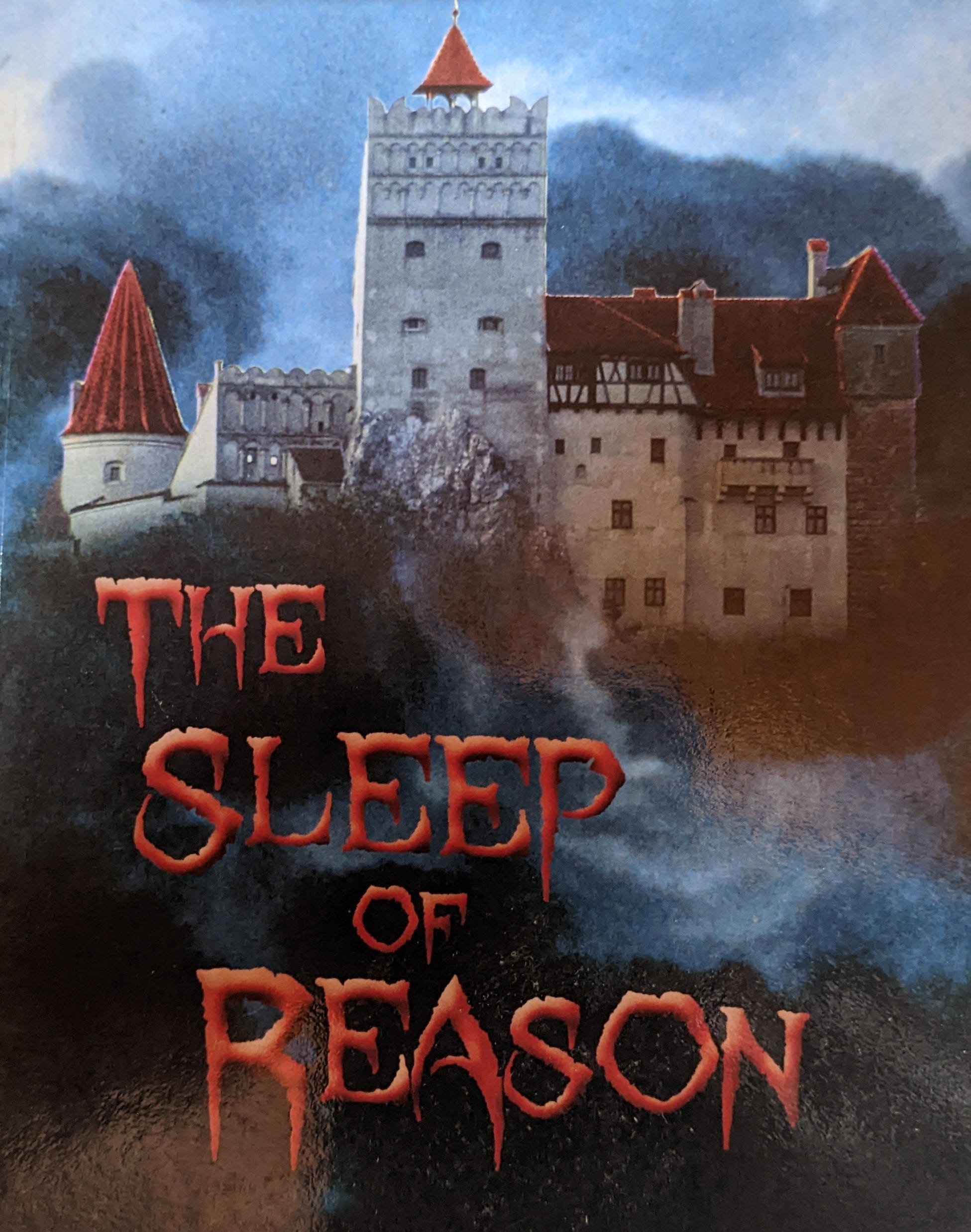
In my screenplay, THE SLEEP OF REASON, a prequel to Bram Stoker’s Dracula, I found my protagonist, Renfield, (the middle-aged, spider-eating lunatic from the book, here a sane young man) an uninvited visitor to Castle Dracula. The problem: a mere mortal, he was much too vulnerable to being attacked by his host. He had just arrived, having been guided there by a Gypsy he’d hired. So, how to protect my hero long enough to reach stalemate with the vampire? No solution presented itself. I began to examine the details of the situation he was in. The Gypsy was, by trade, a wine and spirits merchant. I knew that vampires were repelled by garlic. Spirits are made from fermented and distilled fruits and vegetables. Garlic is a vegetable. Could the Gypsy have created some unusual, yet somehow palatable (amazingly), garlic-based spirit or wine, expressly for keeping vampires at bay and increasing sales among superstitious Transylvanians? I had my solution.
At another point in the story, I found I had no way one character in one part of the castle could plausibly learn something by someone in another part of the castle at the moment needed. I recall wishing they had intercoms in those days. Then I recalled that, as a boy, I had created a silly un-powered telephone contraption with tin cans and wire, and found it actually worked. In the story, Renfield had explored the place at one point finding a large animal horn hanging from a wall. I remembered how old folks used to use horns like that with which to hear. So, what if the castle had a crude communication system of shafts built into the stonework, and networking through the castle structure, such that listening via horn at any shaft vent-hole might pick up sounds from another? I had my intercom system. And it allowed my characters to spy on one another at any point in the story, an added benefit.
From this writer’s perspective, GPT is another lateral-thinking-type approach to creative idea-generation. It specializes in its ability to overcome writer’s block, but it can be used at any point in the creative process. GPT is one of a group of techniques McCaffrey is developing into what he describes as “innovation assistance software.” One of his undergraduate students, a comedy writer, applied the technique to his comedy. And that demonstrates that like minds, do indeed, think alike.
Gen I-dea
Idea-generation is a mysterious process:
In ASK THE PROS: SCREENWRITING, 101 Questions Answered by Industry Professionals, Edited by Howard Meibach and Paul Duran, Lone Eagle, 2004, p. 22, screenwriter, John Fasano (ANOTHER 48 HOURS, JUDGE DREDD, DARKNESS FALLS) said, “I get ideas from paying attention. Wherever I go, whatever I’m doing, I’m aware of the things going on around me. I make connections between disparate images and ideas.” (2nd bolding & italics, mine).
Ideas sometimes come at the most inopportune moments: during unrelated activities like your day job or on a date, times when the writer has no way to write them down or develop them further. In such situations, the writer needs to attempt to retain the idea through memorization or even mnemonic techniques such as associating it with a trigger word or phrase. As soon as possible, the writer can then note the idea on paper for later use. In the best of circumstances, the writer needs to be sensitive to those moments when the ideas are coming. He should facilitate them how ever possible.

In LYNCH ON LYNCH, Edited by Chris Rodley, Faber and Faber , 1997, pp. 222, painter and writer-director, David Lynch observed:
“My friend Bushnell Keeler always said, ‘You need to have four hours of uninterrupted time to do one hour of good painting.’ If you’re rushed, you just can’t think and do it. You’ve gotta really fall in deep to go to this place where you catch ideas. But it really takes sitting still... This is more like contemplation. You start thinking, and one thing leads to another and you forget where you started. You forget that you’re even thinking for a while. You’re lost, and if you suddenly drop through a trapdoor into the big idea bank, then you’ve got a thing happening.”
“one thing leads to another” – Another description of the collision of ideas?
I believe one should refrain from describing one’s ideas to anyone until they have developed at least to the draft stage. This is because what seems extraordinary to the writer (who can associate it with so much more that has been left unsaid), seems ordinary to the listener (who knows nothing of the rest). When the listener responds with less than the same excitement felt by the writer, the writer’s confidence in the idea can be shaken to the core. David Lynch noted in LYNCH ON LYNCH, pp. 223 and 227:
“...(talking about your ideas) can be dangerous. If things get too specific, the dream stops... I don’t like talking about things too much because, unless you’re a poet, when you talk about it, a BIG thing becomes smaller.”
One needs to cultivate one’s ideas: to seed them, water them, prune them, tend them. Within one’s ideas there is magic, the magic of possibilities yet unseen. Too much detail arriving too fast limits them. And when it does…
…the magic goes away. #
Please Re-stack if you found this article of interest.