

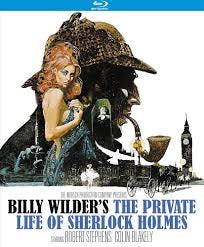
Recently, after a long search, I finally managed to read a copy of a screenplay of the original full (roadshow) version of Billy Wilder’s and I.A.L. Diamond’s THE PRIVATE LIFE OF SHERLOCK HOLMES (hereafter referred to as TPLOSH). This was a script I’d been hunting for decades. Having seen the released film and knowing there was more, in fact, well over an hour more, I wanted to know what was cut out.
As some may know, the original film as shot ran over 3 hours and included an intermission. This type of release was referred to in the business as a “roadshow” picture. Others have included many biblical epics, novelty films like CINERAMA, AROUND THE WORLD IN 80 DAYS, and various historical epics like LAWRENCE OF ARABIA. The roadshow film of TPLOSH was seen by only a few audiences in test showings, and, thanks to the climate within the film industry in 1969-70, not to mention, the disastrous release of the Julie Andrews-starring roadshow film, STAR!, withdrawn by the studio and reduced to standard length. The rumors were that it lost well over an hour. Since it was a compilation of six segments encompassing a prologue and five “tales,” cutting was simply a matter of taking out a few segments in favor of a few surviving others. No plot material from the surviving segments would be damaged. The studio had, in TPLOSH, the perfect victim for something it did routinely with many less than “ideal” prospects whose sole, single, and only plots were unceremoniously gutted in favor of exhibitors having an additional show or two per night. It seemed never to occur to them that the story, once reduced to fragments, might lose the audience that would have filled the single showing, but now avoided the twice-per-night showing because it “isn’t any good”.
I already knew the essentials of the missing material from seeing the re-construction in the special features on the latest TPLOSH DVD. I think I also once read the novelization by Michael and Mollie Hardwick from 1971 (though I no longer have a copy, and can’t recall if it was the full version). At 154 pages, it was probably not the roadshow version. Having a background in book publishing, and seeing the pub date, I suspect the original novel manuscript might have reflected the full roadshow film, but it was, as a result of the studio cuts, delayed and, itself, cut to match the released film, yielding an uncharacteristically short fiction paperback for the era (they all used to strive for 180 - 300 pages back then).
The commonly available copy of the script for TPLOSH runs 140 pages, and the released film runs 125 minutes. On the other hand, the text of the roadshow version of TPLOSH runs 223 pages (with 6 more for a complete studio credit list), and, at the back, along with the credit list, it states the original roadshow running time as 200 minutes (at the prevailing page-per-minute benchmark, certainly that does not include the intermission). So, the cuts amounted to 80+ pages or 75 minutes. The number of segments went from 6 (a 10-page prologue plus 5 stories) to 3 (a 2-page prologue plus 2 stories). While, ordinarily five stories in a 3+ hour movie was odd, it was exactly right for Sherlock Holmes, who “lived” originally in 56 short stories, but only 4 novels, 2 of which were more novellas with long introductions setting up the back stories. So Holmes works best in the short tale.
For the record, the original five stories in the roadshow version included: THE CASE OF THE PHILANDERING SINGING TEACHER (7 pages), THE CURIOUS CASE OF THE UPSIDE-DOWN ROOM (43 pages), THE SINGULAR AFFAIR OF THE RUSSIAN BALLERINA (32 pages), THE DREADFUL BUSINESS OF THE NAKED HONEYMOONERS (17 pages), and THE ADVENTURE OF THE DUMBFOUNDED DETECTIVE (113 pages). The difference that makes the total 223 pages amounts to partial pages and/or transitions from one to the next. Of these, only the RUSSIAN BALLERINA segment and the DUMBFOUNDED DETECTIVE segment survived in slightly reduced versions (30 and 100 pages, respectively; and the prologue went from 10 pages to 2; the rest is re-worked connective material).
I much preferred the excised material over the stuff that was retained (which, of course, I’d seen several times in the final release version). This was not due to over-familiarity with the existing released film. The two stories left in the film do not hold up well for several reasons. THE RUSSIAN BALLERINA story “dates” for reasons I will go into in a moment, and it re-works an old non-canonical idea done to death in the Holmes movies of the ‘40s. THE DUMBFOUNDED DETECTIVE fares even worse as it re-works an idea from the original short stories, and fails to end strongly.
THE RUSSIAN BALLERINA segment seemed daring and heretical (to “the establishment”) in 1969, playing, as it did, with the idea of Holmes and Watson being gay--it was still okay back then for otherwise politically-correct progressive types to openly refer to gays with the 6-letter “F” word (I listened to a “hip” comedy album from someone, circa 1970, a while ago, and that’s what the comic did--it was genuinely surprising; I’d forgotten how things have evolved). But today, for audiences, it amounts to “been there done that,” and ultimately it’s unfunny and simply boring.
The Loch Ness segment (DUMBFOUNDED DETECTIVE) had always been disappointing to me because the ending was anti-climactic and Holmes is bested by a woman who is NOT Irene Adler (whom A.C. Doyle had intended to be the only person to ever beat S.H.).

Why not use Adler as a freelance agent working for the Germans, something for which her experience qualified her, rather than the freshly-created German agent Ilse von Hoffmanstal? So it was just imitative of Adler without giving us the real (fictional) thing (she never really out-thinks him in Wilder’s film--compare it to the version of Adler in the BBC SHERLOCK series, for example where she is a true opponent). She, then, dies off-screen (compare that to the BBC SHERLOCK re-take of much the same idea where the scenario is transplanted to the middle-east). And her execution, then, sends him back to the cocaine (validating its use in a time when illegal drugs were almost becoming an acceptable thing). To me, as with the homosexuality, Wilder and Diamond were pandering to their 1969 audience, trying much too hard to become “hip” themselves. As a result, just as with that “comic” described above, they “dated” themselves and their film, and they failed to satisfy the audience with the expected “rollicking good time” from a “game” well “afoot.”
By today’s standards, the script seems “talky,” almost a soap opera, especially when Watson throws his tantrum over Holmes choosing to get high. It re-surfaces when Watson blames Holmes for casting them as a gay couple to get out of marriage to the Russian Ballerina, Watson self-absorbedly perceiving it as a threat to his own reputation, with Holmes’s and his own careers (idiotically) forgotten.
The submarine plot of the final segment was a weak take on something Doyle had already done with his “Bruce Partington Plans” short story. It starts out well enough, but once it has to pay-off all the mysteries already set up, it has no good solution, and instead opts for a sort of “Deus ex machina” in the form of Holmes’s (“smarter”) brother, Mycroft, who “acquaints” Sherlock with what’s really going on. This effectively neuters the hero. To validate it and avoid a complete humiliation of S.H., Mycroft, himself, is trumped by the appearance and regal fiat of Queen Victoria. With the truth finally out, and the villains unmasked and defeated, the effect is to further disappoint the audience with an unequivocal downer of an ending: Holmes loses his status as hero, and he loses the new love of his life. What’s left but the needle? And, to boot, all that does not improve the original pre-existing short story’s approach. So, why should we bother?
Because the segment runs 113 pages--longer than all the others combined (!), it was placed last. But that made the film end on a melancholy note. And that, in turn, conspired with the poor ticket sales of STAR to prompt the studio to judge it a potential disaster. So, the whole thing seems to have been a “fait accompli.” Wilder and Diamond had a bunch of strong ideas for a take on the Holmes characters, but half of them were insufficiently re-warmed Doyle, and the other half were doomed by their “hip” approaches, or their unsatisfying endings. Despite all that, there were lots of great moments in the script, and one genuinely feels for Holmes at the end when Mycroft delivers the news to the detective.
So, there was in evidence, certainly, great affection for the characters. It’s almost tragic that the writers couldn’t get away from the “Watson as buffoon” trope that had been dogging the character ever since the “Nigel Bruce-as-Watson and Basil Rathbone-as-Holmes” films.

Too bad, as, other than in a few rare moments, it was never really true of the original stories. Sure, Holmes always had to show Watson the light, but Watson was portrayed with a level of respect missing in the Bruce films.
Though the PHILANDERING SINGING TEACHER was mere fluff, the NAKED HONEYMOONERS segment was good unclean fun. It was clear the writers were again after that 1969 audience, then becoming accustomed to ever-more nudity appearing before the large adult audience composed of baby boomers feeling their oats, a phenomenon that culminated with DEEP THROAT and LAST TANGO IN PARIS, and thereafter declined until we rarely see full frontal nudity anymore. So, Wilder undoubtedly wanted to shoot his first nude scene in order to stay relevant. For the record, it only exposed a woman’s breasts, hardly daring by the standards of a few years later. But, for me, at least, even this was a little “shrill” from a director who never needed to be.
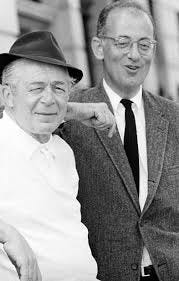
Billy Wilder (left) and his writing partner, I.A.L. Diamond (right)
Billy Wilder had been a master of the mystery with DOUBLE INDEMNITY and WITNESS FOR THE PROSECUTION, and with the Doyle characters, he need only have rendered them faithfully to have another classic. But he apparently felt his grasp of the audience slipping. It is not surprising, given the changes going on in the film industry (EASY RIDER, THE GRADUATE, the arrival of the youth audience, the collapse of the studio system, the decline and/or deaths of many of the stars and moguls from the classic period of the ‘30s and ‘40s, etc.). Like Hitchcock (MARNIE, TOPAZ, FRENZY, FAMILY PLOT) during the same period, Wilder never really “got it back.”
The UPSIDE-DOWN ROOM was also fun, even though Watson was made the idiot for, perhaps (I hope), the last time in films. To me, the Watson-as-buffoon thing always seemed a back-handed slap at the audience because we were usually only as “in-the-know” on Holmes’s cases as Watson was. So if he’s an idiot, then so, too, are we. There’s an old rule: never underestimate (or insult) your audience, something Wilder’s mentor, director Ernst Lubitsch, taught him, now seemingly forgotten (Wilder even had a sign in his office: “What would Lubitsch do?”). The Rathbone films got away with it because Nigel Bruce was played even broader than Blakely had played him, so the audience could see the pure comedy as just that. But Blakely’s character was portrayed and played as seriously stupid; ditto, us, therefore, in the eyes of the storytellers.
As a film, unfortunately, TPLOSH’s casting was weak, and the direction may have suffered from Wilder’s insensitivity to the mood and tone of the 19th Century Victorian mystery setting. Robert Stephens and Colin Blakely seemed to lack the necessary chemistry to get the film going. Blakely couldn’t approach Bruce’s buffoon, and Stephens lacked the charisma of Rathbone. So the roadshow version of the film, for me, probably would’ve always been something of a disappointment.
And yet, somehow the film has always held a special place in my heart. I’m an unabashed Wilder fan, and I so wanted his Holmes film to be great. So it stays in my memory as a work that can be. It was mutilated by the studio, so it is, effectively, un-finished. And that, in turn, means, that in another place, another reality, it could be what he envisioned, if we could only find a way to get it right.

Now for some interesting speculation:
I once wrote a Sherlock Holmes pastiche, THE PANDORA PLAGUE, which combined S.H. with magician, Harry Houdini.
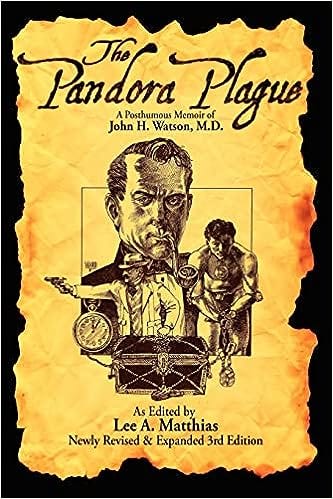
Among the research volumes assembled for that book, was HOUDINI: A MIND IN CHAINS, by Dr. Bernard C. Meyer, a prominent New York City psychiatrist.
It was, and still is, not uncommon for celebrities and VIPs to be invited to advance screenings of important films. On October 29, 1970, an advanced VIP screening of the roadshow version of TPLOSH was held in New York City. It’s possible Dr. Meyer and his family, including son, Nicholas, were in attendance. So...
At one point in the roadshow version (pp. 31-2) Watson tells Holmes that drug addiction is being cured in Vienna (in fact, by Sigmund Freud) with a high rate of success. Watson suggests Holmes go to Europe and give it a try. He even offers to go with him. Holmes dismisses it, and the story moves on.
Some four years later a book appeared that went on to become a huge bestseller. THE SEVEN-PER-CENT SOLUTION (as well as a film) told the story of Sherlock Holmes being tricked by Watson into chasing Professor James Moriarty to Europe, and all the way to Vienna.
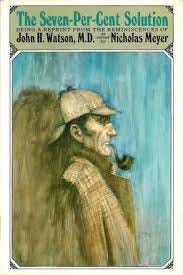
Moriarty was, in this novel, Holmes’s former mathematics teacher, a man whom Holmes believed to be the greatest criminal mind in Europe, but who was, in the novel, merely a math tutor. Again, in the novel, when Holmes, as a boy, found Moriarty and his own mother in “flagrante dilecto,” and then witnessed her murder by Holmes’s father followed by his own suicide, it sent the young Holmes over the edge. Though he recovered, thereafter, he believed Moriarty to be a blackguard of the first rank. To deal with his memories, Holmes takes cocaine. So says the novel. But when they get to Vienna, all is revealed and Holmes discovers Watson tricked him and he is to undergo a cure of his cocaine addiction by none other than Sigmund Freud. Freud had recently cured himself of the same addiction. So, half-way through the book, Freud cures Holmes. Thereafter, the story switches gears as otherwise, the tale would end short and flat. So the author tacks on a case that gives the audience that expected “rollicking good time”. And because it’s good and fun, we forgive him for it. Everybody wins.
Interestingly, however, the idea that Moriarty was Holmes’s mathematics tutor was proposed in William S. Baring-Gould’s essays and book, SHERLOCK HOLMES OF BAKER STREET. And the idea that Moriarty had had an affair with Holmes’s mother that led to Holmes’s parents’ murder-suicide was posited in Trevor Hall’s book, SHERLOCK HOLMES: Ten Literary Studies. So, that implied that the author of THE SEVEN-PER-CENT SOLUTION had read Baring-Gould’s and Hall’s books, uncommon volumes unless one was especially interested in the world of Sherlock Holmes. Of course, an author of a Holmes pastiche would be. Or... he might become such an author after becoming acquainted with such powerful ideas as these.
But, how to make use of them? They happen long before young Holmes becomes the Sherlock Holmes of the stories. So, naturally, they are of the past, something Holmes must certainly have found painful, even psychologically devastating. How, then would it all manifest in Holmes as an adult? Would it, perhaps, account for a drug addiction problem? But, then how would that generate a story? If Holmes’s addiction was rooted in a massive psychological injury, then it would take, not a seven percent, but rather a psychological solution. Enter Sigmund Freud. It happens that, prior to the appearance of the Holmes-Freud book, there appeared in 1968 an article in JAMA, the “Journal of the American Medical Association,” by psychiatrist Dr. David F. Musto that connected Holmes with Freud through cocaine. An article from 1965, “Elementary, My Dear Watson,” by Irving L. Jaffee, added to it. These were mostly arcane works to the average person, but they might be familiar to someone with a strong interest in Holmes and access to medical magazines, perhaps through his father. All that might be needed was a spark that brought them all to mind, a spark such as is found on page 31 of the roadshow version of TPLOSH.
I can even imagine the conversation on the ride home from the movie:
Nicholas - “Were they really curing drug addiction back in the 1800s in Europe?”
Dr. Meyer - “Sure, remember Watson mentioned Vienna? Freud was in Vienna then, and cured himself of it.”
Nicholas - “Wow. No kidding! What if he and Holmes had met...?”
Dr. Meyer - “There’s a story in that, Nick.”
Nicholas - “But, he’d resist. How would Watson get him there? You know, if Moriarty really was responsible for Holmes’s addiction, but he was not the criminal Holmes thought he was, what if he tries to atone by helping Watson trick Holmes into going to Vienna by ‘playing’ Moriarty the criminal, and leading Holmes on a merry chase that ends in the offices of Sigmund Freud?”
Dr. Meyer - “Now THAT’s a story, Nick.”
So, Dr. Bernard C. Meyer, our psychiatrist in New York City, attends the advanced screening of Billy Wilder’s film. With him, perhaps, is his son, a 24 year old young man with an ongoing strong interest in Sherlock Holmes, such that he also read books about the detective, a young man who might have implored his father to use those hypothetical complementary VIP tickets he might have been sent, a young man with access to his father’s back-issues of JAMA and those articles on Holmes, a young man named Nicholas, who, only a few years later, would publish his first bestseller, THE SEVEN-PER-CENT SOLUTION, a story in which three powerful ideas conceived earlier were combined.
Nicholas Meyer went on to build a career with his Holmes pastiches and films. The irony is that, at the same time, by the studio cutting THE PRIVATE LIFE OF SHERLOCK HOLMES to 2 hours, and thus throwing the concept on pages 31-2 away, Wilder might’ve lost one. He never had a great success thereafter. And we’ll never know if the roadshow version might’ve spawned a sequel that had Holmes heading for Vienna. Another bit of irony: when Billy Wilder was a young writer in Vienna, he once tried to get an interview with Sigmund Freud. Freud unceremoniously threw him out.
These speculations are not intended to denigrate Nicholas Meyer, as he did the work and developed it into a bestseller, many sequels, and a film writing and directing career. Ideas aren’t finished stories, and they can’t be copyrighted. Ideas are “in the wind,” and every great work is influenced by ideas from earlier thinkers. We all, in effect, “stand on the shoulders of giants”. But, if this speculation is true, it wouldn’t have hurt if Meyer had acknowledged Wilder and Diamond in the original novel, not to mention Baring-Gould, Hall, Musto, and Jaffe. Nonetheless, it’s all speculation.
___
UPDATE—Nicholas Meyer has corrected me by explaining that the authors mentioned above who influenced the writing of THE SEVEN-PER-CENT SOLUTION were, indeed, acknowledged at the end of his book. As for the name, “von Hoffsmanthal,” that was taken from composer, Richard Strauss’s librettist. Mr. Meyer did see TPLOSH, however. So…
I stand corrected, and thank him for his attention to this. And, I wish I could get back all the digging time I spent on the question. It was fun, though!
___
I hadn’t re-read Meyer’s book in over three years, so I’d forgotten details from it. But in flipping through it, lo and behold, I find a character in the book in the Vienna sections named “Hugo von Hofmannsthal.” So, in 1969 Wilder and Diamond write a movie with a German character named “Ilse von Hoffmanstal”. And four years later, Nicholas Meyer publishes a book using an idea described in the 1969 script and 1970 roadshow version of the movie, with a German character with an almost identical last name. Unless this name has a deeper pedigree from the Holmes stories themselves — it doesn’t, this is hard to ignore as a mere coincidence. Curiouser and curiouser.
For the record, I wrote my novel, ‘THE PANDORA PLAGUE — A Posthumous Memoir of John H. Watson, M.D.’ (the added descriptor lifted from Meyer’s second Holmes novel, THE WEST END HORROR) after I read Nicholas Meyer’s book on Holmes and Freud, and Dr. Bernard C. Meyer’s psychological biography of Houdini. And I read Baring-Gould’s and Hall’s books before both of them. My connecting Holmes with Houdini in my novel sprang from working on a documentary film I was shooting on magicians while, in my leisure time, I was re-reading the original Holmes tales by Sir Arthur Conan Doyle. So, book title aside, the shoulders of the giants I stood upon were those of Harry Houdini and A.C. Doyle.
Nicholas, if you’re out there, can you clear up the mystery? Did Billy Wilder’s film play a role in bringing all of these ideas together in THE SEVEN-PER-CENT SOLUTION? #
Please Re-stack if you found this article of interest.
I go into other aspects of film and screenwriting in two books:
LATERAL SCREENWRITING — Using the Power of Lateral Thinking to Write Great Movies
THE LAST REVEAL — Movies, Screenwriting and the Decline of Western Cinemazation
So, Nicholas Meyer read the article, wrote that he enjoyed it, and pointed out that he listed the writers I cited in his Acknowledgments in THE 7% SOLUTION. He also said he saw the Wilder film and enjoyed it. Finally, he said he took the name of Hugo von Hoffsmanthal from Richard Strauss's librettist, not the Wilder film.
So I probably read the Acknowledgments the first time I read the book back when it appeared, but not in later rereads. Had I done so, it would have saved me some digging.
I have asked him to clarify whether he saw the roadshow version of TPLOSH just to clarify if that speculation was true. I'll post the answer if/when I get it.
Well, as it turns out, a certain author and film director, Mr. Nicholas Meyer, has a Substack! So, I asked him to give the above a look and he consented. Maybe we'll see if he can ratify my speculations, or tell us the observations are way off the mark. Either way, it should be fun.