

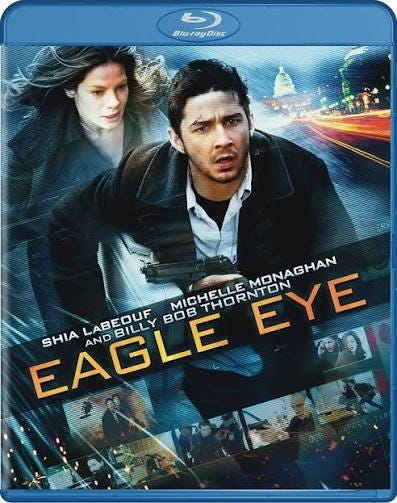
A friend once sent me an email about a film he streamed that he felt was indicative of a worsening practice in movies today. He referred to EAGLE EYE, a film I missed. Here’s his description:
“The male and female leads are recruited, pursued and managed by some super government computer that has supreme control over all things mechanical and digital, etc.
“They are told to drive ‘72 miles per hour’ on a busy urban street with lots of traffic. The entity controls all the traffic lights so they wink green just in time for them at each intersection (what [about] the cross traffic suddenly getting a red light in an unexpected time frame?).
“‘Lie down in four seconds,’ [the hero is] told just as a huge crane’s arm comes crashing through a wall of a municipal building. He follows additional instructions to escape his captors. On a subway, moments later, a stranger’s mobile phone rings with a TEXT MESSAGE for him!”
And on and on.
“Much later, the duo decides not to follow all the instructions fed to them that have kept them alive in impossible situations by split-second timing. The evil entity now turns on them. Somehow, though, [the entity’s] pinpoint accuracy and 100%-on timing are no longer so accurate. These two ordinary folks are able to duck, deflect and evade all that is thrown at them by this same never-fails source.
The filmmakers set up this can’t-miss, powerful ‘thing,’ but then allow it to suddenly fail and become vulnerable when the heroes ‘see the light’ and try to fight back. Why is it no longer so accurate?
It reminded me of the ‘can’t-get-shot’ finale` of the remake of 3:10 TO YUMA.
Actually, it’s not much different than The Great Leslie evading every single thrown pie (save one) in [the old comedy film,] THE GREAT RACE.
Of course, it was funny there.
I responded:
“It is a [pretty well-recognized] policy in screenwriting to make coincidences go against the hero and for the villain in stories; to give nearly all the breaks and advantages to the villain and few or none to the protagonist, so that he/she has to overcome them all by sheer ability, intelligence, and resourcefulness. This sounds like they switched it.”
I added a list of the “real rules of screenwriting” that, among them, included these:
Airline flights always leave and arrive at noon.
During all police investigations, it will be necessary to visit a strip club at least once.
The ventilation system of any building is the perfect hiding place. No one will ever think of looking for you in there, and you can travel to any other part of the building without difficulty.
If being chased through town, you can usually take cover in a passing St. Patrick’s Day parade - at any time of the year.
When paying for a taxi, don’t look at your wallet as you take out a bill - just grab one at random and hand it over. It will always be the exact fare.
Cars which crash will almost always burst into flames.
All bombs are fitted with electronic timing devices with large red readouts so you know exactly when they’re going to go off.
It is always possible to park directly outside the building you’re visiting.
Most laptop computers are powerful enough to override the communication systems of any alien civilization.
Any lock can be picked by a credit card or a paper clip in seconds - unless it’s the door to a burning building with a child trapped inside.
When they’re alone, all foreigners prefer to speak English among themselves.
Women always take showers immediately upon arriving home if someone is hiding in their house.
Scantily-clad young women will always go down into basements when they are being hunted by killers
Television news bulletins usually contain a story that affects you personally at that precise moment, and it’s never necessary to listen to the complete bulletin.
It doesn’t matter if you are heavily outnumbered in a fight involving martial arts - your enemies will wait patiently to attack you one by one. They’ll dance around in a threatening manner until you have knocked out their predecessors.
He added several more, including:
The keys are always already in every vehicle.
At night streets are always wet.
At night people stop and exit their cars, but NEVER turn their lights off.
These kinds of lists are all over the internet. Whole books could be written of them. We all have our own favorites. And it would seem many screenwriters, directors, and producers are unaware of them. Now my friend has encountered an entire film dependent on and brimming with such Hollywood logic.
How can this be? How can films continually give their audiences such ludicrous lapses in plain common sense?
My answer? They don’t care! And they don’t care because, apparently, we don’t care. They will always prefer appearances over reality, the sizzle over the steak. They are well aware that audiences have grown used to such nonsense. Only a small fringe group of people will ever demand better from them. And Hollywood chooses to live without them. So those folks go to foreign films, read books, and only occasionally pay to see a Hollywood offering, generally one of those prestige films that are trotted out for LA and NY audiences by Dec. 31, just in time for the big awards.
In the case of my friend’s example, we have a film that has taken an industry tendency and made it an operative principle. No wonder that despite being Executive Produced by Steven Spielberg, and starring a cast of solid actors, it came and went so quickly. It is one of the latest offenders in a class of films many of which never appear at your local cineplex. Most of these pictures go straight to video. You get what you pay for.
But why do they ever do this kind of thing in the first place? It comes down to Harry Cohn’s Ass. It’s a famous and well-documented story that original Columbia Pictures mogul, Harry Cohn, could always tell a stinker when he saw one: he claimed that if he started squirming in his seat, the film was no good.
I wonder what he would have done with LAWRENCE OF ARABIA, because that estimable film is on many, many Ten Best lists, yet it is a bum-numbing 3 hours and 47 minutes long (Restored, U.S. roadshow version).
But Harry wasn’t alone in his preferred diagnostic method. As an industry, Hollywood film producers are uniformly obsessed with—snap-snap—keeping it moving. They know that their audience will never give their films speeding tickets. But the entire population of suburbia will walk out of slow pictures. So taking the time to show James Bond parking at the airport, shuttling to the terminal, going through baggage check and security, and then awaiting boarding—even if it explains how he gets some key piece of info—just won’t cut it. EAGLE EYE is just under 2 hours long as it is. Restoring common sense might have added fifteen or twenty whole minutes, making it too long to fit the ideal thriller length or those 3-shows-a-night theater schedules.
The thing is, these days, most films take this tendency too far. Anything is fair game for elimination in the interest of pace, even common sense. It’s gotten us to the point where, now, they’re throwing out the babies with the bathwater. Then there’s the effect of incrementalism. First, it’s “Let’s cut ‘slowly I turn, step by step,’ and just have him take a drink and then spit it out when the other guy says, ‘Niagara Falls’”; and then it changes to “Nobody’ll notice if we cut the back-story on why Joe does the ‘spit-take’ whenever somebody says...” And so, with the set-up now gone, the joke itself is lost.
So, in the case of my friend’s film, things have now gone so far that films aren’t just being truncated in the interest of pace. No, they’re now being conceived for pace and pace alone. It isn’t that some internal story logic has been removed. It is that that logic was never there to begin with. In fact, the film now has a different logic, if you’ll accept the Orwellian new-speak, a Hollywood logic. Hollywood, then, has become a kind of a Lewis Carroll-styled, “Alice in Wonderland” place where, if producers think, in order to understand the story, the audience needs it, then the story probably has to lose it. Too much thinking is a bad thing, it’s like the thread in the sweater: pull too hard and the whole thing comes unraveled. If the villain is omniscient in the beginning, by the end he suffers from senior moments. Why? Because “The bad guy has to be impossible to beat, but we’ve got no happy ending if the bad guy wins,” and “we lose the audience out the door if we have to take the time to tell ‘em how the hero does it.”
Bottom line: there is now no difference between many Hollywood films and those arcade games in the lobby.
Anyway…
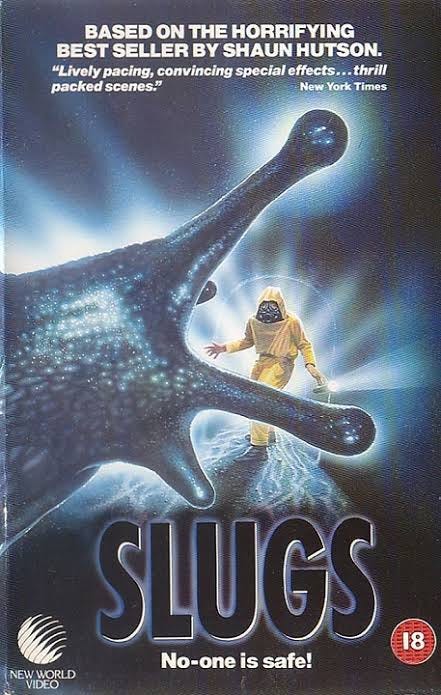
I read a professional’s spec script recently, and by the end I had to kinda scream. So, let’s have at it:
The script is GIANT KILLER SLUGS (NOT the film in the image above, that’s just to get us into a well-established genre—look it up… the giant slug genre), by a pro writer who shall remain anonymous (you can find him in a search, but please don’t “out” him in the comments; like the slugs, his “Oeuvre” doesn’t ALWAYS “Ooze-re”). The guy’s obviously been doing things right for some industry folks.
It’s an adaptation of his play of the same must-see name (LOL).
It’s a “creature feature” (as though that vindicates it) written originally for the stage (as though that dignifies it), and now for feature film (where’s a drive-in when you need one?)… complete with a small town sheriff trying to leave his troubles behind, an unscrupulous mayor in cahoots with the crooked Science Corp, a pack of city slicker kids who know the truth no one wants to believe, and of course, killer slugs that keep getting bigger! Can these predatory pests be stopped before the whole town is lost to their merciless mucous?
So...
“...complete with:
1.) “A SMALL TOWN SHERIFF TRYING TO LEAVE HIS TROUBLES BEHIND” — ‘Reluctant Hero’ cliché
2.) “AN UNSCRUPULOUS MAYOR IN CAHOOTS WITH THE CROOKED SCIENCECORP”— ‘Evil Politician/Evil Corporation’ cliché
3.) “A PACK OF CITY SLICKER KIDS WHO KNOW THE TRUTH NO ONE WANTS TO BELIEVE”—- ‘Kids are smart; adults are idiots’ cliché
and, of course,
4.) “KILLER SLUGS THAT KEEP GETTING BIGGER!!”—- ‘Monster must get worse cliché
Oh, and add “Contrived” to each of those.
Those, among us, who have pitched professionally HAVE to throw up their hands (if not their lunch) at this. Aren’t we all pilloried incessantly for putting even the barest attempts at such clichés in our “spec” scripts? Wouldn’t we be chided at not looking for fresh alternatives? For example:
Couldn’t the slugs start out huge?
What if they started HUGE, then started shrinking… and, then, Greta Thunberg raced against time to save them from extinction? For SCIENCE! To Hell with the victims, it’s IMPORTANT!
Derivative Schmerivative! It’s all OK because “HE’s a PRO!” And, of course... he gets an automatic PASS because… give him a break, it is, after all, just trying to be FUN! Well, ain’t it?
AND IT’S EVEN MORE OK because it’s from a Stage-play, where, y’know, THE TEXT is SACRED!
Which brings up one of my most annoying pet peeves, the one where, back in the 1970s, new writers’ spec scripts ABSOLUTELY HAD to have been under 120 pages. Today, however, they ABSOLUTELY MUST be under 110 (BETTER, if under 105; BEST if under 95!!! I note, we’re moving, here, literally toward NOTHING as our ideal length)!
So, [insert pro writer name here (or Quentin Tarantino will always work)] can write a 190 page “spec” script (full of typos and a hand-scribbled cover page), and that’s ok, because “he’s an experienced, established PROFESSIONAL!” HE can write waaayyyyy more efficiently in 190 pages than YOU can in your “slog” of a read running 90!
Well, some writers out there are EVEN MORE “experienced,” because they are (and will always remain)… AMATEURS! And, they’re getting still more experienced with each new, shorter and shorter, “spec” script!
Let’s be honest. This is really all about getting to bed on time.
OK, I’m done. Just had to vent. :)
And, yet, Hollywood logic along with its accomplice, the cliché, can be defeated at times.
Consider the saga of a story I feel is one of the greatest haunted house tales ever written, Susan Hill’s original novel, THE WOMAN IN BLACK:
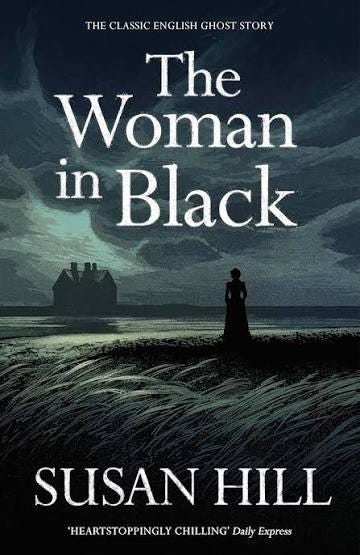
It’s up there with Shirley Jackson’s THE HAUNTING OF HILL HOUSE, and, in my view, a cut above such works as Richard Matheson’s HELL HOUSE and the 1982 George C. Scott film, THE CHANGELING (two other great and scary haunted house tales).
Susan Hill’s book stands on its own. But non-readers, cinefiles, and theater fans have had the good fortune to be able to see two films and one stage adaptation of the story.
A friend watched the BBC television film version from 1989, and said he wondered if anyone else “burst out laughing” at the ending. He’s an active film critic, so there’s that, and we can “consider the source,” i.e. a profession which, invariably, seems compelled to place itself above the thing it reviews, indeed, criticizes, because, well, that’s what the word implies, doesn’t it?
Anyway…I didn’t laugh. But I can somewhat see the point. And, in truth, it’s the fault of (perhaps) the production’s budget, and (probably), the direction by Herbert Wise. In its defense, I would add that, only here, at the end is Wise’s direction lacking.
Amongst all (save the stage) versions of the story (1-novel, 2-teleplay, 3-tv movie, 4-screenplay, and 5-theatrical film) there are, in actuality, five... different... endings.
Five.
_____
NOTE - SPOILERS AHEAD!!! - You are now directed to read the book, and/or see one of the films (even the stage version) before reading further!!!
_____
The BBC ending, script and tv movie, both, were Nigel Kneale’s and Herbert Wise’s adaptations of Susan Hill’s ending in her novel, rather than the one in the theatrical film script screenwriter Jane Goldman wrote, set at the train station; or, the one in the actual film, directed by James Watkins, also set at the train station.
Jane Goldman’s ending, in my opinion, and, presumably, with Susan Hill’s approval, adds depth to the story. Including:
--a serious deficiency to the character of Arthur;
--two vindications to him, as well;
--and also, depth to the character of the Woman in Black.
The altered version that was in the film simplifies the original more complex action in Goldman’s script. And, in so doing, it removes the detail that adds to the character of the Woman in Black. As we will see, it also removes a detail that might have undermined the audience’s sympathies.
In Susan Hill’s novel… and in Nigel Kneale’s teleplay for the 1989 BBC television production…
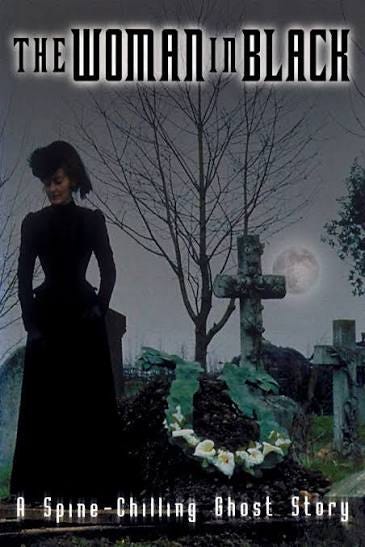
…the ending happens in a park, complete with walking paths, a lagoon, and even row boats.
Hill’s version has the family confronting the Woman in Black on a walking path, with the wife and mother (Stella) and young son (Joseph) on a pony cart. When the Woman menacingly steps out from behind cover, in front of the cart, the pony bolts and, ultimately crashes them head-on into a tree. Stella is gravely injured and Joseph is killed. Months later, we learn Stella dies from her injuries. Arthur survives.
Kneale changed it and put them on the lagoon in a rented rowboat. The setting’s time period is stated as winter, and Kneale states that it has taken a toll on the trees along the bank, with several deadfalls. He has the Woman in Black (and, yes, that’s Miss Lemon from the David Suchet POIROT series) appear:
“Standing twenty feet [from] them on the surface of the water... staring...with those terrible malign eyes”.
Stella screams. But only Arthur, it turns out, sees the Woman. Stella has looked the opposite way and sees an entire tree descending rapidly over the water from the bank and falling on them. Though Arthur turns, trying to row them out of danger, he’s too late, and they are all killed.
So, Hill’s version is straightforward, dramatically, if fairly standard stuff. Kneale’s ending—the one that made the critic burst out laughing—I, at least, feel, improves on it. And, to his credit, he sets up the dead tree element in the script’s text before paying it off. Also, he has the Woman in Black triumphing utterly by killing them all, while Hill has Arthur surviving, having to live with the loss of his wife and son. So, perhaps Hill’s is the most devastating of the two.
But where Kneale’s version goes wrong is in the produced film. It can’t easily communicate the threat of the dead/dying trees because of the harsh winter. And, I’d venture the budget prevented them from even trying. And the shot of the water having taken them is clichéd, as well. The tree falling is insufficient visually to make us believe. So, as he said, as shot, it may be laughable. But that is the production failing the script, not the script failing the production.
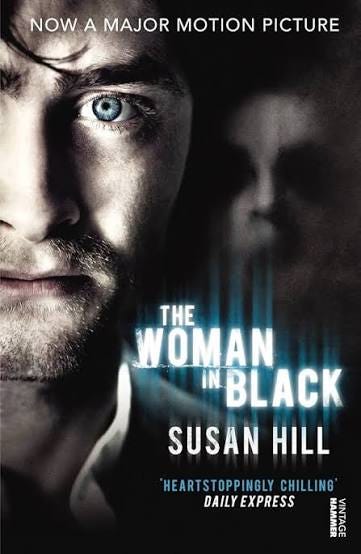
Jane Goldman correctly saw the problems with the earlier endings, so went for something with more power, more irony, rather than the book’s standard, or the tv movie’s less standard, but almost reverse “deus ex machina” ending.
I’ve managed to read two drafts of Goldman’s script for the film: a March, 9, 2010 version running 104 pages (with Joseph, in this draft only, re-named Edward), and a August 3, 2010 version running 100 pages. Apparently, there’s also a draft out there amongst collectors dated July, 21, 2009, but I haven’t read it.
A key change to the story by Jane Goldman is that Arthur’s wife, Stella, mother of their son, Joseph, had died giving birth to him. This is true in both drafts of the script that I’ve read. So, at the end, in both drafts of Goldman’s scripts Arthur and Joseph die, but join wife and mother Stella in the Afterlife as a result. The script version (identical in both drafts) has Arthur seeing the Woman in Black, and (presumably), realizing she will never stop pursuing them, chooses to prevent it by killing himself and Arthur. He stands on the tracks, holding his son, and lets them be taken by the hurtling locomotive. It’s dramatically pragmatic, coldly logical, but morally objectionable, and so, unacceptable.
So, “they” (presumably director Watkins, the producers, and possibly Susan Hill) “adjusted” it by having the Woman in Black merely “compel” Joseph to step down onto the train tracks unseen by his father, the Nanny, or the Porter. When Arthur does see it, he attempts rescue by jumping down to get him, but, then, as he sweeps him into his arms, the train rushing at them, both of them seem to be hit. And the Nanny, witnessing it, slams her eyes shut. The Porter steps forward looking down. And the film shows us Arthur holding Joseph at the side of the tracks. We think Arthur managed to save them both in the last possible second. However, Arthur looks up at the platform and it’s empty--the Nanny and the Porter gone. And then Joseph says, “Who’s that lady?” Arthur (and we, too) at first think he sees the Woman in Black, but Arthur turns to face her, and we see that it’s Joseph’s mother, Stella, standing on the tracks, a foggy brightness behind her. And we realize Arthur and Joseph have passed. So, smiling in the realization, Arthur carries Joseph toward her, and, together, as a family now, they head into the light, and, so, eternity.
The details Goldman added in her script that they removed for the film were:
--First, after Arthur and Joseph are heading into the Afterlife, Arthur beckons the watching children whom the Woman in Black had collected, denying them Heaven, and he gathers them to him, freeing them from her clutches. So, he gives them the Afterlife they deserve;
--And then, turning back to look at the one who caused it all, the Woman in Black, with the most forgivingly charitable gesture anyone after such events could ever offer, he bids she join them in Heaven, putting an end to her evil at last. But she refuses, choosing, instead, eternity and her liminal existence forever haunting Eel Marsh House.
So, in the released film, as the script for it had told it, Arthur does not choose to kill himself and his son in order to deny Joseph to the Woman in Black. Rather, he tries to save Joseph, but, in the attempt, they both die. Arthur’s honor is preserved. And, just as in the script, the family is finally together in the Afterlife, Joseph having met his mother at last.
For me, at least, dramatically it’s no contest: the (possibly) Hill and Goldman, and (certainly) Watkins ending in the released film is the best of the five. Still, it’s true, the excised details of Arthur’s saving of the children, and his gesture of forgiveness, offering the Woman in Black the chance to join them, were both, narratively laudable, if klunky, details that would have, nonetheless, added greater depth.
Although I have seen the recent stageplay based on the novel…
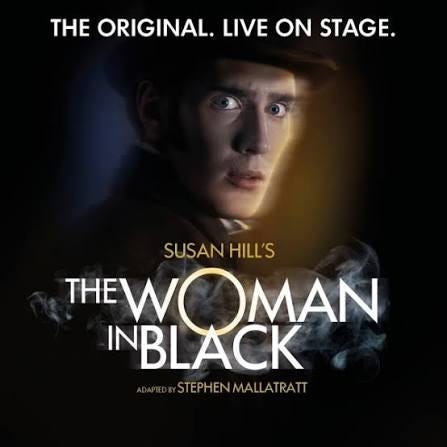
Because you can’t just go out and see it, I will forego a discussion of its ending.
Jane Goldman’s and James Watkins’ film of Susan Hill’s novel, however, was sufficiently successful to spawn a sequel:
Despite this certainly logical cash grab, perhaps “Hollywood” logic has been defeated at last.
Don’t count on it. #
Please Re-stack if you found this article of interest.